• HOME
  • NEWS
  • EXPLORE
    • CAREER
      • Companies
      • Jobs
    • EVENTS
    • iGEM
      • News
      • Team
    • PHOTOS
    • VIDEO
    • WIKI
  • BLOG
  • COMMUNITY
    • FACEBOOK
    • INSTAGRAM
    • TWITTER
Sunday, August 16, 2026
BIOENGINEER.ORG
No Result
View All Result
  • Login
  • HOME
  • NEWS
  • EXPLORE
    • CAREER
      • Companies
      • Jobs
        • Lecturer
        • PhD Studentship
        • Postdoc
        • Research Assistant
    • EVENTS
    • iGEM
      • News
      • Team
    • PHOTOS
    • VIDEO
    • WIKI
  • BLOG
  • COMMUNITY
    • FACEBOOK
    • INSTAGRAM
    • TWITTER
  • HOME
  • NEWS
  • EXPLORE
    • CAREER
      • Companies
      • Jobs
        • Lecturer
        • PhD Studentship
        • Postdoc
        • Research Assistant
    • EVENTS
    • iGEM
      • News
      • Team
    • PHOTOS
    • VIDEO
    • WIKI
  • BLOG
  • COMMUNITY
    • FACEBOOK
    • INSTAGRAM
    • TWITTER
No Result
View All Result
Bioengineer.org
No Result
View All Result
Home NEWS Science News Health

University of Illinois to lead two of seven new national artificial intelligence institutes

Bioengineer by Bioengineer
August 26, 2020
in Health
Reading Time: 3 mins read
0
IMAGE
Share on FacebookShare on TwitterShare on LinkedinShare on RedditShare on Telegram

NSF- and USDA-NIFA-funded institutes will each receive about $2 millionM over 5 years
IMAGE

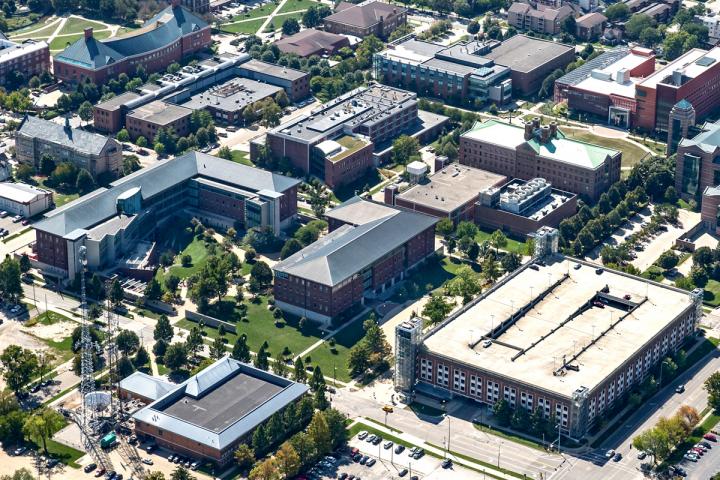
Credit: Photo courtesy University of Illinois Board of Trustees

CHAMPAIGN, Ill. — The National Science Foundation and the U.S. Department of Agriculture’s National Institute of Food and Agriculture are announcing an investment of more than $140 million to establish seven artificial intelligence institutes in the U.S. Two of the seven will be led by teams at the University of Illinois, Urbana-Champaign. They will support the work of researchers at the U. of I. and their partners at other academic and research institutions. Each of the new institutes will receive about $20 million over five years.

The USDA-NIFA will fund the AI Institute for Future Agricultural Resilience, Management and Sustainability at the U. of I. Illinois computer science professor Vikram Adve will lead the AIFARMS Institute.

The NSF will fund the AI Institute for Molecular Discovery, Synthetic Strategy and Manufacturing, also known as the Molecule Maker Lab Institute. Huimin Zhao/, a U. of I. professor of chemical and biomolecular engineering and of chemistry, will lead this institute.

AIFARMS will advance AI research in computer vision, machine learning, soft-object manipulation and intuitive human-robot interaction to solve major agricultural challenges, the NSF reports. Such challenges include sustainable intensification with limited labor, efficiency and welfare in animal agriculture, the environmental resilience of crops and the preservation of soil health. The institute will feature “a novel autonomous farm of the future, new education and outreach pathways for diversifying the workforce in agriculture and technology, and a global clearinghouse to foster collaboration in AI-driven agricultural research,” Adve said.

The Molecule Maker Lab Institute will focus on the development of new AI-enabled tools to accelerate automated chemical synthesis “to advance the discovery and manufacture of novel materials and bioactive compounds,” the NSF reports. The institute also will train a new generation of scientists with combined expertise in AI, chemistry and bioengineering. The goal of the institute is to establish “an open ecosystem of disruptive thinking, education and community engagement powered by state-of-the-art molecular design, synthesis and spectroscopic characterization technologies – all interfaced with AI and a modern cyberinfrastructure,” Zhao said.

“The National Science Foundation and USDA-NIFA recognize the breadth and depth of Illinois expertise in artificial intelligence, agricultural systems and molecular innovation,” U. of I. Chancellor Robert Jones said. “It is no surprise to me that two of seven new national AI institutes will be led by our campus. I look forward to seeing the results of these new investments in improving agricultural outcomes and innovations in basic and applied research.”

Adve is a co-director of the U. of I. Center for Digital Agriculture with crop sciences bioinformatics professor Matthew Hudson. AIFARMS will be under the CDA umbrella. Zhao and Hudson are affiliates of the Carl R. Woese Institute for Genomic Biology, where Zhao leads the Biosystems Design theme. The Molecule Maker Lab Institute will be associated with two campus institutes: IGB and the Beckman Institute for Advanced Science and Technology.

###

Editor’s notes:

To reach Vikram Adve, email [email protected].

To reach Huimin Zhao, email [email protected].

Media Contact
Diana Yates
[email protected]

Original Source

https://news.illinois.edu/view/6367/1159979456

Tags: Agricultural Production/EconomicsBiochemistryBiotechnologyChemistry/Physics/Materials SciencesComputer ScienceFertilizers/Pest ManagementGrants/FundingMaterialsPharmaceutical ScienceTechnology/Engineering/Computer Science
Share12Tweet8Share2ShareShareShare2

Related Posts

PARP1 Drives Neuropathic Pain Through GPX4-Dependent Ferroptosis in Injured Mice’s Sensory Neurons

August 15, 2026

Genome-wide skin pQTL map reveals genetic regulators and mechanisms underlying skin disorders

August 15, 2026

Levistilide A Drives Ferroptosis via RNF40-HSP90α Axis, Suppressing Colorectal Cancer Lung Metastasis

August 15, 2026

Sintilimab, IBI305, and Chemotherapy Show Promise in First-Line Advanced Gastric and GEJ Adenocarcinoma

August 15, 2026
Please login to join discussion

POPULAR NEWS

  • KAIST develops semiconductor neuron that harnesses noise to selectively process signals

    29 shares
    Share 12 Tweet 7
  • Imagining natural and extra robotic thumbs together strengthens kinesthetic sensorimotor networks

    29 shares
    Share 12 Tweet 7
  • PARP1 Drives Neuropathic Pain Through GPX4-Dependent Ferroptosis in Injured Mice’s Sensory Neurons

    29 shares
    Share 12 Tweet 7
  • Strubbelig–NHL3 Receptor Complex Helps Arabidopsis Respond to Cellulose Deficiency

    29 shares
    Share 12 Tweet 7

About

We bring you the latest biotechnology news from best research centers and universities around the world. Check our website.

Follow us

Recent News

KAIST develops semiconductor neuron that harnesses noise to selectively process signals

Imagining natural and extra robotic thumbs together strengthens kinesthetic sensorimotor networks

PARP1 Drives Neuropathic Pain Through GPX4-Dependent Ferroptosis in Injured Mice’s Sensory Neurons

Subscribe to Blog via Email

Success! An email was just sent to confirm your subscription. Please find the email now and click 'Confirm' to start subscribing.

Join 85 other subscribers
  • Contact Us

Bioengineer.org © Copyright 2023 All Rights Reserved.

Welcome Back!

Login to your account below

Forgotten Password?

Retrieve your password

Please enter your username or email address to reset your password.

Log In
No Result
View All Result
  • Homepages
    • Home Page 1
    • Home Page 2
  • News
  • National
  • Business
  • Health
  • Lifestyle
  • Science

Bioengineer.org © Copyright 2023 All Rights Reserved.