• HOME
  • NEWS
  • EXPLORE
    • CAREER
      • Companies
      • Jobs
    • EVENTS
    • iGEM
      • News
      • Team
    • PHOTOS
    • VIDEO
    • WIKI
  • BLOG
  • COMMUNITY
    • FACEBOOK
    • INSTAGRAM
    • TWITTER
Saturday, February 7, 2026
BIOENGINEER.ORG
No Result
View All Result
  • Login
  • HOME
  • NEWS
  • EXPLORE
    • CAREER
      • Companies
      • Jobs
        • Lecturer
        • PhD Studentship
        • Postdoc
        • Research Assistant
    • EVENTS
    • iGEM
      • News
      • Team
    • PHOTOS
    • VIDEO
    • WIKI
  • BLOG
  • COMMUNITY
    • FACEBOOK
    • INSTAGRAM
    • TWITTER
  • HOME
  • NEWS
  • EXPLORE
    • CAREER
      • Companies
      • Jobs
        • Lecturer
        • PhD Studentship
        • Postdoc
        • Research Assistant
    • EVENTS
    • iGEM
      • News
      • Team
    • PHOTOS
    • VIDEO
    • WIKI
  • BLOG
  • COMMUNITY
    • FACEBOOK
    • INSTAGRAM
    • TWITTER
No Result
View All Result
Bioengineer.org
No Result
View All Result
Home NEWS Science News Biology

Under the lens: Link between macular degeneration and retinitis pigmentosa

Bioengineer by Bioengineer
November 25, 2019
in Biology
Reading Time: 2 mins read
0
IMAGE
Share on FacebookShare on TwitterShare on LinkedinShare on RedditShare on Telegram

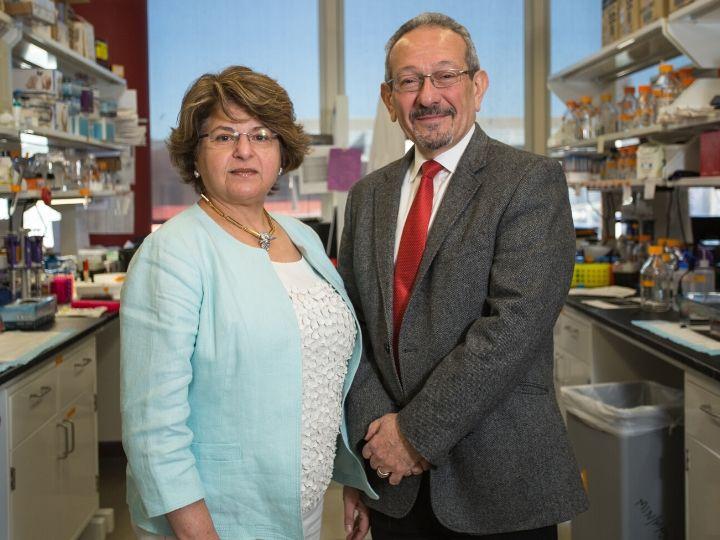
University of Houston research team examines eye disease with $2.5 million award
IMAGE

Credit: University of Houston


Four words you never want to hear from the eye doctor are retinitis pigmentosa and macular degeneration. Both are genetic disorders that can cause loss of vision and neither has a cure. A team of biomedical researchers at the University of Houston is now tackling both eye diseases by exploring a protein in the retina that links them: peripherin2 (prph2).

“Mutations in peripherin 2 are associated with a variety of retinal degenerative diseases, including retinitis pigmentosa, cone-rod dystrophy and multiple forms of macular dystrophy,” said Muna Naash, John S. Dunn Endowed Professor of biomedical engineering and principal investigator. “Peripherin2 mutations can also cause secondary defects in adjacent tissues including the retinal pigment epithelium and choroid, which hampers the development of therapeutics for these diseases.”

When healthy, prph2 is essential for the structure and function of the outer segments of the retinal photoreceptors. The two types of photoreceptors involved in sight are rods, which work at low levels of light, and cones, which are used to see color. Damaged rods cause retinitis pigmentosa; degeneration of cones causes macular degeneration.

“We are focused on advancing current knowledge on the role of peripherin2 in outer segment rim and disc formation, and in understanding the pathogenic mechanisms of associated diseases,” said Muayyad Al Ubaidi, professor of biomedical engineering and project partner. The work is funded by a $2.5 million grant from the National Eye Institute.

“Periphen2 is an incredibly exciting protein to study and understand because, depending on which part of the protein has a mutation, it can cause different phenotypes in each patient,” said Al-Ubaidi.

Prph2 does not always work alone. It has a partner, a photoreceptor-specific gene called ROM1 (rod outer segment membrane protein 1). The two proteins combine in different ratios, subsequently causing different diseases.

In prior research, Naash found that by changing the ratio of prph2 and ROM1 she could convert cases of the more dangerous macular degeneration to the less severe retinitis pigmentosa.

“We found we could convert the pattern dystrophy or macular degeneration phenotype to retinitis pigmentosa phenotype by modulating ROM1 level,” said Naash. This suggests that elimination of the mutant protein will be a pre-requisite for any curative therapeutic strategy.

Naash and Al-Ubaidi will examine how different mutations in prph2 lead to different disease phenotypes; what contributes to variability among patients carrying the same mutation; what role ROM1 plays in these events; and, how to shift prph2-associated severe phenotypes to milder ones.

###

Click here for more information on Naash and Al Ubaidi’s 44-year marriage in life and in the lab.

Media Contact
Laurie Fickman
[email protected]
713-743-8454

Original Source

https://uh.edu/news-events/stories/2019/november-2019/112519-naash-alubaidi-eye-disease-link-prph2.php

Tags: Biomedical/Environmental/Chemical EngineeringBiotechnologyCell BiologyGenesMedicine/HealthMicrobiologyMolecular BiologyOphthalmologyOptics
Share12Tweet8Share2ShareShareShare2

Related Posts

New Study Uncovers Mechanism Behind Burn Pit Particulate Matter–Induced Lung Inflammation

New Study Uncovers Mechanism Behind Burn Pit Particulate Matter–Induced Lung Inflammation

February 6, 2026

DeepBlastoid: Advancing Automated and Efficient Evaluation of Human Blastoids with Deep Learning

February 6, 2026

Navigating the Gut: The Role of Formic Acid in the Microbiome

February 6, 2026

AI-Enhanced Optical Coherence Photoacoustic Microscopy Revolutionizes 3D Cancer Model Imaging

February 6, 2026
Please login to join discussion

POPULAR NEWS

  • Robotic Ureteral Reconstruction: A Novel Approach

    Robotic Ureteral Reconstruction: A Novel Approach

    82 shares
    Share 33 Tweet 21
  • Digital Privacy: Health Data Control in Incarceration

    63 shares
    Share 25 Tweet 16
  • Study Reveals Lipid Accumulation in ME/CFS Cells

    57 shares
    Share 23 Tweet 14
  • Breakthrough in RNA Research Accelerates Medical Innovations Timeline

    53 shares
    Share 21 Tweet 13

About

We bring you the latest biotechnology news from best research centers and universities around the world. Check our website.

Follow us

Recent News

Oxygen-Enhanced Dual-Section Microneedle Patch Improves Drug Delivery and Boosts Photodynamic and Anti-Inflammatory Treatment for Psoriasis

Scientists Identify SARS-CoV-2 PLpro and RIPK1 Inhibitors Showing Potent Synergistic Antiviral Effects in Mouse COVID-19 Model

Neg-Entropy: The Key Therapeutic Target for Chronic Diseases

Subscribe to Blog via Email

Enter your email address to subscribe to this blog and receive notifications of new posts by email.

Join 73 other subscribers
  • Contact Us

Bioengineer.org © Copyright 2023 All Rights Reserved.

Welcome Back!

Login to your account below

Forgotten Password?

Retrieve your password

Please enter your username or email address to reset your password.

Log In
No Result
View All Result
  • Homepages
    • Home Page 1
    • Home Page 2
  • News
  • National
  • Business
  • Health
  • Lifestyle
  • Science

Bioengineer.org © Copyright 2023 All Rights Reserved.