For the first time in the University of North Carolina at Charlotte’s nearly 80-year history, a faculty member has won a NASA Exobiology grant. Assistant Professor of Bioinformatics and Genomics Richard Allen White III will use the ultra-competitive grant in his research on microbialites, a kind of “living rock” that could hold the key to how life formed on Earth.
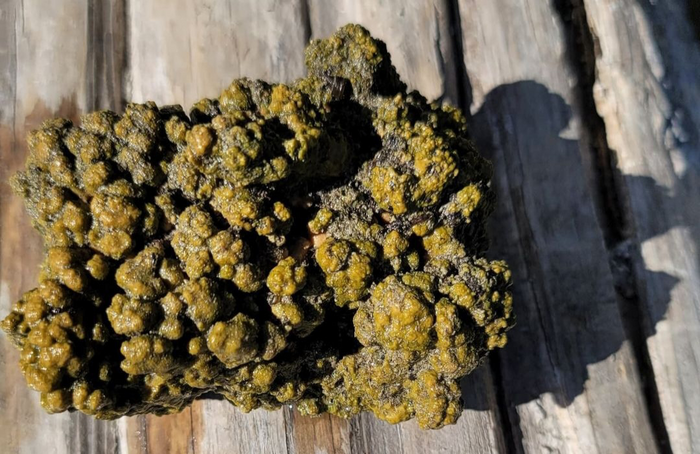
Credit: Richard Allen White III
For the first time in the University of North Carolina at Charlotte’s nearly 80-year history, a faculty member has won a NASA Exobiology grant. Assistant Professor of Bioinformatics and Genomics Richard Allen White III will use the ultra-competitive grant in his research on microbialites, a kind of “living rock” that could hold the key to how life formed on Earth.
Microbialites form when microbial mats, living colonies of mostly bacteria, transform into stronger hard structures. White explores how viruses may have helped to kickstart the transformation (i.e., lithification) of modern microbialites, which have ancient relatives that are billions of years old.
“NASA’s interest in microbialites is that they’re the ‘sign-posts’ for life on Earth,” said White, lead principal investigator, who shares the grant with Pieter Visscher at the University of Connecticut. “The thought is that if we eventually go to a place like Mars, Europa or Enceladus, if we found these structures, then we could say in high likelihood life had been there; if we found them active, we would say life was still going on.”
Highlighted as the cover story in the March 2021 issue of the prestigious journal Trends in Microbiology, White’s work on the impact of viruses on the lithification of microbialites, a specialized microbial mat that forms hard carbonate structures via cyanobacteria, formally known as blue green algae, is on the cutting edge of our understanding of how life evolved. For millions of years, “most of life” on Earth existed in microbial mats because “they provide an oasis in the desert,” White says, with a more stable environment than the hostile surroundings of primordial Earth.
White first worked on microbialites in Pavilion and Kelly Lake southeastern Canada, harboring clotted thrombolite microbialites, which was used as a Mars mission analog site. Since 2010, he has investigated modern microbialites and microbial mats in Shark Bay, Australia, and he joined the Australia Centre of Astrobiology in 2014. Shark Bay holds some of the oldest ancient stromatolites, a layered type of microbialite which can date from 3.7-3.4 billion years ago. He has plans to head to Mexico to further investigate the role of viruses in these living rock formations.
“Every biology textbook that you look at, the first page talks about the origin of life and you’ll see a picture of Shark Bay, Australia,” says White, who joined the faculty in 2020. “These structures have survived every major mass extinction, including the greatest mass extinction of all around 2.4 billion years ago (known as the Great Oxidation Event), when 99% percent of life on the planet ceased to exist.”
Along with receiving the grant from NASA’s Exobiology program, which researches the origin, evolution, distribution, and future of life in the universe, White has been appointed to the steering committee of NASA’s Network for Life Detection, a coalition of a few dozen research teams from across the country.
Ultimately, beyond increasing understanding of how life evolved, White believes studying microbialites will help continue life on earth. Trapping climate change gases—carbon dioxide, methane, and nitrous oxide—into a “bio-cement” could help “end a large carbon polluter in manufacturing,” White says. Such an invention would be in line with the National Biotechnology and Biomanufacturing Initiative, announced last year by President Biden to identify “priority R&D needs to translate bioscience and biotechnology discoveries” into practical solutions.
“Right now, we’re trying to understand how microbialites function, and trying to validate our hypotheses relating to them,” says White. “I’m hoping that eventually we move away from the environmental characterization in microbialites. Our goal is to apply their mechanisms to bank carbon on a global scale which is useful for humanity.”