• HOME
  • NEWS
  • EXPLORE
    • CAREER
      • Companies
      • Jobs
    • EVENTS
    • iGEM
      • News
      • Team
    • PHOTOS
    • VIDEO
    • WIKI
  • BLOG
  • COMMUNITY
    • FACEBOOK
    • INSTAGRAM
    • TWITTER
Saturday, September 26, 2026
BIOENGINEER.ORG
No Result
View All Result
  • Login
  • HOME
  • NEWS
  • EXPLORE
    • CAREER
      • Companies
      • Jobs
        • Lecturer
        • PhD Studentship
        • Postdoc
        • Research Assistant
    • EVENTS
    • iGEM
      • News
      • Team
    • PHOTOS
    • VIDEO
    • WIKI
  • BLOG
  • COMMUNITY
    • FACEBOOK
    • INSTAGRAM
    • TWITTER
  • HOME
  • NEWS
  • EXPLORE
    • CAREER
      • Companies
      • Jobs
        • Lecturer
        • PhD Studentship
        • Postdoc
        • Research Assistant
    • EVENTS
    • iGEM
      • News
      • Team
    • PHOTOS
    • VIDEO
    • WIKI
  • BLOG
  • COMMUNITY
    • FACEBOOK
    • INSTAGRAM
    • TWITTER
No Result
View All Result
Bioengineer.org
No Result
View All Result
Home NEWS Science News Health

Un-natural mRNAs modified with sulfur atoms boost efficient protein synthesis

Bioengineer by Bioengineer
July 16, 2020
in Health
Reading Time: 3 mins read
0
IMAGE
Share on FacebookShare on TwitterShare on LinkedinShare on RedditShare on Telegram

Towards the development of mRNA therapeutics and new methods of protein production
IMAGE

Credit: Nagoya University

Since mRNAs play a key role in protein synthesis in vivo, the use of mRNAs as medicines and for in vitro protein synthesis has been desired. In particular, mRNA therapeutics hold the potential for application to vaccine therapy(1) against coronaviruses and are being developed. However, the efficiency of protein production with mRNAs in the natural form is not sufficient enough for certain purposes, including application to mRNA therapeutics. Therefore, mRNA molecules allowing for efficient protein production have been required to be developed.

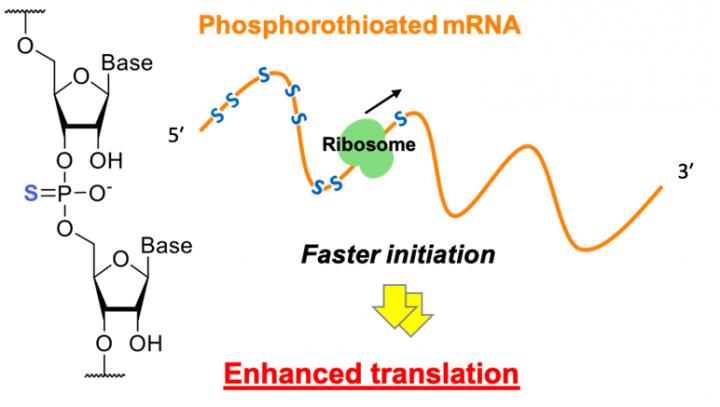
A ribosome(2) repeats the following three steps to synthesize a protein in vivo using an mRNA as a template (translation reaction): 1) Initiation step: A ribosome binds to an mRNA to form a translation initiation complex; 2) Elongation step: The ribosome moves on the mRNA and links amino acids to synthesize a protein; and 3) Termination step: The protein synthesis process concludes, and the ribosome is liberated. In the translation reaction cycle, the initiation step takes the longest time.

Collaborative research by a group of Nagoya University consisting of Professor Hiroshi Abe, Research Assistant Professor Naoko Abe, and graduate student Daisuke Kawaguchi with Yoshihiro Shimizu, a team leader at RIKEN, has succeeded in the development of modified messenger RNAs (mRNAs). The modified mRNA contains sulfur atoms in the place of oxygen atoms of phosphate moieties of natural mRNAs. It is capable of supporting protein synthesis at increased efficiency. They discovered that modified mRNAs accelerated the initiation step of the translation reactions and improved efficiency of protein synthesis by at least 20 times compared with that using natural-form mRNAs.”

This method is expected to be used for large-scale synthesis of proteins as raw materials for the production of biomaterials. Moreover, the application of the results obtained in this study to eukaryotic translation systems enables the efficient production of mRNA therapeutics for protein replacement therapy(3) to contribute to medical treatments. Furthermore, there are virtually no previous reports on the molecular design of highly functional mRNAs; therefore, the successful design achieved in this study can guide a future direction of the molecular design of modified mRNAs.

###

This study was supported by the Strategic Basic Research Program CREST of the Japan Science and Technology Agency (JST).

(1) Vaccine therapy

A method of administering a protein antigen to individuals to elicit antibodies that can reduce the susceptibility to infectious diseases. In the case of an mRNA vaccine, an mRNA for in vivo expression of an antigen protein is administered, and then antibodies are produced against the expressed antigen protein.

(2) Ribosome

Multicomponent machinery providing a place where sequence information of an mRNA is read, and a protein is synthesized based on the sequence information while migrating on the mRNA. A ribosome is composed of ribosomal proteins and ribosomal RNAs.

(3) Protein replacement therapy

A treatment method that aims at improvement by supplementing protein from the outside when the deficiency of proteins (enzymes, etc.) is a cause of an illness.

Media Contact
Hiroshi Abe
[email protected]

Original Source

hhttps://www.jst.go.jp/pr/announce/20200707/index_e.html

Related Journal Article

http://dx.doi.org/10.1002/anie.202007111

Tags: BiotechnologyGene TherapyMedicine/HealthPharmaceutical ChemistryPharmaceutical SciencePharmaceutical/Combinatorial ChemistryVaccines
Share12Tweet8Share2ShareShareShare2

Related Posts

Tiny Blood RNAs Emerge as Early Warning Signals of Sepsis in Newborns

September 26, 2026

Nanoparticle-Wrapped Herbal Compound Shields Rat Livers From Arsenic Damage

September 26, 2026

Tap Water Fluoride Study Links Plasma Levels to Blood Pressure, Testosterone and Sodium in U.S. Children

September 26, 2026

Emergency Abdominal Surgery Proves Feasible for Patients Over 85, Japanese Study Finds

September 26, 2026
Please login to join discussion

POPULAR NEWS

  • New Protocol Reveals Millions of Microplastic Clues Hidden in Greenhouse Soils

    29 shares
    Share 12 Tweet 7
  • Lanthanum Nanorods Deliver New Drug Candidate That Kills Parasitic Worms

    29 shares
    Share 12 Tweet 7
  • Tiny Blood RNAs Emerge as Early Warning Signals of Sepsis in Newborns

    29 shares
    Share 12 Tweet 7
  • Bumblebees and Flies Keep Pollination Networks Alive by Switching Teams All Season

    29 shares
    Share 12 Tweet 7

About

We bring you the latest biotechnology news from best research centers and universities around the world. Check our website.

Follow us

Recent News

New Protocol Reveals Millions of Microplastic Clues Hidden in Greenhouse Soils

Lanthanum Nanorods Deliver New Drug Candidate That Kills Parasitic Worms

Tiny Blood RNAs Emerge as Early Warning Signals of Sepsis in Newborns

Subscribe to Blog via Email

Enter your email address to subscribe to this blog and receive notifications of new posts by email.

Join 85 other subscribers
  • Contact Us

Bioengineer.org © Copyright 2023 All Rights Reserved.

Welcome Back!

Login to your account below

Forgotten Password?

Retrieve your password

Please enter your username or email address to reset your password.

Log In
No Result
View All Result
  • Homepages
    • Home Page 1
    • Home Page 2
  • News
  • National
  • Business
  • Health
  • Lifestyle
  • Science

Bioengineer.org © Copyright 2023 All Rights Reserved.