• HOME
  • NEWS
  • EXPLORE
    • CAREER
      • Companies
      • Jobs
    • EVENTS
    • iGEM
      • News
      • Team
    • PHOTOS
    • VIDEO
    • WIKI
  • BLOG
  • COMMUNITY
    • FACEBOOK
    • INSTAGRAM
    • TWITTER
Sunday, May 10, 2026
BIOENGINEER.ORG
No Result
View All Result
  • Login
  • HOME
  • NEWS
  • EXPLORE
    • CAREER
      • Companies
      • Jobs
        • Lecturer
        • PhD Studentship
        • Postdoc
        • Research Assistant
    • EVENTS
    • iGEM
      • News
      • Team
    • PHOTOS
    • VIDEO
    • WIKI
  • BLOG
  • COMMUNITY
    • FACEBOOK
    • INSTAGRAM
    • TWITTER
  • HOME
  • NEWS
  • EXPLORE
    • CAREER
      • Companies
      • Jobs
        • Lecturer
        • PhD Studentship
        • Postdoc
        • Research Assistant
    • EVENTS
    • iGEM
      • News
      • Team
    • PHOTOS
    • VIDEO
    • WIKI
  • BLOG
  • COMMUNITY
    • FACEBOOK
    • INSTAGRAM
    • TWITTER
No Result
View All Result
Bioengineer.org
No Result
View All Result
Home NEWS Science News Chemistry

UMass Amherst team discovers use of elasticity to position microplates on curved 2D fluids

Bioengineer by Bioengineer
April 5, 2021
in Chemistry
Reading Time: 3 mins read
0
IMAGE
Share on FacebookShare on TwitterShare on LinkedinShare on RedditShare on Telegram

Research is a leap forward in the quest for flexible ultrathin materials
IMAGE

Credit: Weiyue Xin of Santore lab.

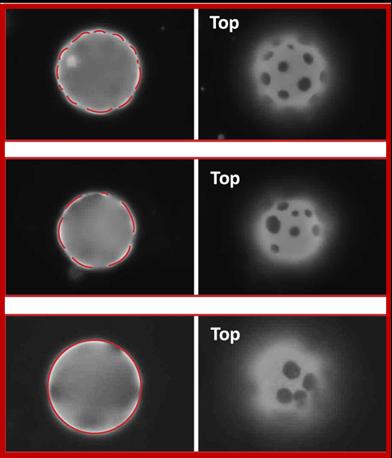
AMHERST, Mass. – A team of polymer science and engineering researchers at the University of Massachusetts Amherst has demonstrated for the first time that the positions of tiny, flat, solid objects integrated in nanometrically thin membranes – resembling those of biological cells – can be controlled by mechanically varying the elastic forces in the membrane itself. This research milestone is a significant step toward the goal of creating ultrathin flexible materials that self-organize and respond immediately to mechanical force.

The team has discovered that rigid solid plates in biomimetic fluid membranes experience interactions that are qualitatively different from those of biological components in cell membranes. In cell membranes, fluid domains or adherent viruses experience either attractions or repulsions, but not both, says Weiyue Xin, lead author of the paper detailing the research, which recently appeared in Science Advances. But in order to precisely position solid objects in a membrane, both attractive and repulsive forces must be available, adds Maria Santore, a professor of polymer science and engineering at UMass. In the Santore Lab at UMass, Xin used giant unilamellar vesicles, or GUVs, which are cell-like membrane sacks, to probe the interactions between solid objects in a thin, sheet-like material. Like biological cells, GUVs have fluid membranes and form a nearly spherical shape. Xin modified the GUVs so that the membranes included tiny, solid, stiff plate-like masses. The team, a collaboration between the Santore lab and the Grason theory group in UMass’s polymer science and engineering department, is the first to show that by modifying the curvature and tension of the membrane, the plate-like masses could be made to attract and repel each other. This allowed the researchers to control the plates’ positions within the membrane.

The membrane tension can be adjusted mechanically, using a micropipette to inflate or deflate the GUV, or physically, by osmosis. In either case when the membrane is tensed, the flat plates attract each other progressively, forming predictable, repeatable arrangements. By contrast, decreasing the tension causes the plates to migrate apart. In both cases the movement and positioning of the plates is predictable and controllable.

This ability to direct the positioning of the plates in a membrane is a giant step toward engineering a material that is responsive to stimuli and can self-organize in controllable and reconfigurable ways. “Our research has applications in nanotechnology and other spheres where it’s desirable to have sophisticated, flexible devices that can respond to their environment,” says Xin. One real-world application of the team’s research includes flexible, ultrathin, and reconfigurable, wearable electronics.

###

This research was supported by a grant from the U.S. Department of Energy. Additionally, Xin received partial support from a National Institutes of Health Trainee Fellowship.

Contacts:

Maria Santore,
[email protected]

Daegan Miller,
[email protected]

Media Contact
Daegan Miller
[email protected]

Original Source

https://www.umass.edu/newsoffice/article/umass-amherst-team-discovers-how-use

Related Journal Article

http://dx.doi.org/10.1126/sciadv.abf1943

Tags: BiotechnologyCell BiologyChemistry/Physics/Materials SciencesMaterialsMolecular PhysicsNanotechnology/MicromachinesPolymer Chemistry
Share13Tweet8Share2ShareShareShare2

Related Posts

Miniature Sensor Uses Light to Detect Touch — Chemistry

Miniature Sensor Uses Light to Detect Touch

May 8, 2026
Iron Minerals Determine Whether Dissolved Organic Matter Fuels Microbes or Becomes Long-Term Carbon Storage — Chemistry

Iron Minerals Determine Whether Dissolved Organic Matter Fuels Microbes or Becomes Long-Term Carbon Storage

May 8, 2026

Kate Evans Appointed Associate Lab Director for Biological and Environmental Systems Science at ORNL

May 8, 2026

Advancing Multiscale Modeling and Overcoming Operational Challenges in Autothermal COâ‚‚-to-Methanol Reactors

May 8, 2026
Please login to join discussion

POPULAR NEWS

  • Research Indicates Potential Connection Between Prenatal Medication Exposure and Elevated Autism Risk

    840 shares
    Share 336 Tweet 210
  • New Study Reveals Plants Can Detect the Sound of Rain

    727 shares
    Share 290 Tweet 181
  • Scientists Investigate Possible Connection Between COVID-19 and Increased Lung Cancer Risk

    68 shares
    Share 27 Tweet 17
  • Salmonella Haem Blocks Macrophages, Boosts Infection

    61 shares
    Share 24 Tweet 15

About

We bring you the latest biotechnology news from best research centers and universities around the world. Check our website.

Follow us

Recent News

Evaluating Digoxin Use in Patients with Symptomatic Rheumatic Heart Disease

Evaluating the Effectiveness and Safety of Digitalis Glycosides in Treating Heart Failure

Urdu Fall Risk Questionnaire Adapted for Elderly

Subscribe to Blog via Email

Enter your email address to subscribe to this blog and receive notifications of new posts by email.

Join 82 other subscribers
  • Contact Us

Bioengineer.org © Copyright 2023 All Rights Reserved.

Welcome Back!

Login to your account below

Forgotten Password?

Retrieve your password

Please enter your username or email address to reset your password.

Log In
No Result
View All Result
  • Homepages
    • Home Page 1
    • Home Page 2
  • News
  • National
  • Business
  • Health
  • Lifestyle
  • Science

Bioengineer.org © Copyright 2023 All Rights Reserved.