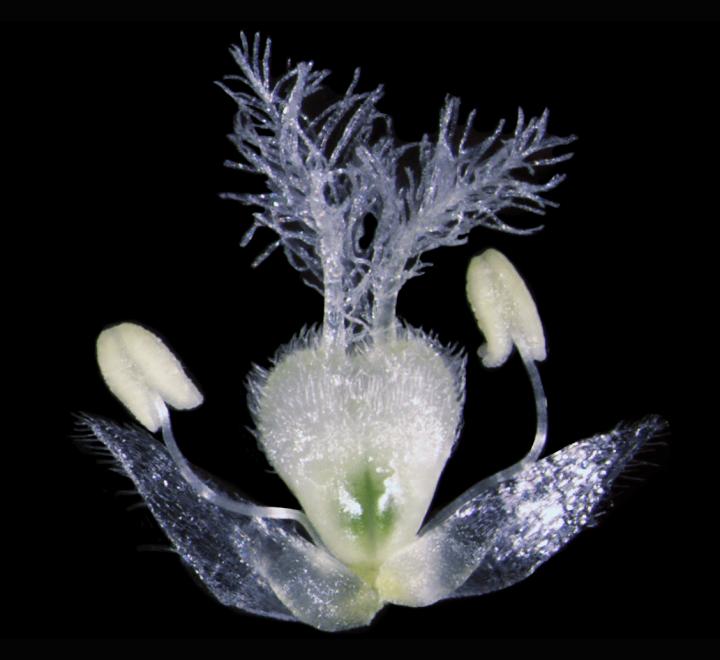
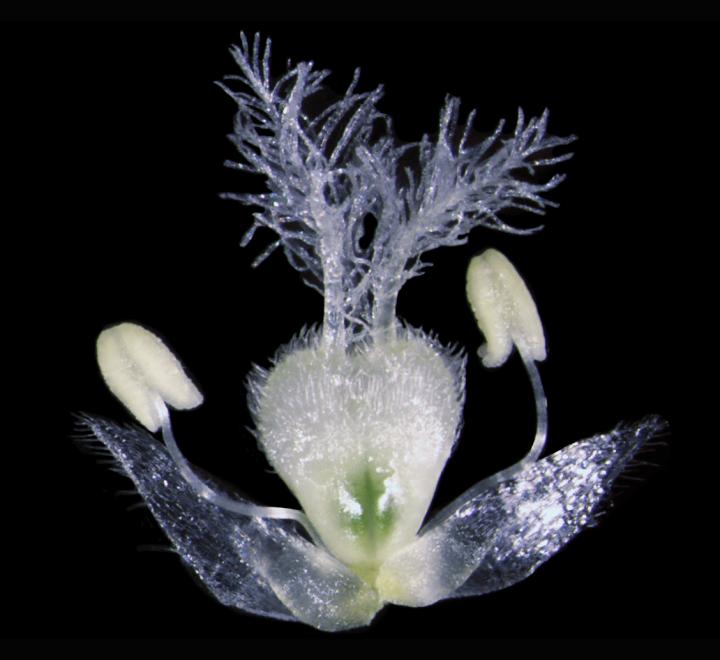
Credit: UMass Amherst
AMHERST, Mass. – There are at least 250,000 species of flowering plants on earth and though their flowers can look radically different, the same core set of genes generates all this diversity through developmental processes that are not fully understood, says biologist Madelaine Bartlett at the University of Massachusetts Amherst.
To investigate how this developmental control works at the gene transcriptional level, and how it has changed over the course of evolution, she has received a five-year, $837,000 National Science Foundation (NSF) Faculty Early Career Development (CAREER) grant. The CAREER grant is NSF's highest award in support of junior faculty who exemplify the role of teacher-scholars through outstanding research, excellent education and the integration of both.
Her project will uncover the molecular underpinnings of floral diversification and provide key insight into the molecular biology of floral development in the economically important grass family, which includes corn and wheat. Bartlett explains, "The big picture will be to understand how grass flowers develop. Without grass flowers we wouldn't have any grass crops to eat – crops such as rice, corn, wheat, barley and oats. Understanding this one process can help us understand how the evolution of development works, and how we might be able to breed better grass crops."
She explains that many aspects of flower development, including whether a floral organ will develop as a petal or as a stamen, are controlled by transcription factors known as MADS-box genes. This is true even when the flowers look really different.
"You might think of it like primary colors," she adds. "There are only three but you can mix them in an almost infinite number of combinations to get new colors. In a similar way, these MADS-box genes are always there and as they mix and match, that is, turn on and off during development, you get very different outcomes and patterns."
A long-standing hypothesis but one that was not testable until now, the biologist notes, is that evolutionary change in flower form may be driven by shifting interactions between floral MADS-box transcription factors. Altered interactions between MADS-box proteins may, in turn, affect downstream gene regulation, turning on gene A, for example, while turning off gene B.
Using an experimental system she developed in grasses, Bartlett will test this idea in a series of experiments using genomics, proteomics and CRISPR/Cas9 genome-editing, in collaboration with her UMass Amherst biology colleague Courtney Babbitt. They will precisely manipulate interactions between MADS-box transcription factors in planta to study how these affect downstream gene expression and floral development.
Bartlett notes, "This idea has been around for a while, but there has been no system to test it. Now we have a system in the grasses which we can use to do the tests."
As part of the research program, she also plans to teach high school students, especially women, basic molecular biology in her lab in summer sessions. Bartlett will also train undergraduates in the theory and techniques of molecular biology and molecular evolution in a lab-based class and independent research. Graduate students will be involved in all aspects of the research and outreach.
###
Media Contact
Janet Lathrop
[email protected]
413-545-0444
@umassscience
http://www.umass.edu
Original Source
http://www.umass.edu/newsoffice/article/umass-amherst-biologist-hopes-unlock