• HOME
  • NEWS
  • EXPLORE
    • CAREER
      • Companies
      • Jobs
    • EVENTS
    • iGEM
      • News
      • Team
    • PHOTOS
    • VIDEO
    • WIKI
  • BLOG
  • COMMUNITY
    • FACEBOOK
    • INSTAGRAM
    • TWITTER
Sunday, May 10, 2026
BIOENGINEER.ORG
No Result
View All Result
  • Login
  • HOME
  • NEWS
  • EXPLORE
    • CAREER
      • Companies
      • Jobs
        • Lecturer
        • PhD Studentship
        • Postdoc
        • Research Assistant
    • EVENTS
    • iGEM
      • News
      • Team
    • PHOTOS
    • VIDEO
    • WIKI
  • BLOG
  • COMMUNITY
    • FACEBOOK
    • INSTAGRAM
    • TWITTER
  • HOME
  • NEWS
  • EXPLORE
    • CAREER
      • Companies
      • Jobs
        • Lecturer
        • PhD Studentship
        • Postdoc
        • Research Assistant
    • EVENTS
    • iGEM
      • News
      • Team
    • PHOTOS
    • VIDEO
    • WIKI
  • BLOG
  • COMMUNITY
    • FACEBOOK
    • INSTAGRAM
    • TWITTER
No Result
View All Result
Bioengineer.org
No Result
View All Result
Home NEWS Science News Chemistry

UMass Amherst astronomer reveals never-before-seen detail of the center of our galaxy

Bioengineer by Bioengineer
May 27, 2021
in Chemistry
Reading Time: 3 mins read
0
IMAGE
Share on FacebookShare on TwitterShare on LinkedinShare on RedditShare on Telegram

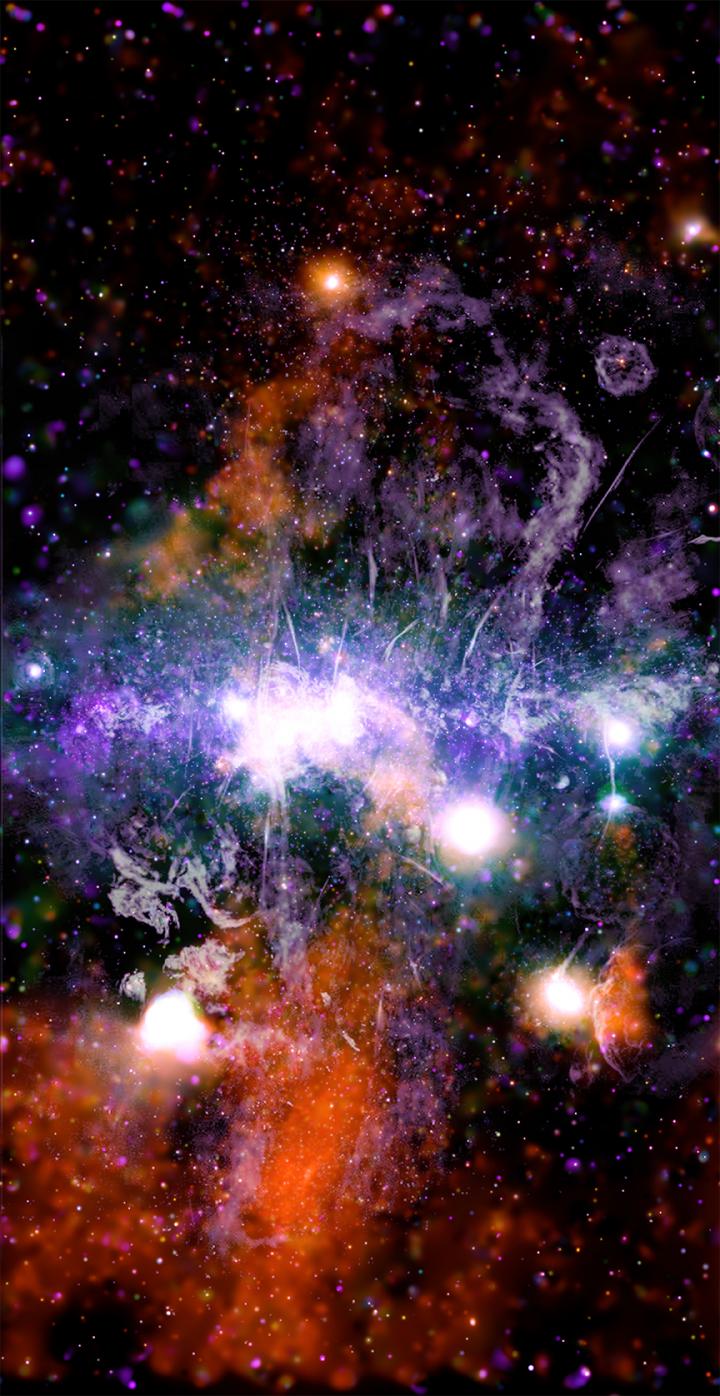
New image made using NASA’s Chandra X-Ray Observatory hints at previously unknown interstellar energy source at the Milky Way center
IMAGE

Credit: X-ray: NASA/CXC/UMass/Q.D. Wang; Radio: NRF/SARAO/MeerKAT

AMHERST, Mass. – New research by University of Massachusetts Amherst astronomer Daniel Wang reveals, with unprecedented clarity, details of violent phenomena in the center of our galaxy. The images, published recently in Monthly Notices of the Royal Astronomical Society, document an X-ray thread, G0.17-0.41, which hints at a previously unknown interstellar mechanism that may govern the energy flow and potentially the evolution of the Milky Way.

“The galaxy is like an ecosystem,” says Wang, a professor in UMass Amherst’s astronomy department, whose findings are a result of more than two decades of research. “We know the centers of galaxies are where the action is and play an enormous role in their evolution.” And yet, whatever has happened in the center of our own galaxy is hard to study, despite its relative proximity to Earth, because, as Wang explains, it is obscured by a dense fog of gas and dust. Researchers simply can’t see the center, even with an instrument as powerful as the famous Hubble Space Telescope. Wang, however, has used a different telescope, NASA’s Chandra X-Ray Observatory, which “sees” X-rays, rather than the rays of visible light that we perceive with our own eyes. These X-rays are capable of penetrating the obscuring fog–and the results are stunning.

Wang’s findings, which were supported by NASA, give the clearest picture yet of a pair of X-ray-emitting plumes that are emerging from the region near the massive black hole lying at the center of our galaxy. Even more intriguing is the discovery of an X-ray thread called G0.17-0.41, located near the southern plume. “This thread reveals a new phenomenon,” says Wang. “This is evidence of an ongoing magnetic field reconnection event.” The thread, writes Wang, probably represents “only the tip of the reconnection iceberg.”

A magnetic field reconnection event is what happens when two opposing magnetic fields are forced together and combine with one another, releasing an enormous amount of energy. “It’s a violent process,” says Wang, and is known to be responsible for such well-known phenomena as solar flares, which produce space weather powerful enough to disrupt power grids and communications systems here on Earth. They also produce the spectacular Northern Lights. Scientists now think that magnetic reconnection also occurs in interstellar space and tends to take place at the outer boundaries of the expanding plumes driven out of our galaxy’s center.

“What is the total amount of energy outflow at the center of the galaxy? How is it produced and transported? And how does it regulate the galactic ecosystem?” These, says Wang, are the fundamental questions whose answers will help to unlock the history of our galaxy. Though much work remains to be done, Wang’s new map points the way. For more information, including additional images and video, visit the Chandra X-Ray Observatory’s Galactic Center website.

###

Contact: Daniel Wang, [email protected]
Daegan Miller, [email protected]

Media Contact
Daegan Miller
[email protected]

Related Journal Article

http://dx.doi.org/10.1093/mnras/stab801

Tags: AstronomyAstrophysicsSpace/Planetary Science
Share12Tweet8Share2ShareShareShare2

Related Posts

Miniature Sensor Uses Light to Detect Touch — Chemistry

Miniature Sensor Uses Light to Detect Touch

May 8, 2026
Iron Minerals Determine Whether Dissolved Organic Matter Fuels Microbes or Becomes Long-Term Carbon Storage — Chemistry

Iron Minerals Determine Whether Dissolved Organic Matter Fuels Microbes or Becomes Long-Term Carbon Storage

May 8, 2026

Kate Evans Appointed Associate Lab Director for Biological and Environmental Systems Science at ORNL

May 8, 2026

Advancing Multiscale Modeling and Overcoming Operational Challenges in Autothermal COâ‚‚-to-Methanol Reactors

May 8, 2026
Please login to join discussion

POPULAR NEWS

  • Research Indicates Potential Connection Between Prenatal Medication Exposure and Elevated Autism Risk

    840 shares
    Share 336 Tweet 210
  • New Study Reveals Plants Can Detect the Sound of Rain

    727 shares
    Share 290 Tweet 181
  • Scientists Investigate Possible Connection Between COVID-19 and Increased Lung Cancer Risk

    68 shares
    Share 27 Tweet 17
  • Salmonella Haem Blocks Macrophages, Boosts Infection

    61 shares
    Share 24 Tweet 15

About

We bring you the latest biotechnology news from best research centers and universities around the world. Check our website.

Follow us

Recent News

Evaluating Digoxin Use in Patients with Symptomatic Rheumatic Heart Disease

Evaluating the Effectiveness and Safety of Digitalis Glycosides in Treating Heart Failure

Urdu Fall Risk Questionnaire Adapted for Elderly

Subscribe to Blog via Email

Enter your email address to subscribe to this blog and receive notifications of new posts by email.

Join 82 other subscribers
  • Contact Us

Bioengineer.org © Copyright 2023 All Rights Reserved.

Welcome Back!

Login to your account below

Forgotten Password?

Retrieve your password

Please enter your username or email address to reset your password.

Log In
No Result
View All Result
  • Homepages
    • Home Page 1
    • Home Page 2
  • News
  • National
  • Business
  • Health
  • Lifestyle
  • Science

Bioengineer.org © Copyright 2023 All Rights Reserved.