• HOME
  • NEWS
  • EXPLORE
    • CAREER
      • Companies
      • Jobs
    • EVENTS
    • iGEM
      • News
      • Team
    • PHOTOS
    • VIDEO
    • WIKI
  • BLOG
  • COMMUNITY
    • FACEBOOK
    • INSTAGRAM
    • TWITTER
Saturday, May 16, 2026
BIOENGINEER.ORG
No Result
View All Result
  • Login
  • HOME
  • NEWS
  • EXPLORE
    • CAREER
      • Companies
      • Jobs
        • Lecturer
        • PhD Studentship
        • Postdoc
        • Research Assistant
    • EVENTS
    • iGEM
      • News
      • Team
    • PHOTOS
    • VIDEO
    • WIKI
  • BLOG
  • COMMUNITY
    • FACEBOOK
    • INSTAGRAM
    • TWITTER
  • HOME
  • NEWS
  • EXPLORE
    • CAREER
      • Companies
      • Jobs
        • Lecturer
        • PhD Studentship
        • Postdoc
        • Research Assistant
    • EVENTS
    • iGEM
      • News
      • Team
    • PHOTOS
    • VIDEO
    • WIKI
  • BLOG
  • COMMUNITY
    • FACEBOOK
    • INSTAGRAM
    • TWITTER
No Result
View All Result
Bioengineer.org
No Result
View All Result
Home NEWS Science News Chemistry

Ultrastable, selective catalyst for propane dehydrogenation developed

Bioengineer by Bioengineer
June 5, 2020
in Chemistry
Reading Time: 2 mins read
0
IMAGE
Share on FacebookShare on TwitterShare on LinkedinShare on RedditShare on Telegram

IMAGE

Credit: Yuki Nakaya, et al., Nature Communications, June 5, 2020

A group of Japanese scientists has developed an ultrastable, selective catalyst to dehydrogenate propane – an essential process to produce the key petrochemical substance of propylene – without deactivation, even at temperatures of more than 600°C.

Propylene is an important raw material for plastics, synthetic rubber, surfactants, dyes and pharmaceuticals. In recent years, there has been an increased demand for propylene produced from cheaper, shale-originated propane. Reaction temperatures of more than 600°C are necessary to obtain sufficient propylene yields, but under these harsh conditions, severe catalyst deactivation is inevitable due to carbon deposition and/or sintering. Catalysts in practical use, therefore, must be regenerated either continuously or in short cycles, making the process inefficient and costly.

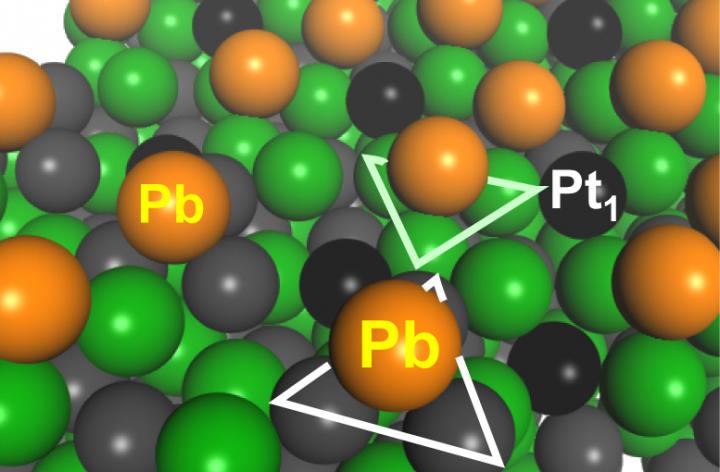
In the present study, the group, including a master’s student Yuki Nakaya and Associate Professor Shinya Furukawa at Hokkaido University’s Institute for Catalysis, focused on the intermetallics (PtGa) of platinum (Pt) and gallium (Ga), which have unique properties and structures. PtGa has a high thermal stability and its structure does not change even under high temperatures. It is also known to have two kinds of catalytic sites on its surface: a site with three Pt atoms (Pt3 site) and one with single-atom-like isolated Pt (Pt1 site).

The group hypothesized that if the Pt3 sites – which facilitates carbon deposition in addition to producing propylene – is disabled to allow only the Pt1 sites to function, the catalyst will be ultrastable and also able to prevent carbon deposition. The group tried various metals and catalyst synthesis methods to make only the Pt1 site function.

The newly developed catalyst (PtGa-Pb/SiO2), which is silica-supported and made by adding lead (Pb) to the surface of PtGa, exhibits no deactivation when dehydrogenating propane at 600°C. The catalyst maintained the initial conversion rate of 30 percent for 96 hours after the reaction started, which is significantly more stable than conventional catalysts. Propylene selectivity is as high as 99.6 percent with few side reactions, including carbon deposition. The results showed that this catalyst produces the world’s best performance at temperatures of 580°C or higher. In particular, its life span is more than twice as long as the previous reported record longevity for such catalysts. Furthermore, the catalyst can be produced as cheaply as conventional catalysts. Their structural analysis confirmed Pt3 sites, not Pt1 sites, were covered and disabled by Pb, as they expected.

“Our finding could lead to a more efficient and cheaper industrial process to produce propylene from propane without the need for catalyst regeneration – which is far superior in selectivity and stability than conventional ones,” says Furukawa. “Moreover, this method could be applicable to dehydrogenation of other lower alkanes such as ethane and isobutane, thus contributing to the petrochemical industry’s development.”

###

Media Contact
Naoki Namba
[email protected]

Original Source

https://www.global.hokudai.ac.jp/blog/ultrastable-selective-catalyst-for-propane-dehydrogenation-developed/

Related Journal Article

http://dx.doi.org/10.1038/s41467-020-16693-9

Tags: Chemistry/Physics/Materials SciencesIndustrial Engineering/Chemistry
Share12Tweet8Share2ShareShareShare2

Related Posts

New Drexel Study Reveals Key to Keeping Students on Track in Physics Learning — Chemistry

New Drexel Study Reveals Key to Keeping Students on Track in Physics Learning

May 15, 2026
Reversible Glue Technology Powers Up with Electric Activation — Chemistry

Reversible Glue Technology Powers Up with Electric Activation

May 15, 2026

Sweet as Honey: Unveiling a New Heat Transport Regime in Ultrathin Semiconductors

May 15, 2026

High-Precision Boltzmann Luminescent Nanothermometry Achieved Through Predictive Rules

May 15, 2026
Please login to join discussion

POPULAR NEWS

  • Research Indicates Potential Connection Between Prenatal Medication Exposure and Elevated Autism Risk

    843 shares
    Share 337 Tweet 211
  • New Study Reveals Plants Can Detect the Sound of Rain

    730 shares
    Share 291 Tweet 182
  • Salmonella Haem Blocks Macrophages, Boosts Infection

    62 shares
    Share 25 Tweet 16
  • Breastmilk Balances E. coli and Beneficial Bacteria in Infant Gut Microbiomes

    58 shares
    Share 23 Tweet 15

About

We bring you the latest biotechnology news from best research centers and universities around the world. Check our website.

Follow us

Recent News

Narrative Medicine Boosts Residency Training Outcomes

Perinatal and Early Childhood Factors in PFAPA Persistence

New Actinomycin Derivatives Target Malaria More Selectively

Subscribe to Blog via Email

Enter your email address to subscribe to this blog and receive notifications of new posts by email.

Join 82 other subscribers
  • Contact Us

Bioengineer.org © Copyright 2023 All Rights Reserved.

Welcome Back!

Login to your account below

Forgotten Password?

Retrieve your password

Please enter your username or email address to reset your password.

Log In
No Result
View All Result
  • Homepages
    • Home Page 1
    • Home Page 2
  • News
  • National
  • Business
  • Health
  • Lifestyle
  • Science

Bioengineer.org © Copyright 2023 All Rights Reserved.