The Advanced Research Projects Agency for Health (ARPA-H) has awarded $45 million to rapidly develop sense-and-respond implant technology that could slash U.S. cancer-related deaths by more than 50%.
Credit: University of Houston
The Advanced Research Projects Agency for Health (ARPA-H) has awarded $45 million to rapidly develop sense-and-respond implant technology that could slash U.S. cancer-related deaths by more than 50%.
The award to a team of researchers from seven states, led by Rice University, will fast-track development and testing of a first-of-its-kind approach to cancer treatment that aims to dramatically improve immunotherapy outcomes for patients with ovarian, pancreatic and other difficult-to-treat cancers.
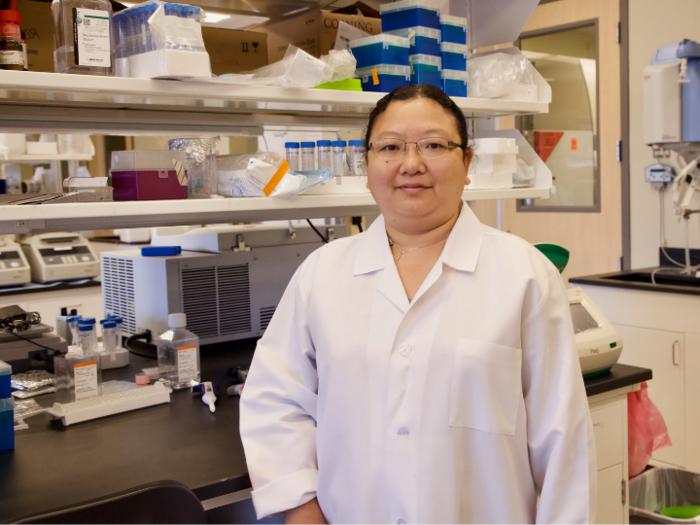
Weiyi Peng, assistant professor of biology and biochemistry at the University of Houston’s College of Natural Sciences and Mathematics, is co-principal investigator and one of three group leaders of the project. She will provide expertise in tumor immunology and lead preclinical testing of the targeted hybrid oncotherapeutic regulation or THOR technology, along with discovery of biomarkers associated with efficacy. Her portion of the project is $2.1 million.
“By integrating a self-regulated circuit, the THOR technology can adjust the dose of immunotherapy reagents based on a patient’s responses,” Peng said. “With this new feature, THOR is expected to achieve better efficacy and minimize immune-related toxicity. We hope this personalized immunotherapy will revolutionize treatments for patients with peritoneal cancers that affect the liver, lungs and other organs.”
The technology works through a minimally invasive procedure to implant a small device that continuously monitors a patient’s cancer and adjusts their dose in real time.
“This kind of ‘closed-loop therapy’ has been used for managing diabetes, where you have a glucose monitor that continuously talks to an insulin pump. But for cancer immunotherapy, it’s revolutionary,” said Rice University bioengineer Omid Veiseh, principal investigator on the ARPA-H cooperative agreement.
ARPA-H is a new federal funding agency established in 2022 that supports transformative biomedical and health breakthroughs – ranging from the molecular to the societal – to provide health solutions for all.
Along with UH’s Peng, Veiseh’s team includes 19 co-PIs from the University of Texas MD Anderson Cancer Center, Georgia Institute of Technology, Stanford University, Carnegie Mellon University, Northwestern University, Johns Hopkins University, the Chicago-based startup CellTrans and New York City-based Bruder Consulting and Venture Group.
The THOR cooperative agreement includes funding for a first-phase clinical trial of the implant for the treatment of recurrent ovarian cancer. The implant goes by the name hybrid advanced molecular manufacturing regulator or HAMMR. The trial is slated to begin in the fourth year of THOR’s 5 1/2-year project.
“The first clinical trial will focus on refractory recurrent ovarian cancer, and the benefit of that is that we have an ongoing trial for ovarian cancer with our encapsulated cytokine ‘drug factory’ technology,” said Veiseh.
“We’ll be able to build on that experience. And that is partly why ARPA-H was interested in funding us. We had already demonstrated a unique model to go from concept to clinical trial within five years, and HAMMR is the next iteration of that approach.”
Peng collaborated with Veiseh and his team on the cytokine “drug factory” technology that was published in Science Advances last year. She and Chunyu Xu, technical research supervisor at UH, investigated how the capsules reshape the tumor environment to achieve maximum tumor-fighting immune responses in pre-clinical cancer models.
THOR is the second program funded under ARPA-H’s inaugural Open Broad Agency Announcement solicitation for research proposals.
Jade Boyd of Rice University contributed to this news release