• HOME
  • NEWS
  • EXPLORE
    • CAREER
      • Companies
      • Jobs
    • EVENTS
    • iGEM
      • News
      • Team
    • PHOTOS
    • VIDEO
    • WIKI
  • BLOG
  • COMMUNITY
    • FACEBOOK
    • INSTAGRAM
    • TWITTER
Wednesday, May 20, 2026
BIOENGINEER.ORG
No Result
View All Result
  • Login
  • HOME
  • NEWS
  • EXPLORE
    • CAREER
      • Companies
      • Jobs
        • Lecturer
        • PhD Studentship
        • Postdoc
        • Research Assistant
    • EVENTS
    • iGEM
      • News
      • Team
    • PHOTOS
    • VIDEO
    • WIKI
  • BLOG
  • COMMUNITY
    • FACEBOOK
    • INSTAGRAM
    • TWITTER
  • HOME
  • NEWS
  • EXPLORE
    • CAREER
      • Companies
      • Jobs
        • Lecturer
        • PhD Studentship
        • Postdoc
        • Research Assistant
    • EVENTS
    • iGEM
      • News
      • Team
    • PHOTOS
    • VIDEO
    • WIKI
  • BLOG
  • COMMUNITY
    • FACEBOOK
    • INSTAGRAM
    • TWITTER
No Result
View All Result
Bioengineer.org
No Result
View All Result
Home NEWS Science News

UD’s Anderson Janotti receives NSF Career Award to model defects in complex materials

Bioengineer by Bioengineer
January 31, 2017
in Science News
Reading Time: 2 mins read
0
Share on FacebookShare on TwitterShare on LinkedinShare on RedditShare on Telegram
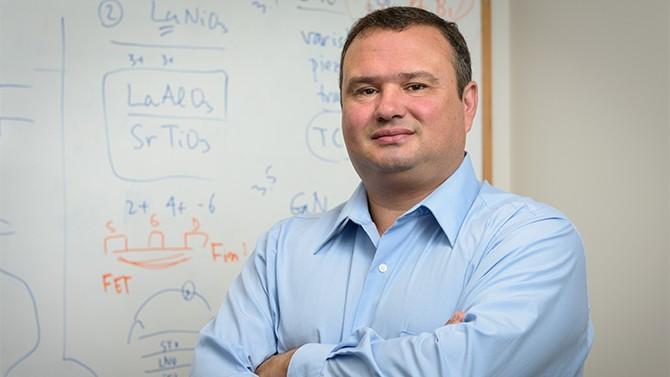
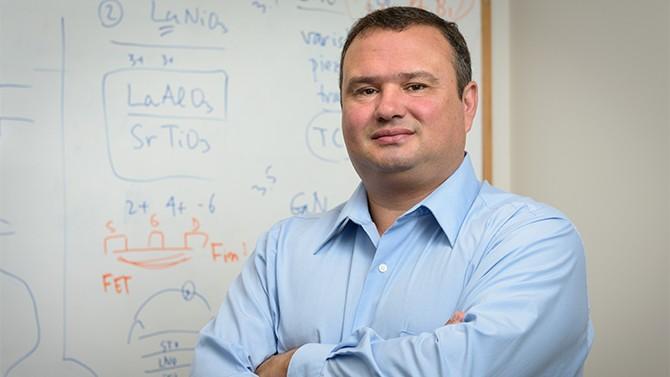
IMAGE

Credit: Evan Krape/University of Delaware

The University of Delaware's Anderson Janotti has won a National Science Foundation Faculty Early Career Development Award to develop computational models of defects in materials that are used for energy, electronics, and optoelectronics applications.

The five-year grant, "Defects and Polarons in Complex Materials," was awarded through NSF's Division of Materials Research.

According to Janotti, an assistant professor in the Department of Materials Science and Engineering, the ability to control the type and number of defects present determines whether a given material will be suitable for device applications, so understanding and controlling defects is crucial to materials development.

Not surprisingly, defects can be detrimental to device performance, as is the case with those that limit the efficiency of solar cells.

On the other hand, they can also be manipulated to improve certain desirable characteristics.

"For example, the electrical conductivity of semiconductors such as silicon and gallium arsenide can be drastically modified by adding minute concentrations of impurities, transforming a good insulator into an excellent conductor," Janotti says. "This technology is widely exploited in the microchips that are found inside our computers, smart phones, and tablets."

Computer modeling can play an important role in this effort, as it can complement experiments on materials by providing access to properties and phenomena that are difficult to probe at the atomic scale.

With the NSF support, Janotti will use advanced methods of electronic structure theory and supercomputers to investigate the role of defects in a series of complex materials that exhibit an array of physical properties. The research may enhance existing properties and could even lead to the discovery of new ones that can be used in novel device designs.

The funding will also enable the training of graduate and high school students. The graduate students will learn cutting-edge computational methods and advanced concepts in materials theory. They will also participate in an outreach program that involves teaching scientific programing to high school students. Through summer internships, the high school participants will develop data-manipulation tools that will help the graduate students with complex data visualization.

"Ultimately, we hope the work will identify defects that are detrimental to materials performance in devices and provide a basis to engineer defects, through doping or alloying, to enhance or broaden materials functionality," Janotti says.

###

About the professor

Anderson Janotti spent 11 years as a project scientist at the University of California, Santa Barbara, before joining UD in August 2015. A native of Brazil, he earned his doctoral degree in physics at the University of São Paulo. Before UCSB, he worked at the National Renewable Energy Laboratory in Colorado and at Oak Ridge National Laboratory in Tennessee.

Media Contact

Peter Bothum
[email protected]
302-831-1418
@UDResearch

http://www.udel.edu

############

Story Source: Materials provided by Scienmag

Share12Tweet8Share2ShareShareShare2

Related Posts

Thermal Imaging Uncovers Altermagnetic Domains in RuO2 for the First Time, Paving the Way for Advanced Spintronic Technologies — Chemistry

Thermal Imaging Uncovers Altermagnetic Domains in RuO2 for the First Time, Paving the Way for Advanced Spintronic Technologies

May 20, 2026
New Discovery Reveals How Cancer Progresses During Cell Division — Biology

New Discovery Reveals How Cancer Progresses During Cell Division

May 20, 2026

Hepatic SNHG9 Connects Gut Microbiota to Liver Defense

May 20, 2026

NCCN Reinforces Global Commitment to Cancer-Related Distress Resources in Observance of Mental Health Awareness Month

May 20, 2026
Please login to join discussion

POPULAR NEWS

  • blank

    New Study Reveals Plants Can Detect the Sound of Rain

    732 shares
    Share 292 Tweet 183
  • Research Indicates Potential Connection Between Prenatal Medication Exposure and Elevated Autism Risk

    846 shares
    Share 338 Tweet 212
  • ESMO 2025: mRNA COVID Vaccines Enhance Efficacy of Cancer Immunotherapy

    287 shares
    Share 115 Tweet 72
  • Breastmilk Balances E. coli and Beneficial Bacteria in Infant Gut Microbiomes

    58 shares
    Share 23 Tweet 15

About

We bring you the latest biotechnology news from best research centers and universities around the world. Check our website.

Follow us

Recent News

Thermal Imaging Uncovers Altermagnetic Domains in RuO2 for the First Time, Paving the Way for Advanced Spintronic Technologies

New Discovery Reveals How Cancer Progresses During Cell Division

Hepatic SNHG9 Connects Gut Microbiota to Liver Defense

Subscribe to Blog via Email

Enter your email address to subscribe to this blog and receive notifications of new posts by email.

Join 82 other subscribers
  • Contact Us

Bioengineer.org © Copyright 2023 All Rights Reserved.

Welcome Back!

Login to your account below

Forgotten Password?

Retrieve your password

Please enter your username or email address to reset your password.

Log In
No Result
View All Result
  • Homepages
    • Home Page 1
    • Home Page 2
  • News
  • National
  • Business
  • Health
  • Lifestyle
  • Science

Bioengineer.org © Copyright 2023 All Rights Reserved.