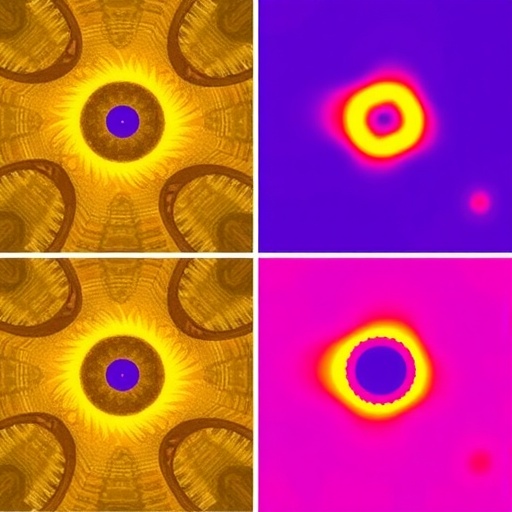
In a groundbreaking advancement that could redefine the future landscape of spintronics and magnetic materials research, a collaborative team of scientists from Tsinghua University, the University of Science and Technology of China, and the Hong Kong University of Science and Technology has successfully achieved real-space imaging of altermagnetic domains in RuO₂. This seminal discovery, published in National Science Review, marks the first experimental visualization of altermagnets, an enigmatic class of magnetic materials that had long evaded direct characterization due to their elusive magnetic signatures.
Altermagnets represent a striking departure from traditional magnetic materials, inhabiting a unique middle ground between ferromagnets and antiferromagnets. Unlike ferromagnets, where magnetization manifests as a net macroscopic field, or antiferromagnets, composed of antiparallel aligned spins canceling out macroscopic magnetization, altermagnets display spin splitting in momentum space governed by their crystallographic symmetries. This complex spin structure leads to the coexistence of 0° and 180° domains, distinguished by Néel vectors pointing in antiparallel directions, thereby neutralizing net magnetic signals and frustrating conventional magnetic imaging techniques. The enigmatic nature of this magnetism had sparked controversy about the actual embodiment of altermagnetic order in materials such as RuO₂.
Overcoming these challenges, the research team devised a novel approach, ingeniously circumventing the limitations of direct magnetic detection. At the heart of their method is the application of lock-in thermography, a sensitive imaging technique capable of capturing minute temperature fluctuations—down to sub-millikelvin levels—coupled with the spin-dependent Peltier effect (SDPE). The SDPE emerges when a pure spin current is injected into an altermagnet: the distinct Peltier coefficients associated with spin-up and spin-down electrons yield a directional heat flow at the interface. Crucially, this heat flow reverses upon flipping the orientation of the Néel vector by 180°, creating a direct thermal fingerprint that faithfully maps the altermagnetic domain structure.
Implementing this powerful technique, the scientists imaged epitaxial RuO₂(110) thin films with micrometer spatial resolution, revealing striking patterns in domain distribution. Instead of a random landscape of domains, the thermal maps depicted large-scale preferential arrangements of 0° and 180° domains spanning tens of micrometers. This highly organized domain configuration provides the first unequivocal experimental evidence validating the altermagnetic state within RuO₂, conclusively settling the debate about its magnetic character after years of theoretical and indirect experimental examinations.
The breakthrough also extended to active control of these domain structures. By cooling samples through the Néel temperature (~370 K) under external magnetic fields—a process known as magnetic field cooling—the team achieved deterministic alignment of the Néel vectors. The magnetic field direction during cooling robustly set the final antiferromagnetic domain orientation, demonstrating that even in the absence of net magnetization, the domains in altermagnets can be manipulated with high fidelity. This capability solves a critical puzzle in altermagnetic research: the controllable switching and stabilization of magnetic order in materials lacking conventional magnetic signatures.
To further confirm their results and complete the reciprocity of the effect, the researchers measured the spin-dependent Seebeck effect, the inverse phenomenon of SDPE. By analyzing hysteresis loop shifts in samples annealed under different field orientations, they observed sign reversals that perfectly corresponded to controlled Néel vector switching. This reciprocal verification solidified the robustness of their experimental methodology and the deep spin-heat coupling intrinsic to altermagnets.
Professor Cheng Song, leading the effort from Tsinghua University, emphasized the significance of these findings: “Our experiments establish a definitive thermal fingerprint of altermagnetism, enabling direct imaging of magnetic domains through heat flow patterns. This breakthrough provides unambiguous proof of altermagnetic order in RuO₂ and opens an entirely new pathway for exploring and harnessing this novel magnetic phase.”
The implications of this work resonate beyond fundamental physics. By pioneering a practical imaging tool for altermagnetic domains, the team opens the door to exploring a broad family of altermagnetic compounds, including Mn₅Si₃, V₂Se₂O, and V₂Te₂O. Each presents unique spin textures promising transformative advances in spin caloritronics—the burgeoning field that leverages spin-dependent heat and charge transport processes for novel device functionalities.
Moreover, the ability to thermally detect and control antiferromagnetic domains with micrometer precision paves the way for innovative spintronic devices that combine ultrafast operation with negligible stray fields. This technology could revolutionize memory, logic, and sensing applications by exploiting the intrinsic robustness and symmetry-driven spin textures of altermagnets, bypassing the limitations of conventional ferromagnetic systems.
The research also establishes an exciting scientific narrative by merging spin-caloritronic effects with new magnetic orders, enriching our understanding of how spin currents and thermal gradients intertwine in complex quantum materials. By capturing the spin-dependent heat transfer associated with subtle spin-momentum locking, the study pushes the frontier of both magnetism and energy conversion technologies.
Looking forward, the research collective is enthusiastic about expanding their approach to a wider array of candidate materials, unlocking fresh opportunities for investigating altermagnetic phenomena across diverse chemical compositions and crystallographic structures. Their technique offers the scientific community a potent and versatile tool to probe hidden antiferromagnetic orders that evade traditional magnetometry, heralding a new era of magnetic materials research driven by precision thermal imaging.
In conclusion, the successful imaging and controlled manipulation of altermagnetic domains in RuO₂ constitute a major leap in magnetism research, proving that even materials without net magnetization can manifest rich and controllable spin textures. Combining cutting-edge thermography with the spin-dependent Peltier effect provides a high-resolution and direct means to visualize and tune these exotic magnetic states, challenging existing paradigms and unlocking new technological horizons in spintronics and beyond.
Subject of Research: Experimental real-space imaging and manipulation of altermagnetic domains in RuO₂ using spin-dependent thermoelectric effects.
Article Title: Real-space thermal imaging and deterministic switching of altermagnetic domains in RuO₂ epitaxial films.
Web References: 10.1093/nsr/nwag203
Image Credits: ©Science China Press
Keywords
Altermagnetism, RuO₂, spin-dependent Peltier effect, spin caloritronics, magnetic domain imaging, antiferromagnetism, spintronics, thermal imaging, spin Seebeck effect, Néel vector, magnetic field cooling, epitaxial thin films
Tags: altermagnetic materials spin structurealtermagnets vs ferromagnets and antiferromagnetscrystallographic symmetry spin splittingexperimental visualization of altermagnetsmagnetic imaging challenges in altermagnetsNéel vector domain visualizationnovel techniques for spintronic materialsreal-space imaging of RuO2RuO2 magnetic domain characterizationspintronic technologies advancementsspintronics research breakthroughsthermal imaging of altermagnetic domains