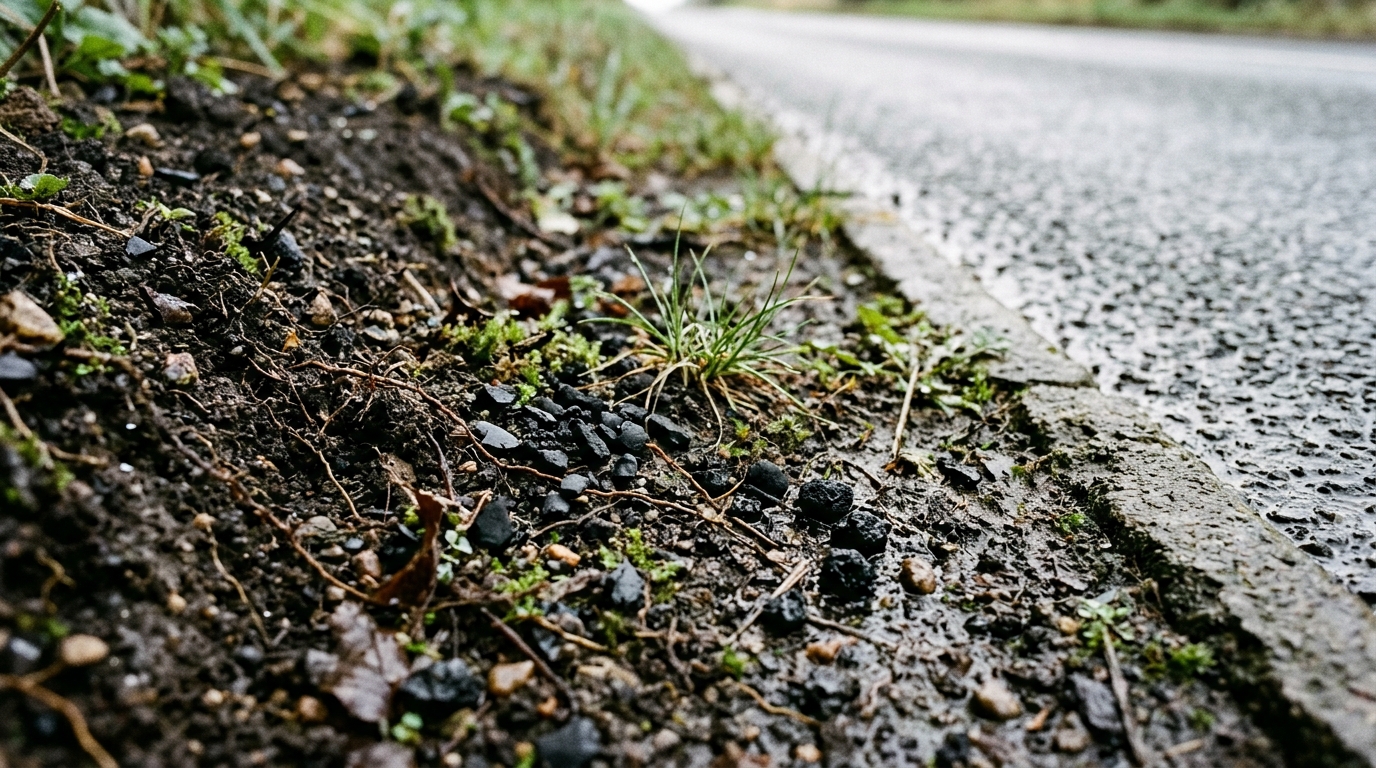
Tyre wear particles, one of the largest sources of microplastics in the environment, are largely trapped in the uppermost layers of road ditch soils, according to a ten-month column experiment testing soil mixtures for stormwater treatment.
Biochar was added to some columns as a carbon sink and sorbent, and duplicates were established both with and without grass cover. The columns were irrigated at different frequencies with real stormwater collected from a sedimentation facility beside a highway carrying an annual average daily traffic load of 105,000 vehicles, of which 11 percent were heavy-duty trucks.
The stormwater itself contained tyre wear particle concentrations ranging from 1.8 to 3.2 micrograms per litre. To test the columns under more extreme loading, the team also used stormwater spiked with sediments from the same facility, which raised particle concentrations to between 230 and 1,500 micrograms per litre. Samples were analysed using pyrolysis gas chromatography coupled with mass spectrometry, with soil particles measured in the 0.3 to 500 micrometre range and waterborne particles in the 1.6 to 500 micrometre range.
After ten months of irrigation, the results showed that the top layer of the soil columns held between 91 and 96 percent of all retained tyre wear particle mass, with decreasing amounts found at greater depths. Removal efficiencies for waterborne particles between 1.6 and 500 micrometres were high across all treatments, ranging from 93 percent in clay with grass up to 99 percent in sandy loam-clay without grass. Notably, biochar-amended soils generally showed similarly high retention of tyre wear particles as the corresponding soils without biochar, meaning the biochar did not provide a clear additional retention benefit under the conditions tested.
The concentrations of tyre-derived chemicals were highest in the upper soil layers and followed a distinct order: 6PPD, BTSA, DPG, DPPD, 6PPD-Q, OHBT, TMQ, MBT, MTBT, PhBT, IPPD, HMMM, 7PPD and CPPD. The study’s highlights note that tyre-derived chemicals, particularly 6PPD and 6PPD-Q, were efficiently retained in several of the soil mixtures. However, these chemicals were retained in the total fraction but proved more mobile in the fraction smaller than 0.45 micrometres, suggesting that dissolved or colloidal forms may travel further down the soil profile than the particles themselves.
One of the most striking findings concerned vegetation. Grass enhanced the transport of tyre wear particles following drought conditions, suggesting that plant roots and the soil structure they create may increase particle mobility within road ditch soils under certain climatic conditions.
Despite this mobility effect, the overall picture was one of strong retention. Tyre wear particles mainly accumulated in the upper soil layers, and all investigated soil mixtures showed high retention efficiencies of 93 to 99 percent. The authors conclude that sandy loam-clay, sandy and biochar-amended road ditch soils all have a high capacity to retain tyre wear particles from stormwater.
At the same time, the influence of vegetation on particle mobility under drought-rewetting cycles suggests that planting decisions in road ditches should be made with particle transport in mind.
The study also underscores the scale of the tyre wear particle problem.
Subject of Research: Transport and retention of tyre wear particles, tyre-derived chemicals and metals in road ditch soil mixtures with and without biochar
Article Title: Transport processes of tyre wear particles, tyre-derived chemicals, and metals in road ditch soil with and without the addition of biochar
Article References: Polukarova, M., Johansson, G., Rødland, E., Rundberget, J. T., Strömvall, A.-M., & Andersson-Sköld, Y. (2026). Transport processes of tyre wear particles, tyre-derived chemicals, and metals in road ditch soil with and without the addition of biochar. Microplastics and Nanoplastics. https://doi.org/10.1186/s43591-026-00237-x
Image Credits: AI Generated
DOI: 10.1186/s43591-026-00237-x
Keywords: tyre wear particles, microplastics, road ditch soil, biochar, stormwater, 6PPD, 6PPD-Q, soil retention, highway runoff, vegetation, column experiment, soil pollution
News Source: Bethany Barker. (November 5, 2026). Tyre wear particles pile up in topsoil: biochar offers little extra retention in road ditch soils. Scienmag.