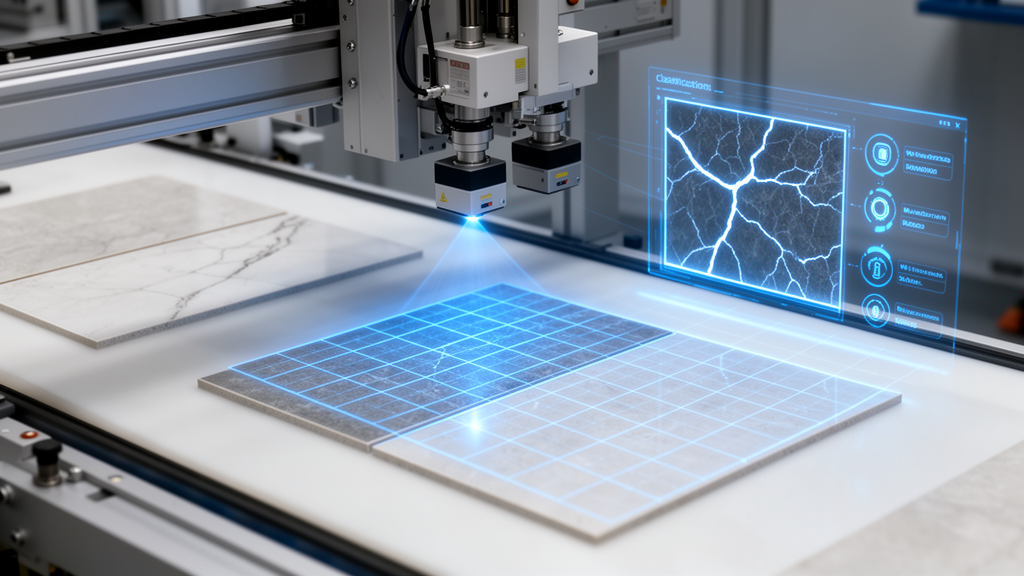
Researchers have engineered an end-to-end two-phase deep learning pipeline designed to automate ceramic tile defect detection and classification, achieving a peak classification accuracy of 99.92 percent.
The ceramic tile manufacturing industry represents a global market exceeding 104 billion dollars annually, where product reliability and brand reputation depend heavily on rigorous, continuous quality control.
To establish an integrated assessment workflow, the researchers formulated a two-phase architecture that unifies localization and classification into a continuous pipeline. Phase one employs the YOLOv8n object detection model, which successfully identifies and localizes tile defects with an overall detection accuracy of 99.15 percent. However, despite this exceptional ability to isolate bounding regions containing anomalies, the detector cannot reliably distinguish between cracks and spots.
Resolving this classification ambiguity is critical for factory operations and economic efficiency. In industrial tile manufacturing, cracked tiles are structurally compromised, meaning their physical integrity is broken and they must be discarded as scrap. In contrast, tiles bearing superficial spots can be salvaged through secondary repair or surface refinishing processes, substantially reducing industrial waste and production expenses.
The second phase of the pipeline was organized into a systematic framework comprising six distinct experimental steps. In the first step, the team evaluated several widely used pretrained convolutional neural network baselines, including VGG-16, ResNet50, InceptionV3, EfficientNetB0, and MobileNetV2. Remarkably, every baseline architecture achieved only 50 percent classification accuracy, a performance level equivalent to random guessing that underscored the acute complexity of separating spot patterns from crack geometries. To investigate the fundamental causes of this widespread failure, the investigators dedicated step two to applying three distinct explainable artificial intelligence techniques.
Guided by insights from the explainable AI evaluations, the researchers developed steps three through six using advanced modeling strategies. These stages explored conventional ensemble learning methods, specifically blending, stacking, and averaging, alongside novel hybrid models combining convolutional neural networks with vision transformers. By merging local convolutional feature extraction with the global attention mechanisms of vision transformers, the hybrid CNN-ViT model achieved an accuracy of 99.84 percent. The highest overall performance was attained in step six, where UNet++ segmentation preprocessing paired with MobileNetV2 reached 99.92 percent classification accuracy.
The experimental results demonstrate that achieving reliable defect categorization in ceramic tile production requires either explicit defect isolation through segmentation algorithms or sophisticated attention mechanisms that capture defect-specific representations despite heavy background interference.
Subject of Research: Automated defect detection and classification in ceramic tile manufacturing using deep learning and segmentation
Article Title: An end-to-end pipeline for cermaic tiles defect detection and classification: highlighting on explainable Al, CNN-ViT ensemble and UNet/UNet++ segmentation
Article References: Rahman, M. N., Moon, M. M. H., Azmi, M. H., & Sharmin, N. (2026). An end-to-end pipeline for cermaic tiles defect detection and classification: highlighting on explainable Al, CNN-ViT ensemble and UNet/UNet++ segmentation. Neural Computing and Applications, 38(23), Article 923. https://doi.org/10.1007/s00521-026-12622-x
Image Credits: AI Generated
DOI: 10.1007/s00521-026-12622-x
Keywords: ceramic tile manufacturing, defect detection, defect classification, quality control, YOLOv8n, explainable AI, vision transformers, CNN-ViT ensemble, UNet, UNet++, MobileNetV2, ResNet50, VGG-16, InceptionV3, EfficientNetB0, ensemble learning, structural cracks, surface spots
News Source: Denise Maddox. (November 26, 2026). Two-Phase Deep Learning Pipeline Accurately Identifies and Classifies Ceramic Tile Defects. Scienmag.