• HOME
  • NEWS
  • EXPLORE
    • CAREER
      • Companies
      • Jobs
    • EVENTS
    • iGEM
      • News
      • Team
    • PHOTOS
    • VIDEO
    • WIKI
  • BLOG
  • COMMUNITY
    • FACEBOOK
    • INSTAGRAM
    • TWITTER
Tuesday, August 18, 2026
BIOENGINEER.ORG
No Result
View All Result
  • Login
  • HOME
  • NEWS
  • EXPLORE
    • CAREER
      • Companies
      • Jobs
        • Lecturer
        • PhD Studentship
        • Postdoc
        • Research Assistant
    • EVENTS
    • iGEM
      • News
      • Team
    • PHOTOS
    • VIDEO
    • WIKI
  • BLOG
  • COMMUNITY
    • FACEBOOK
    • INSTAGRAM
    • TWITTER
  • HOME
  • NEWS
  • EXPLORE
    • CAREER
      • Companies
      • Jobs
        • Lecturer
        • PhD Studentship
        • Postdoc
        • Research Assistant
    • EVENTS
    • iGEM
      • News
      • Team
    • PHOTOS
    • VIDEO
    • WIKI
  • BLOG
  • COMMUNITY
    • FACEBOOK
    • INSTAGRAM
    • TWITTER
No Result
View All Result
Bioengineer.org
No Result
View All Result
Home NEWS Science News Biology

Two new species of parasitic wasps described from an altitude of over 3,400 m in Tibet

Bioengineer by Bioengineer
July 3, 2019
in Biology
Reading Time: 2 mins read
0
IMAGE
Share on FacebookShare on TwitterShare on LinkedinShare on RedditShare on Telegram

IMAGE

Credit: Wangzhen Zhang

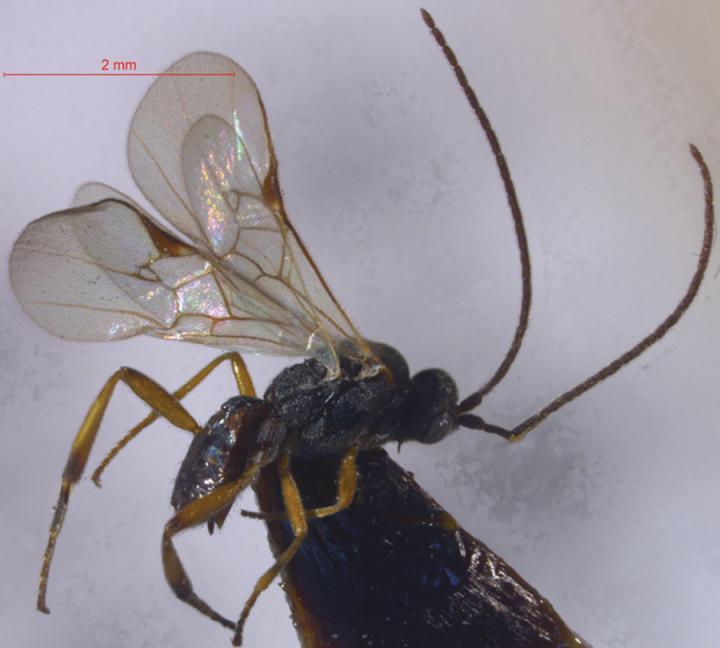
Specimens kept in the collection of the Institute of Beneficial Insects at the Fujian Agriculture and Forestry University (FAFU, China) revealed the existence of two previously unknown species of endoparasitoid wasps. Originally collected in 2013, the insects are known to inhabit prairies and bushes at above 3,400 m, which is quite an unusual altitude for this group of wasps.

The new to science wasps are described and illustrated in a paper published in the open-access, peer-reviewed scholarly journal ZooKeys by the team of Dr Wangzhen Zhang (FAFU and Fuzhou Airport Inspection and Quarantine Bureau) and his colleagues at FAFU: Dr Dongbao Song and Prof Jiahua Chen.

Looking very similar to each other, the species were found to belong to one and the same genus (Microplitis), which, however, is clearly distinct from any other within the subfamily, called Microgastrinae. The latter group comprises tiny, mostly black or brown wasps that develop in the larvae of specific moths or butterflies. Interestingly, once parasitised, the host continues living and does not even terminate its own growth. It is only killed when the wasp eggs hatch and feed on its organs and body fluids before spinning cocoons.

From now on, the newly described wasps will be called by the scientific names Microplitis paizhensis and Microplitis bomiensis, where their species names refer to the localities from where they were originally collected: Paizhen town and Bomi county, respectively.

Due to their parasitism, some microgastrine wasps are considered important pest biocontrol agents. Unfortunately, the hosts of the newly described species remain unknown.

In addition, the scientists also mention a third new to science species spotted amongst the specimens they studied. However, so far they have only found its male, whereas a reliable description of a new microgastrine wasp requires the presence of a female.

###

Original source:

Zhang W, Song D, Chen J (2019) Two new species of the genus Microplitis Förster, 1862 (Hymenoptera, Braconidae, Microgastrinae) from China. ZooKeys 859: 49-61. https://doi.org/10.3897/zookeys.859.31720

Contacts:

Wangzhen Zhang

Email: [email protected]

Jiahua Chen

Email: [email protected]

Dongbao Song

Email: [email protected]

Media Contact
Wangzhen Zhang
[email protected]

Related Journal Article

http://dx.doi.org/10.3897/zookeys.859.31720

Tags: BiodiversityBiologyEcology/EnvironmentEntomologyEvolutionPopulation BiologyZoology/Veterinary Science
Share12Tweet8Share2ShareShareShare2

Related Posts

Scientists unravel the mystery behind narwhals’ uniquely twisted tusks

Scientists unravel the mystery behind narwhals’ uniquely twisted tusks

August 18, 2026
Five new Cyprus wasp species discovered, including one named after Aphrodite

Five new Cyprus wasp species discovered, including one named after Aphrodite

August 18, 2026

Scientists map plant-fungus symbiosis at single-cell resolution

August 18, 2026

One in 20 Australian women now receive intravenous iron infusions

August 18, 2026
Please login to join discussion

POPULAR NEWS

  • TUM develops single-photon sources to advance quantum communication

    29 shares
    Share 12 Tweet 7
  • Restoring missing sunlight indoors may help prevent myopia

    29 shares
    Share 12 Tweet 7
  • Retraction: Study on NOTCH mitochondrial localization and tumor-initiating cell reprogramming withdrawn

    29 shares
    Share 12 Tweet 7
  • NUS CDE researchers set new brightness records for flexible displays

    29 shares
    Share 12 Tweet 7

About

We bring you the latest biotechnology news from best research centers and universities around the world. Check our website.

Follow us

Recent News

TUM develops single-photon sources to advance quantum communication

Restoring missing sunlight indoors may help prevent myopia

Retraction: Study on NOTCH mitochondrial localization and tumor-initiating cell reprogramming withdrawn

Subscribe to Blog via Email

Enter your email address to subscribe to this blog and receive notifications of new posts by email.

Join 85 other subscribers
  • Contact Us

Bioengineer.org © Copyright 2023 All Rights Reserved.

Welcome Back!

Login to your account below

Forgotten Password?

Retrieve your password

Please enter your username or email address to reset your password.

Log In
No Result
View All Result
  • Homepages
    • Home Page 1
    • Home Page 2
  • News
  • National
  • Business
  • Health
  • Lifestyle
  • Science

Bioengineer.org © Copyright 2023 All Rights Reserved.