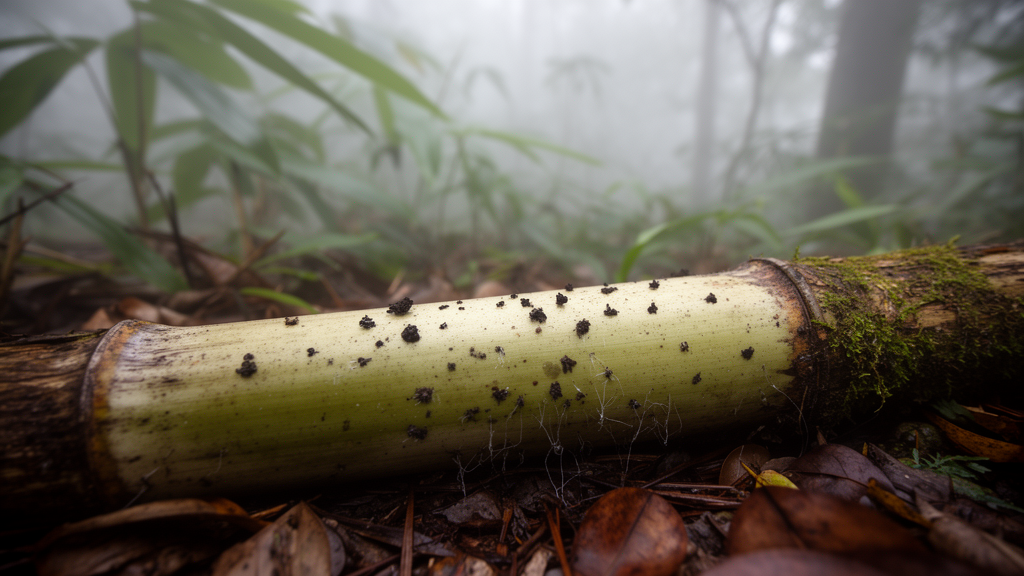
Deep in the misty forests of southwestern China, two previously unknown species of wood-decaying fungi have been formally identified and named, adding fresh branches to the fungal tree of life. The discoveries, published in the journal MycoKeys, emerged from field surveys across the Yunnan-Guizhou Plateau, where researchers collected specimens growing inconspicuously on dead bamboo culms. Using a combination of detailed microscopic anatomy and DNA-based evolutionary analysis, the team confirmed that the fungi represent entirely new species: Minuticlypeus zunyiensis from Guizhou Province and Paravamsapriya yunnanensis from Yunnan Province. Both belong to the order Xylariales, one of the largest and most ecologically important groups of saprotrophic fungi on Earth.
The order Xylariales is a powerhouse of forest decomposition. It encompasses 165 genera distributed across 22 families, with dozens more genera still awaiting stable familial placement. Its members colonize decaying wood, fallen branches, and trunks, where they break down tough lignocellulosic material and drive nutrient cycling through terrestrial ecosystems. Many species also live hidden inside healthy plant tissues as endophytes, quietly influencing plant-microbe interactions, boosting host fitness, and sometimes shielding their hosts from pathogens. Beyond their ecological roles, xylariaceous fungi are prolific chemists, producing a striking diversity of secondary metabolites with functions in competition, defense, and symbiosis, and with considerable potential for pharmaceutical, agricultural, and biotechnological applications.
Despite this importance, the taxonomy of Xylariales remains notoriously difficult. Molecular data are scarce for many lineages, the connections between sexual and asexual forms are often uncertain, and taxa with poorly developed stromata have proven to be polyphyletic, meaning that outwardly similar fungi may not actually be close relatives. These complications make species delimitation a genuine scientific challenge. Yet interest in the group has surged in recent years, driven by growing recognition of their ecological significance and sheer species diversity, particularly in underexplored tropical and subtropical regions such as southwestern China.
The new study focused on two relatively recently established genera. Minuticlypeus, placed in the family Pallidoperidiaceae, was erected in 2024 with Minuticlypeus discosporus as its type species. It is known only from its sexual morph and is defined by a distinctive suite of features: perithecia immersed beneath a small clypeus and surrounded by pseudostromatic tissue, solitary subglobose ascomata with periphysate conical necks, unbranched paraphyses, eight-spored asci bearing an amyloid inverted hat-shaped apical apparatus, and unicellular brown ascospores enclosed in a mucilaginous sheath with a germ slit running the full length of the spore. Before this study, the genus comprised five species, all found exclusively on bamboo, four of them already reported from southwestern China.
Paravamsapriya, the second genus, belongs to the family Vamsapriyaceae and was introduced in 2022 with Paravamsapriya ostiolata as the type species, originally found on dead bamboo branches in Thailand. Like Minuticlypeus, it is known only from its sexual morph, characterized by immersed black ascomata with a yellowish-brown clypeus-like margin, a multi-layered peridium with a thick-walled outer layer and hyaline inner layer, long septate paraphyses, eight-spored unitunicate cylindrical asci with a non-amyloid apical ring, and hyaline, ellipsoidal to fusiform, aseptate ascospores lacking germ slits. Only two species were known previously: P. ostiolata from Thailand and P. nypae from China. The genus resembles its relative Vamsapriya but can be separated by the yellow-black margin around the ostioles, an easily detachable peridium, and aseptate ascospores.
The specimens behind the new species were collected during field surveys in August and September 2025 in two of China’s most biodiverse protected areas: Kuankuoshui National Nature Reserve in Guizhou Province and Xishuangbanna National Nature Reserve in Yunnan Province. Kuankuoshui experiences a humid subtropical monsoon climate with mean annual temperatures of roughly 13 to 20 degrees Celsius, annual precipitation of 1,100 to 1,500 millimeters, and relative humidity generally exceeding 80 percent, supporting mixed forest and bamboo forest vegetation. Xishuangbanna, by contrast, has a tropical monsoon climate with mean annual temperatures of 18 to 22 degrees Celsius, precipitation of 1,200 to 2,000 millimeters, and extensive tropical seasonal rainforests, monsoon forests, and montane evergreen broad-leaved forests. Collected samples were sealed, air-dried, and deposited in the herbaria of Guizhou Medical University and the Kunming Institute of Botany.
In the laboratory, the researchers examined macroscopic features such as ostioles and clypei with a stereomicroscope, then probed microscopic structures, including ascomata, peridia, paraphyses, asci, and ascospores, with a compound microscope, testing the amyloid reaction of apical apparatuses with Melzer’s reagent. Attempts to germinate ascospores on potato dextrose agar and oatmeal agar failed, so genomic DNA was extracted directly from perithecial contents. Four genetic loci were amplified and sequenced: the internal transcribed spacer region, the large subunit of ribosomal DNA, the beta-tubulin gene tub2, and rpb2, the second largest subunit of RNA polymerase II. These multi-locus datasets were aligned and subjected to both maximum likelihood and Bayesian inference phylogenetic analyses, the gold-standard combination for establishing evolutionary relationships.
The results were unambiguous. In a dataset of 3,049 aligned characters, all known Minuticlypeus species formed a well-supported monophyletic clade, and the sequences of the new fungus clustered as a distinct lineage sister to M. yunnanensis with maximal statistical support of 100 percent bootstrap support and a Bayesian posterior probability of 1.0. Morphology reinforced the genetic verdict: the new species, named Minuticlypeus zunyiensis after Zunyi City, possesses fusiform to ellipsoidal ascospores tapering toward slightly pointed tips with a distinct germ slit, whereas its sister species has rounder, rugby-shaped spores lacking a germ slit. M. zunyiensis also has larger ascomata, measuring 354 to 665 by 407 to 566 micrometers, and longer asci, 166.5 to 208.5 micrometers, than any of its close relatives, and comparisons with all five known congeners confirmed its uniqueness.
The second new species told a parallel story. In a 2,799-character dataset, Paravamsapriya yunnanensis formed a well-supported clade sister to P. nypae, again with 100 percent bootstrap support and a posterior probability of 1.0. The two species are morphologically similar in ascus and ascospore characters but differ markedly in ecology and dimensions. P. yunnanensis was collected on dead bamboo culms, while P. nypae grows on the palm rachides of Nypa fruticans. The new species also has larger ascomata, 536 to 622 by 386 to 438 micrometers, and longer asci, 145 to 183 micrometers, than P. nypae. Compared with the type species P. ostiolata, it has smaller ascospores, 17 to 21.5 by 5.7 to 7.8 micrometers, wrapped in a relatively thick mucilaginous sheath of 10 to 31 micrometers, lacking the prominent mucilaginous caps found at both ends of P. ostiolata’s larger spores. Named for Yunnan Province, the species was formally described with a holotype and paratype from Xishuangbanna.
Beyond the naming of two species, the study carries broader implications. Both genera show a strong ecological preference for monocotyledonous hosts, particularly bamboo, and the addition of two more bamboo-associated species strengthens the case that these lineages are ecologically adapted to plants such as Poaceae and Arecaceae. Intriguingly, the phylogenetic relationships within the genera do not always track morphology: species sharing similar ascospore shapes or the presence or absence of a germ slit are not always close relatives, a mismatch the authors attribute to limited taxon sampling, convergent evolution under similar ecological pressures, or retained ancestral traits that obscure true relationships. The findings underscore bamboo microhabitats as underappreciated reservoirs of fungal diversity and highlight the Yunnan-Guizhou Plateau as a frontier for future exploration, where continued surveys and integrative taxonomic studies are essential to document the full ecological and evolutionary roles of these hidden decomposers.
Subject of Research: Taxonomy and multi-locus phylogeny of two new bamboo-associated Xylariales fungal species from the Yunnan-Guizhou Plateau, China
Article Title: Taxonomy and phylogeny reveal new species of Minuticlypeus ( Pallidoperidiaceae , Xylariales ) and Paravamsapriya ( Vamsapriyaceae , Xylariales ) from Yunnan-Guizhou Plateau, China
Article References: Yao, Z.-Q., Liu, L.-L., Li, W.-H., Yang, Q., Wijayawardene, N. N., Al-Arjani, A.-B. F., Elgorban, A. M., Filimban, F. Z., Habib, K., & Li, Q.-R. (2026). Taxonomy and phylogeny reveal new species of Minuticlypeus (Pallidoperidiaceae, Xylariales) and Paravamsapriya (Vamsapriyaceae, Xylariales) from Yunnan-Guizhou Plateau, China. MycoKeys, 137, 241-255. https://doi.org/10.3897/mycokeys.137.195655
Image Credits: AI Generated
DOI: 10.3897/mycokeys.137.195655
Keywords: Xylariales, Minuticlypeus zunyiensis, Paravamsapriya yunnanensis, bamboo fungi, Yunnan-Guizhou Plateau, phylogenetics, taxonomy, new species, mycology, saprobes, Kuankuoshui, Xishuangbanna
News Source: Roger Howard. (October 18, 2026). Two New Fungal Species Unearthed on Bamboo in China’s Yunnan-Guizhou Plateau. Scienmag.