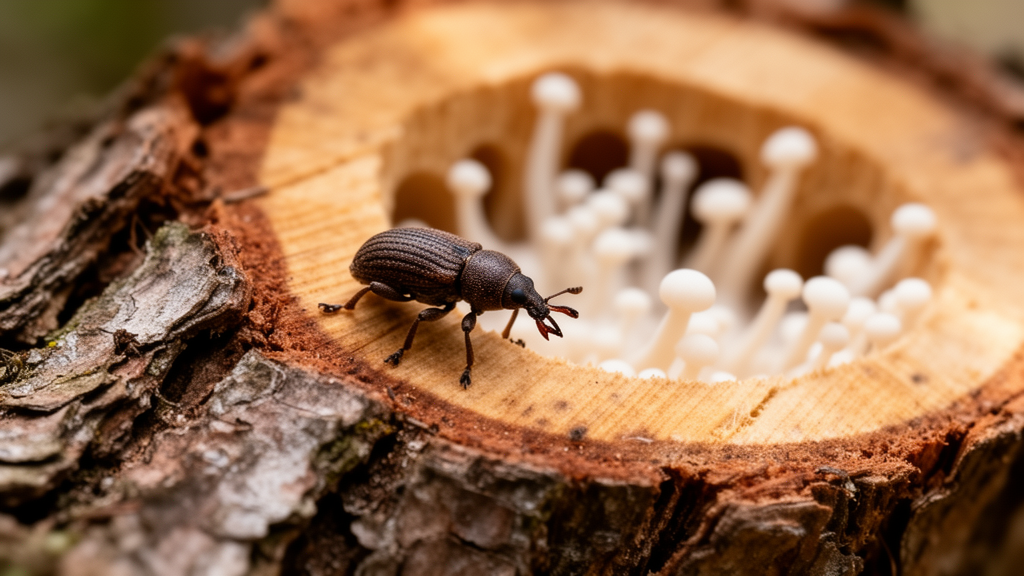
Deep inside the trunk of a dead silver fir in Slovakia, a tiny pinhole borer has been quietly farming a fungal garden that no one had ever properly surveyed. Now, a detailed cultivation-based study of the rare ambrosia beetle Treptoplatypus oxyurus has revealed a remarkably isolated pocket of fungal diversity, including an entirely new genus and species of ophiostomatoid fungus and two previously unknown yeasts. The findings, published in IMA Fungus, suggest that the fungal world associated with Europe’s conifer-colonising beetles is far richer, and far stranger, than current databases indicate.
Ambrosia beetles are wood-boring weevils that live in an obligate nutritional symbiosis with so-called ambrosia fungi, which they carry in specialised pouches called mycangia and cultivate inside their galleries as their primary food source. Among these insects, the pinhole borers of the subfamily Platypodinae are predominantly tropical, with only two native European representatives. One of them, Treptoplatypus oxyurus, is a rare and understudied beetle with a highly specialised ecology: it develops almost exclusively in large dead trunks of Abies species in natural forests, often concentrating in windthrow gaps that managed forests typically lack. Even more remarkably, Platypodinae entered into fungus farming at least 80 million years ago, making them the oldest known fungus-farming system on Earth, predating the better-known scolytine ambrosia beetles and other fungus-farming insects.
Despite this ancient pedigree, the symbiotic fungi of platypodine beetles have been studied in only a negligible fraction of species. To close part of that gap, researchers collected a lower trunk section from a standing, recently dead silver fir colonised by T. oxyurus in Tŕnie near Zvolen, Slovakia, and kept it outdoors to allow beetle development before transferring it to a laboratory in Prague. From there, they excised teneral adults, larvae, and active gallery fragments, and used scanning electron microscopy to document the beetle’s morphology, including the female and male mycangia. The team then applied a quantitative, cultivation-dependent approach: crushed female thoraces containing mycangia, living larvae, and gallery segments were vortexed in buffer, serially diluted, and plated onto malt extract agar, with colonies counted as colony-forming units after incubation at 25 degrees Celsius.
The results revealed five numerically dominant fungal associates across the beetle’s microhabitats. Candida schatavii dominated on the larval surface, accounting for between 13 and 92 percent of all colony-forming units from individual larvae, and was the second most frequent symbiont in the mycangia. Magnusiomyces fungicola dominated in the active galleries, where it made up roughly 44 percent of the fungal community. But the most abundant fungus in the mycangia itself, reaching between 37 and 74 percent of colony-forming units from female thoraces, was something no one had ever described: a novel member of the order Ophiostomatales, now named Wilhelmdebeerea oxyuri in honour of the mycologist Wilhelm de Beer.
Wilhelmdebeerea oxyuri is taxonomically remarkable. Its best matches in public sequence databases were no closer than 83 percent identity for the ITS barcode and 76 percent for beta-tubulin, underscoring how isolated this lineage is. Morphologically, it is equally unusual: it simultaneously produces both leptographium-like and hyalorhinocladiella-like asexual states, a combination that is rare in the Ophiostomatales and known only in a handful of phylogenetically unrelated species. The fungus grows optimally at 25 degrees Celsius, tolerates high concentrations of cycloheximide, and carries both mating-type idiomorphs in its genome, suggesting it can be considered homothallic. Multigene phylogenetic analyses based on ITS, LSU, TEF1-alpha, and RPB2 placed it in a separate lineage related to Hausneria geniculata, Ophiostoma angusticollis, O. denticulatum, and the termite-associated genus Intubia, while phylogenomic analysis of 522 conserved genes resolved Masuyamyces pallidulus as its sister taxon. The team’s phylogenomic reconstruction represents the most comprehensive sampling of Ophiostomatales taxa to date.
Two additional yeasts, isolated at much lower frequencies from female thoraces, also proved to be new species. Blastobotrys sasensis, named after the Slovak Academy of Sciences, and Sugiyamaella casensis, named after the Czech Academy of Sciences, both belong to the family Trichomonascaceae within the order Dipodascales. Neither could be assigned to any known species: the closest ITS matches were only 85 and 86.7 percent identical, respectively. Phylogenomic analyses based on 1,399 conserved single-copy orthologs from 195 genomes placed B. sasensis as a sister lineage to B. muscicola and B. robertii within the monophyletic genus Blastobotrys, while S. casensis emerged as the sister species of S. mastotermitis, a yeast originally isolated from the gut of the termite Mastotermes darwiniensis.
The physiological profiles of both new yeasts reveal strong adaptations for life in deadwood. Of 34 carbon compounds tested, B. sasensis assimilated 23 and S. casensis assimilated 29, including nearly all the saccharides previously detected in the bark and decomposing wood of silver fir, such as glucose, fructose, sucrose, trehalose, cellobiose, and xylose. Neither species fermented sugars, but both tolerated osmotic stress, growing in the presence of 50 percent glucose and on media with 10 percent sodium chloride plus 5 percent glucose. This assimilation spectrum closely mirrors the carbohydrate composition of living and decaying fir wood, where concentrations of mannose, xylose, and arabinose rise significantly during decomposition. Many Sugiyamaella species are potential xylanase producers, and some can ferment xylose, highlighting their economic potential for producing bioethanol and xylitol from plant waste, so the biotechnological potential of the new species remains to be verified.
Biogeographic searches in the GlobalFungi database, which contains environmental ITS sequences from nearly 85,000 samples worldwide, added an unexpected dimension. Exact matches to Wilhelmdebeerea oxyuri were found in 45 deadwood substrate samples from boreal forests in Finland and European Russia, primarily on Norway spruce rather than on fir, the exclusive host of the beetle. Blastobotrys sasensis appeared in 54 samples, nearly all from spruce deadwood in Finland, and Candida schatavii was detected in five European deadwood samples. The co-occurrence of C. schatavii, B. sasensis, and W. oxyuri in the same Finnish locations, and in some cases the same samples, is certainly not coincidental given how almost absent these rare fungi are from the wider database. Sugiyamaella casensis, by contrast, has no identical or even similar sequences anywhere in GlobalFungi, making it, for now, a truly local discovery.
These discordant records raise a fundamental question about the nature of the beetle-fungus association. If Wilhelmdebeerea oxyuri is genuinely the primary nutritional symbiont of T. oxyurus, why do identical DNA markers turn up in spruce deadwood thousands of kilometres from the beetle’s range, on a host the beetle never colonises? The authors caution that the ecological roles of all identified fungi and the strength of their association with the beetle require confirmation through further studies at additional locations. No Raffaelea species, the genus considered the primary ambrosia fungus of all well-researched platypodine beetles, was isolated in this study, which is itself notable. The difficulty is both methodological and biological: most approaches have failed to distinguish between beetle tissues and their microhabitats, and evidence is emerging that in most ambrosia beetles the mycangium only contains viable inoculum in young females during transport, so isolation from indiscriminate body parts and life stages can produce misleading results.
What the study does establish is that a unique European pinhole borer, confined to natural fir forests from the Pyrenees to the Carpathians and beyond, carries a previously undocumented fungal community dominated by a new genus, two new yeast species, and rare associates like Magnusiomyces fungicola, whose only other verified record outside this beetle comes from ascocarps of the coral-spot fungus Nectria cinnabarina. The abundance of several new or poorly known fungal species suggests that the ambrosia beetle ecosystem continues to yield discoveries, and that either T. oxyurus vectors unorthodox symbionts or the search for its bona fide mutualist continues. For a beetle that is scarce across most of Central Europe and dependent on habitats usually absent from managed forests, T. oxyurus has proven to be something of a living island, harbouring a fungal diversity that enriches our understanding of conifer-colonising beetles and their ecological and biotechnological importance.
Subject of Research: Mycology
Article Title: The ambrosial mycobiota of Treptoplatypus oxyurus ( Coleoptera , Platypodidae ): a unique island of fungal diversity revealing Wilhelmdebeerea oxyuri gen. et sp. nov. ( Ophiostomatales ), and two new yeast species Blastobotrys sasensis sp. nov., and Sugiyamaella casensis sp. nov. ( Dipodascales )
Article References: Kolařík, M., Vadkertiová, R., Knížek, M., Sklenář, F., Vakula, J., Zúbrik, M., Kolář, M., & Hulcr, J. (2026). The ambrosial mycobiota of Treptoplatypus oxyurus (Coleoptera, Platypodidae): a unique island of fungal diversity revealing Wilhelmdebeerea oxyuri gen. et sp. nov. (Ophiostomatales), and two new yeast species Blastobotrys sasensis sp. nov., and Sugiyamaella casensis sp. nov. (Dipodascales). IMA Fungus, 17, Article e177075. https://doi.org/10.3897/imafungus.17.177075
Image Credits: AI Generated
DOI: 10.3897/imafungus.17.177075
Keywords: ambrosia beetles, fungal symbiosis, mycangia, Ophiostomatales, new species, deadwood, yeasts, Platypodinae, phylogenomics, conifer forests, ambrosial, mycobiota
News Source: Roger Howard. (October 18, 2026). Rare European ambrosia beetle harbors a hidden island of unknown fungi, including three brand-new species. Scienmag.