Deep in the forests of northern Thailand, a quiet microbial treasure hunt has just paid off. Researchers collecting healthy leaves and stems of Itea plants — a genus prized across East Asia for producing rare sugars and medicinally valuable compounds — have pulled out fungal stowaways that turn out to be entirely new to science. The team, writing in the journal MycoKeys, formally describes two new species, Diaporthe iteae and Neptunomyces iteae, and reports the first Thai record of a third fungus, Diaporthe coracoralinae, previously known only from Brazil. All three were living as endophytes, the fungi that dwell harmlessly inside plant tissues without causing any visible disease.
The discovery matters because Itea is far more than botanical wallpaper. Species such as Itea japonica and Itea riparia are distributed widely through China, Japan and Southeast Asia, and they attract attention for their ability to accumulate rare sugars and bioactive compounds with nutritional and therapeutic potential. Endophytic fungi are increasingly recognized as prolific sources of bioactive substances, capable of modulating the accumulation of secondary metabolites in their hosts, fostering plant growth and boosting resistance to disease and environmental stress. Yet despite the plant’s economic and medicinal profile, the fungal communities living inside Itea have remained strikingly understudied. Mapping this hidden diversity is a logical first step toward finding novel sources of useful chemistry.
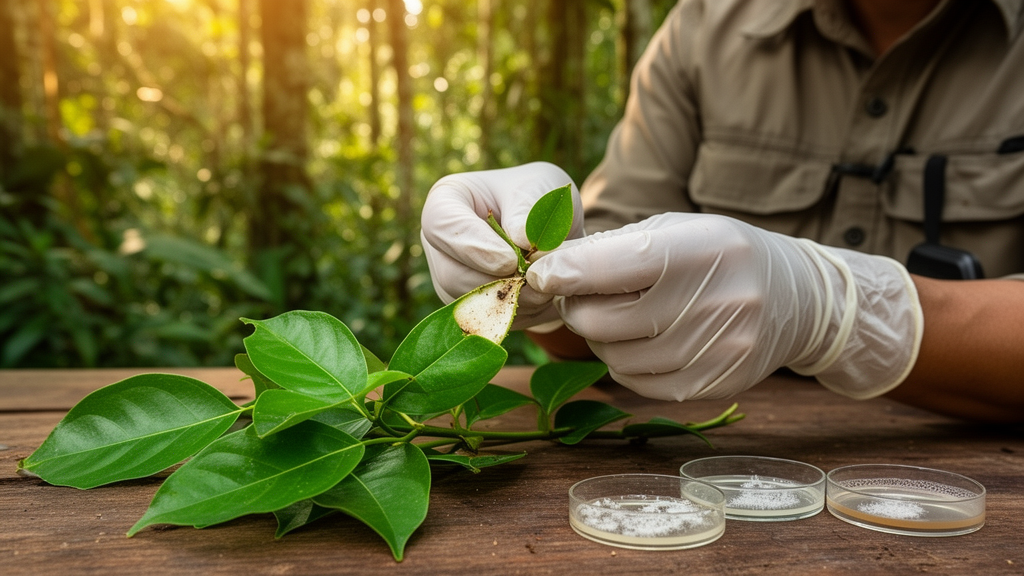
The fieldwork took place in Chiang Mai Province, with fresh samples of Itea japonica collected in Hang Dong District and Itea riparia gathered in Mae Rim District. The researchers cut small segments roughly five square millimeters from healthy tissues and surface-sterilized them through a careful rinse sequence: sterile distilled water for one minute, 70 percent ethanol for thirty seconds, then two percent sodium hypochlorite for another thirty seconds. After air-drying, the segments were placed on potato dextrose agar and incubated at 25 degrees Celsius. Single hyphal tips were transferred to fresh plates for purification. During their observations, four coelomycetous strains stood out because they produced distinct conidial exudates in culture — a clue that something unusual was growing.
Identifying fungi this cryptic requires more than a glance through a microscope. The team adopted a polyphasic approach, combining detailed morphological characterization with multilocus phylogenetic analyses and pairwise nucleotide polymorphism comparisons. Cultures were examined for colony features, pigment production, growth rate and sporulation after one to two months, using stereo and compound microscopes equipped with digital cameras. Measurements were taken systematically: ten readings for conidiomata, conidiomatal walls, ostioles, conidiophores and conidiogenous cells, and thirty for conidia. The newly introduced taxa were registered with Index Fungorum numbers, and dried cultures were deposited as fungarium specimens at the Mae Fah Luang University herbarium in Chiang Rai Province.
On the molecular side, DNA was extracted from mycelium grown for one week on potato dextrose agar, and seven genomic regions were amplified by polymerase chain reaction: the internal transcribed spacer (ITS) and the partial 28S large subunit (LSU) and 18S small subunit (SSU) of ribosomal DNA, plus the protein-coding loci translation elongation factor 1-alpha (tef1-alpha), beta-tubulin (tub2), calmodulin (cal) and histone H3 (his3). For the Diaporthe analysis, the researchers concatenated ITS, tef1-alpha, tub2, cal and his3 sequences from 84 taxa, producing an alignment of 2,609 characters. For Didymosphaeriaceae, they combined ITS, LSU, SSU and tef1-alpha from 65 taxa, yielding 3,459 characters. Phylogenetic trees were constructed using maximum likelihood with 1,000 bootstrap replicates and Bayesian inference with six simultaneous Markov chains, run through the CIPRES Science Gateway platform.
The Diaporthe results were unambiguous in one key respect. Diaporthe iteae, isolated from Itea japonica in Hang Dong District, sits within the Diaporthe siamensis species complex in section Sojae, forming a distinct sister lineage to D. kyushuensis, D. fici-septicae and D. citriasiana. Morphologically, the new species produces stromatic, multilocular conidiomata 500 to 1,800 micrometers across, with prominent black necks and white to pale-yellow conidial drops. It generates filiform beta conidia measuring 21.8 to 35.5 by 1 to 1.8 micrometers — shorter than those of D. citriasiana and D. kyushuensis — while D. fici-septicae produces only alpha conidia, making direct conidial comparison impossible. The nucleotide comparisons sealed the case: differences of 3.2 percent in ITS, 5.3 percent in tef1-alpha, 3.7 percent in tub2, 6.3 percent in cal and 5 percent in his3 against D. citriasiana, and 2 to 3.4 percent divergence against the other relatives, well above the 1.5 percent threshold widely applied for species delimitation.
The second Diaporthe finding was a biogeographic surprise. Strain MFLUCC 26-0215 clusters with the type strain of D. coracoralinae with maximal statistical support — 100 percent bootstrap and 1.00 Bayesian posterior probability — and is identical to the ex-type sequences across all five loci except for a two-base difference in his3. That species was originally described as an endophyte on healthy branches of Brosimum gaudichaudii in Brazil, so finding it inside Itea japonica leaves in Thailand represents both a new host record and a new geographical record. Intriguingly, the Thai collection also revealed beta conidia for the first time in D. coracoralinae, which had previously been documented producing only fusiform alpha conidia. The researchers suggest that the clade containing D. coracoralinae and several related species, sitting outside the refined species complexes but near the D. ganjae and D. sclerotioides complexes, could eventually warrant recognition as a novel species complex.
The second new genus-level addition came from Itea riparia in Mae Rim District. Neptunomyces iteae, isolated from healthy stems and leaves, belongs to Didymosphaeriaceae, a large family in the order Pleosporales with a remarkably wide range of hosts and habitats worldwide. The genus Neptunomyces was proposed only in 2019 with the type species N. aureus, an algicolous fungus from Portugal, and it currently comprises seven species. The new species forms an independent lineage sister to N. jeanbriggsiae, with the two Thai isolates clustering together under maximal support. It is distinguished by a 9.9 percent ITS difference from N. jeanbriggsiae, and morphologically by the presence of septate, branched conidiophores and longer conidiogenous cells — 5 to 15.5 by 1.5 to 3 micrometers — compared with its closest relatives N. chinensis, N. soli and N. yunnanensis. Its aseptate, ellipsoidal to limoniform conidia, brown to golden brown with acute to apiculate apices, fit the generic profile while adding a new dimension: conidiophores are rarely observed in other species of the genus.
The study also exposes the growing pains of modern fungal taxonomy. Diaporthe, with more than 1,300 species epithets listed in Index Fungorum, has long been taxonomically ambiguous because key morphological traits such as conidiogenous cells and conidia are shared by species that are not closely related. The researchers follow a recent sectional framework that reassessed Diaporthe into seven phylogenetically distinct sections, and they note that incomplete sequence data — particularly missing tub2, cal and his3 loci in many species — probably caused the weak branch support for D. iteae. In the Didymosphaeriaceae backbone tree, several Neptunomyces species occupy unresolved placements for the same reason. Notably, the team found that the type strains of N. yunnanensis and N. soli are identical in ITS and LSU and morphologically overlapping, and they recommend treating N. yunnanensis as a synonym of N. soli until tef1-alpha data can verify the relationship.
The Thai Itea work is part of a broader research program that has already yielded three further new species — Neopestalotiopsis iteae, Nigrospora iteae and Pseudopestalotiopsis iteae — along with four new host records from the same plants. The cumulative picture is one of significant, previously underestimated fungal richness inside a single medicinal plant genus. The authors argue that future sampling across additional regions of Thailand and China is essential to explore further fungal lineages, and that examining the pathogenic potential of these isolates is crucial for characterizing disease dynamics and developing sustainable management plans for the conservation of medicinal plant hosts and forest resources in this ecologically significant area. For now, two new names have entered the fungal catalogue, and the hidden world inside Itea is only beginning to give up its secrets.
Subject of Research: Mycology
Article Title: Additions to Diaporthe ( Sordariomycetes , Diaporthaceae ) and Neptunomyces ( Dothideomycetes , Didymosphaeriaceae ) species associated with Itea in Thailand
Article References: Monkai, J., Phookamsak, R., Khuna, S., Bhat, D. J., Swe Zin Ei, T., Xu, J., Hongsanan, S., & Lumyong, S. (2026). Additions to Diaporthe (Sordariomycetes, Diaporthaceae) and Neptunomyces (Dothideomycetes, Didymosphaeriaceae) species associated with Itea in Thailand. MycoKeys, 138, 209-236. https://doi.org/10.3897/mycokeys.138.203334
Image Credits: AI Generated
DOI: 10.3897/mycokeys.138.203334
Keywords: Additions, Diaporthe, Sordariomycetes, Diaporthaceae, Neptunomyces, Dothideomycetes, Didymosphaeriaceae, species, associated, Itea, Thailand, scientific research
News Source: Roger Howard. (October 18, 2026). Two New Fungal Species Discovered Hiding Inside Medicinal Itea Plants in Thailand. Scienmag.