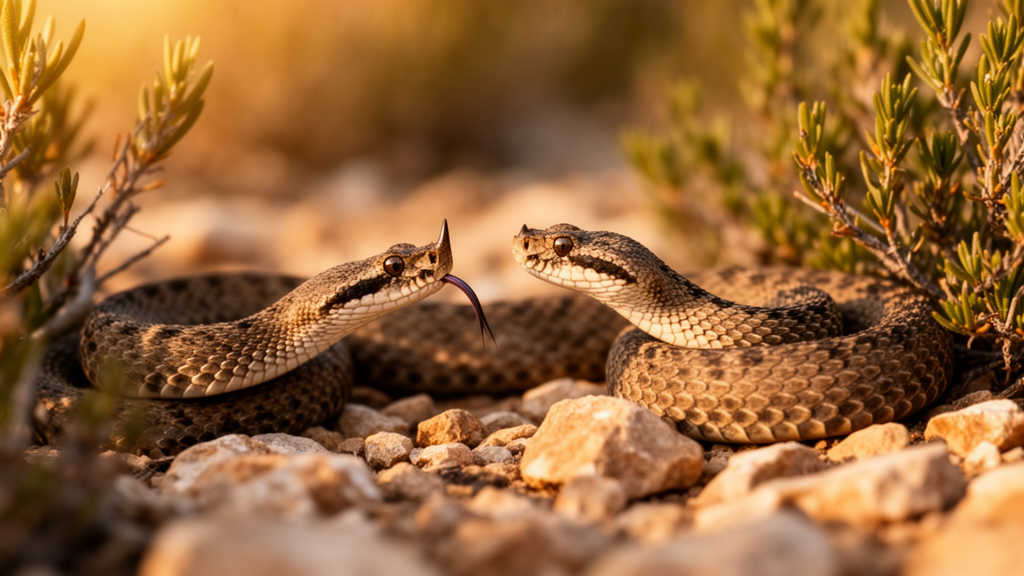
The nose-horned viper (Vipera ammodytes), one of Europe’s most distinctive venomous snakes, appears to rely on a surprisingly subtle chemical vocabulary when it comes to courtship. A new experimental study published in the journal Herpetozoa has tested whether two long-chained ketones abundant in the species’ skin lipids act as pheromones, and the results point to a sexually dimorphic communication system in which males, not females, are the active responders. The findings offer rare behavioral evidence for an Old World viper whose chemical ecology had been described but never functionally tested.
Snakes are famously dependent on chemical communication. With limited visual capabilities, most species use tongue-flicking to sample chemical cues for trailing conspecifics, locating hibernation sites, and finding mates during the breeding season. Decades of research on the red-sided garter snake (Thamnophis sirtalis parietalis) established that snake sex pheromones are typically complex mixtures of heavy, non-volatile, long-chained methyl ketones embedded in skin lipids. Yet this paradigm does not hold universally: the brown tree snake (Boiga irregularis), for example, lacks methyl ketones in female samples entirely, and several studies suggest airborne compounds may also participate in sexual signaling. Because chemical profiles alone cannot confirm pheromone function, behavioral assays are essential.
Previous chemical analyses of Vipera ammodytes skin extracts identified 2-pentacosanone (a C25 ketone) and 2-heptacosanone (a C27 ketone) as the two most frequently occurring heavy, long-chained methyl ketones in the species. Intriguingly, both males and females produce these compounds in similar concentrations, raising the question of what role they actually play. The new study, led by researchers working with a population near the village of Karlukovo in northwest Bulgaria, set out to determine whether these ketones elicit courtship-related behavior and whether responses differ between the sexes.
The team collected eight adult males and seven adult females in April 2022 and April 2023, keeping them in captivity for no more than two months before releasing them at their exact capture sites. The vipers were housed individually in terraria with controlled temperature gradients, fed every ten to fifteen days, and given a week to acclimate before testing began. All experiments ran from early May to the first ten days of June, coinciding with the species’ natural mating period. In total, the researchers conducted 270 behavioral assays: 144 with males and 126 with females.
Methodologically, the study broke with convention in several ways. Initial trials with Y-shaped mazes proved unproductive, as males displayed mainly exploratory behavior and females rarely moved at all. The vipers also became visibly stressed when moved to unfamiliar spaces, and they tended to remain still or defensive in the presence of humans. To minimize interference, the researchers abandoned the commonly used cotton swab test and direct observation. Instead, they placed paper towels soaked with test compounds directly into each viper’s home terrarium and recorded responses with a video camera positioned in front of the enclosure, with no human present in the room. Each towel was left for ten minutes, and each compound was tested three times per individual, with no more than four tests per day per animal.
The compounds tested included synthetic 2-pentacosanone, 2-heptacosanone, an equal-parts mixture of the two, the straight-chain alkane heptacosane (C27H56), the solvent n-hexane, and a blank control. Solid compounds were dissolved in 99% purity n-hexane at a concentration of 1 mg/ml, and between 0.20 and 0.25 ml of solution was dripped onto each towel. The researchers transcribed full ethograms from every video, counting tongue-flicks to calculate general tongue-flick rates (total flicks divided by experiment duration) and specific tongue-flick rates (total flicks divided by the time between first and last flick). They also recorded whether individuals showed directed interest in the towel for at least ten seconds and whether they performed chin-rubbing, a behavior typical of courting male vipers, for more than ten consecutive seconds.
Statistical analysis relied on Bayesian multivariate generalized linear mixed-effects models fitted in the R package brms, with sex and compound as predictors and individual identity as a random effect. Because many variables contained large proportions of zero values—interest in the compound was absent in 81.85% of tests, and chin-rubbing in 92.96%—the team compared standard, zero-inflated, and hurdle models using the Watanabe-Akaike information criterion and leave-one-out cross-validation. Hurdle gamma models best fit the tongue-flick rate data, while a zero-inflated Poisson model best captured chin-rubbing counts. On average, vipers took 291 seconds to make their first tongue-flick, underscoring how long recordings must run to capture meaningful behavior in these sedentary ambush predators.
The results revealed a clear sexual divide. Males showed significantly higher levels of interest in the ketones than females did, and chin-rubbing behavior was observed exclusively in males, with the most active individuals responding to the ketone treatments. In pairwise comparisons, male interest was significantly stronger toward the C25 ketone and the C27 ketone than toward the C27 alkane, and the ketone mixture elicited significantly more chin-rubbing than the alkane, the hexane solvent, or the control. When compounds were grouped, males responded significantly more to ketones than to alkanes for both interest and chin-rubbing. Females, by contrast, showed no significant differences in interest or chin-rubbing for any compound, though their tongue-flick rates were modestly elevated toward the C27 ketone and the ketone mixture relative to controls—patterns the authors interpret cautiously due to convergence issues and the overwhelming number of zero responses.
The authors conclude that 2-pentacosanone and 2-heptacosanone do indeed provoke sexual attraction in male nose-horned vipers and are likely involved in intraspecific communication, potentially contributing to the female sex pheromone. Notably, the combination of the two ketones proved more attractive than either compound alone, echoing findings from garter snake studies. However, the response was modest rather than overwhelming, leading the researchers to hypothesize that additional compounds—possibly volatile, airborne molecules of a different chemical nature—complete the pheromone blend. They also note that the absence of visual stimuli, such as an actual female, may have dampened male responses, since mating signals in snakes often integrate multiple sensory channels.
Perhaps the most provocative implication concerns why males produce the same ketones as females. In red-sided garter snakes, so-called she-males emit female-like pheromones to deceive rival males, gaining a mating advantage in the species’ chaotic mating balls. Nose-horned vipers, which engage in ritualized male-to-male combat rather than mating balls, might use a different strategy: males could deposit female-like ketones—heavy, non-volatile molecules well suited to substrate marking—to distract rivals or lure them into exhausting fights. Alternatively, the authors suggest that females lacking sufficient energy reserves for reproduction, which in European vipers reproduce only once every one to three years, may simply skip ketone production, rendering themselves unattractive to males. Both hypotheses await direct testing, as does the possibility that body condition and hormone levels modulate the behavioral responses observed here. What is already clear is that chemical communication in European vipers is more nuanced than a single compound can explain, and that the male nose-horned viper’s tongue holds answers still being uncovered.
Subject of Research: Behavioral responses of the nose-horned viper to long-chained ketones as candidate sex pheromone components
Article Title: Behavioral effects of long-chained ketones in Vipera ammodytes : an experimental approach
Article References: Andonov, K., Dyugmedzhiev, A., Lukanov, S., Vacheva, E., Popgeorgiev, G., Nedeltcheva-Antonova, D., & Naumov, B. (2025). Behavioral effects of long-chained ketones in Vipera ammodytes: an experimental approach. Herpetozoa, 38, 161-171. https://doi.org/10.3897/herpetozoa.38.e151358
Image Credits: AI Generated
DOI: 10.3897/herpetozoa.38.e151358
Keywords: Vipera ammodytes, pheromones, long-chained ketones, chemical communication, snake behavior, courtship, 2-pentacosanone, 2-heptacosanone, tongue-flicking, vipers, Bulgaria, chemical ecology
News Source: Drew Townsend. (October 18, 2026). Long-chained ketones trigger courtship behavior in male nose-horned vipers. Scienmag.