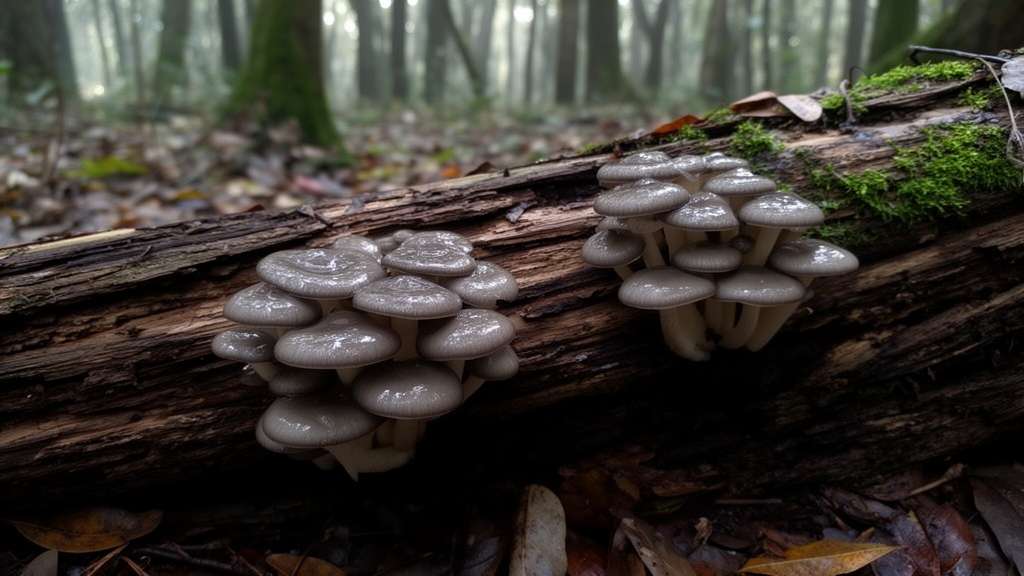
In the forests and gardens of Pakistan, a group of small, fan-shaped mushrooms has been quietly growing on decaying wood, largely unnoticed by science. A new study published in the Italian Botanist has now formally documented three species of the genus Hohenbuehelia in the country for the first time, combining classical microscopy with DNA-based phylogenetics to put the identifications beyond reasonable doubt. The findings, based on collections made between 2020 and 2023, expand the known fungal diversity of Pakistan and offer a rare molecular window into a genus that has historically been catalogued there on morphology alone.
Hohenbuehelia belongs to the family Pleurotaceae, the same family as the familiar oyster mushrooms, and is what mycologists call a pleurotoid genus: its fruiting bodies are laterally attached, shell-like or fan-shaped, and usually lack a well-developed stem. The genus is characterized by a spathulate, reniform, or flabelliform cap, typically with a gelatinous layer beneath the cap surface, decurrent gills radiating from the point of attachment, ellipsoid basidiospores, thick-walled metuloid pleurocystidia, and hyphae with clamp connections. Index Fungorum currently lists around 140 taxa under the genus, and many of its species are decomposers widely distributed in tropical and temperate regions, growing on decayed wood, dead branches, logs, and occasionally on the bark of living trees or herbaceous stems. Some species of the genus are also known to be nematode-trapping fungi, a remarkable ecological trait reflected in their anamorph genus Nematoctonus.
Before this study, only four Hohenbuehelia species had been recorded from Pakistan, and all of those identifications rested on morpho-anatomical grounds alone: H. atrocaerulea, H. petaloides, H. reniformis, and H. testudo. The research team, working from the Fungal Biology and Systematics Research Laboratory at the Institute of Botany, University of the Punjab, Lahore, conducted mycological surveys across three geographically diverse sites: Abbottabad in the northern part of Khyber Pakhtunkhwa, Lahore in Punjab, and Margalla Hills National Park near Islamabad. Abbottabad, at an elevation of 1,256 meters above sea level, is a rugged mountainous region with monsoon rainfall from July to September. Lahore, at just 217 meters, features a hot semi-arid climate whose monsoon humidity favors mushroom growth in lawns, gardens, and wastelands. Margalla Hills National Park, ranging from 450 to 1,580 meters, has a humid subtropical climate with roughly 940 millimeters of mean annual rainfall and two rainy seasons each year.
Fresh specimens were photographed in their natural habitat, dried at 40 to 50 degrees Celsius using a fan heater, and carried to the laboratory for analysis before deposition at the LAH Herbarium. Colors were referred to Munsell Soil Color Charts, and terminologies followed Vellinga. For microscopic characterization, dried specimens were free-hand sectioned, mounted in 5 percent KOH, stained with Congo red, and observed under a compound microscope at 40x and 100x magnification. At least 30 to 40 measurements of each feature, including the shape, color, and size of basidiospores, basidia, cystidia, and hyphae of the stipe and pileus covering, were taken using Scope Image 9.0 software.
The molecular work followed a standard fungal barcoding pipeline. DNA was extracted from dried material using the CTAB method, and the internal transcribed spacer (ITS) region of nuclear ribosomal DNA was amplified with the ITS1F and ITS4 primer pairs. PCR products were sequenced and the newly generated sequences deposited in GenBank under accession numbers PP594062, PP594063, PP594061, and PP702161. Sequences were aligned with the MUSCLE alignment tool and trimmed in BioEdit, then subjected to Maximum Likelihood analysis via RAxML-HPC2 on the CIPRES Science Gateway Portal, with 1,000 bootstrap repetitions as statistical support and significant support considered at 50 percent or above. The phylogram was rooted with Pleurotus ostreatus as the outgroup.
The final ITS dataset consisted of 70 DNA sequences of Hohenbuehelia, with the alignment composed of 707 characters: 408 conserved, 287 variable, and 221 parsimony-informative. All newly generated sequences grouped within the genus Hohenbuehelia. Sequences of H. canadensis and H. portegna clustered with their respective GenBank sequences with strong bootstrap support, and the third Pakistani species, H. tristis, clustered with sequences of the same species retrieved from GenBank, also with a strong bootstrap value. The three species represent new records for Pakistan, and the study also provides a key to the known species of the genus in the country.
The first new record, Hohenbuehelia canadensis, was collected from Mushkpuri top in Abbottabad district at 1,300 meters, growing solitarily on a fallen log of Abies pindrow, the West Himalayan silver fir. Its fruiting bodies are small, less than 2 centimeters broad, fan-shaped with an undulating, incurved margin, cream to light brown or camel brown from the center and becoming dark to grayish brown toward the margins. The basidiospores measure 6.4 to 11 by 3.2 to 5.8 micrometers, hyaline, inamyloid, and smooth. The Pakistani collections agree phylogenetically and morpho-anatomically with specimens originally described from Canada, though the type specimen has slightly smaller basidiospores, a difference the authors attribute to the type description being based on a herbarium specimen and possibly on developmental stage.
The second record, Hohenbuehelia portegna, turned up in an unexpectedly urban setting: gregarious on a decaying wooden door at the Quaid-e-Azam Campus of the University of the Punjab in Lahore. Its cap is laterally attached, 1 to 2 centimeters wide, highly striate, brown when young and brownish yellow when mature, with very crowded, narrow, white to creamy white gills and a strongly reduced lateral pseudo-stipe that disappears at maturity. The pleurocystidia are metuloid, fusiform, and lanceolate, with an apex covered by a layer of crystals, and are brownish in 5 percent KOH. The Pakistani specimen matched the macro- and micro-morphological features described for H. portegna from Brazil and Mexico, with the Brazilian and Mexican collections differing only in slightly different cap sizes and larger basidiospores.
The third record, Hohenbuehelia tristis, was found in Margalla Hills National Park on Trail 5 at 1,580 meters, growing gregariously to imbricate on small dead fallen branches. Its cap is dimidiate to flabelliform and spathulate, light grey to whitish toward the margins, shiny and slightly translucent, with a sparsely pubescent surface. The species was originally described from New Zealand and has also been reported from Thailand. The Pakistani and New Zealand collections share a flabelliform pileus, creamy-white decurrent lamellae, and thick-walled metuloid pleurocystidia encrusted with crystals, while the New Zealand material differs in having a buff to sordid colored pileus and larger metuloid cystidia. Both micro-morphologically and phylogenetically, the Pakistani collection agreed with the Thai collection of H. tristis, which differs mainly by its larger yellowish-white basidiomata and slightly larger basidiospores. These differences might be due to different developmental stages and environmental factors.
The study expands the known fungal diversity of Pakistan by documenting three species of Hohenbuehelia for the first time from different geographical regions of the country, and it does so through a combination of molecular phylogenetic analysis and morpho-anatomical characterization. With the new records, seven Hohenbuehelia species are now known from Pakistan, and the authors provide an identification key that distinguishes them by cap size, color, basidiomata shape, basidiospore dimensions, and cystidial form. The work underscores how much fungal diversity remains to be uncovered in Pakistan, a country whose monsoon-drenched forests and gardens continue to yield species never before recorded within its borders, and it demonstrates that pairing ITS barcoding with careful microscopy remains the most reliable way to put names on them.
Subject of Research: Three new records of genus Hohenbuehelia (Pleurotaceae, Agaricales) in Pakistan
Article Title: Three new records of genus Hohenbuehelia ( Pleurotaceae , Agaricales ) in Pakistan
Article References: Khalid, M., Razzaq, F., Ashraf, U., Afshaan, N.-U.-S., & Khalid, A. N. (2024). Three new records of genus Hohenbuehelia (Pleurotaceae, Agaricales) in Pakistan. Italian Botanist, 18, 179-191. https://doi.org/10.3897/italianbotanist.18.131137
Image Credits: AI Generated
DOI: 10.3897/italianbotanist.18.131137
Keywords: Three, records, genus, Hohenbuehelia, Pleurotaceae, Agaricales, Pakistan, scientific research
News Source: Roger Howard. (October 18, 2026). Three Hohenbuehelia mushroom species recorded in Pakistan for the first time. Scienmag.