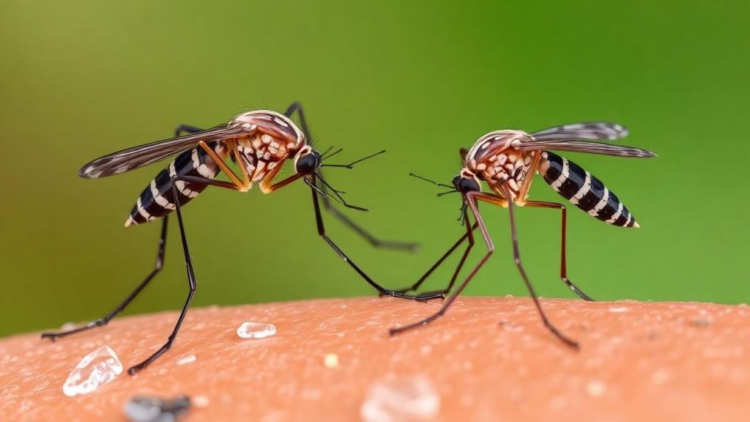
Malaria in the Republic of Korea is transmitted primarily by mosquitoes of the Anopheles Hyrcanus Group, a collection of closely related species that are notoriously difficult to tell apart. Among them, Anopheles sinensis and Anopheles kleini occupy a particularly intriguing evolutionary position: they are considered to be at an incipient stage of speciation, meaning they were once a single lineage and are only now diverging into separate species. A new study published in Parasites & Vectors by Jiseung Jeon of Kyungpook National University and colleagues provides fresh evidence that the genetic boundary between these two vectors is far from impermeable. Using a purpose-built molecular marker and a panel of microsatellite loci, the researchers detected signals consistent with hybridization and gene flow between the two species in populations living near the demilitarized zone that divides the Korean Peninsula. The finding carries practical weight, because genes that confer resistance to insecticides could, in principle, move across species boundaries and undermine control strategies that assume each species can be managed independently.
The research team focused their sampling on a region where the two species coexist. Mosquitoes were collected at United States military installations and training sites in northern Gyeonggi and Gangwon provinces, close to the demilitarized zone separating the Republic of Korea from the Democratic People’s Republic of Korea. In this sympatric zone, both An. sinensis and An. kleini breed in overlapping habitats, creating natural opportunities for interspecific mating. To provide a comparison, the team also collected mosquitoes from allopatric sites where only one species occurs: Humphreys US Army Garrison in Pyeongtaek city and a cattle shed near Daegu city, both of which yielded only An. sinensis. This design allowed the investigators to ask a deceptively simple question with profound implications: when two young species share the same landscape, do they truly keep their genomes separate, or do they exchange genetic material?
Answering that question required a reliable way to distinguish the two species, which is no trivial matter in the Anopheles Hyrcanus Group. Traditional identification has often relied on ribosomal DNA markers and morphological characters, but these tools can fail precisely where they matter most, in hybrids whose inherited markers may come from either parental species. Jeon and colleagues therefore developed a species-specific molecular marker based on the resistance to dieldrin gene, known as rdl. This gene encodes a subunit of a gamma-aminobutyric acid-gated chloride channel in the insect nervous system, and a well-characterized point mutation at position 296, producing the so-called 296S substitution, is known to confer resistance to the cyclodiene insecticide dieldrin. Because the marker is anchored in a functional gene tied to insecticide response, it offered the researchers a dual advantage: a species diagnostic and a window into the movement of resistance-associated variation.
When the team applied the rdl-based marker to their field collections, the results pointed toward gene flow between the two species. The analysis suggested potential genetic exchange that may correlate with the presence of the rdl 296S mutation in both An. sinensis and An. kleini. In other words, the same resistance-associated variant appears in both species, and the pattern is consistent with the possibility that the mutation, or the chromosomal region surrounding it, has moved between lineages through introgressive hybridization rather than arising independently in each. The authors are careful to note that this is a correlation drawn from a targeted marker, not a demonstration of the mutation’s historical path, but the implication for public health is clear: if resistance alleles can traverse species boundaries, then insecticide pressure applied to one vector species may inadvertently select for resistance in the other.
To probe population structure more broadly, the researchers turned to microsatellite markers, short tandemly repeated DNA sequences that are highly polymorphic and widely used to infer genetic relationships among populations. Microsatellite analyses demonstrated that An. sinensis and An. kleini form distinct genetic clusters with marked differentiation, confirming that the two species are genuinely separate evolutionary entities rather than a single panmictic population. Yet within that overall separation, the data also displayed signals consistent with hybridization and backcrossing, the process by which hybrids mate with individuals of one parental species and gradually dilute the foreign genome while retaining selected segments. This combination, clear species-level structure alongside evidence of admixture, is exactly the signature expected when reproductive isolation is incomplete and gene flow continues at low but meaningful levels.
The authors are appropriately cautious in interpreting these signals. With a targeted marker set, in this case the rdl locus and a panel of microsatellites, it is not possible to completely exclude alternative explanations, most notably shared ancestral variation or incomplete lineage sorting. Incomplete lineage sorting occurs when two recently diverged species fail to sort ancestral genetic variants into separate lineages, so that some alleles are more similar between species than within them, mimicking the footprint of hybridization. Given that An. sinensis and An. kleini are at an incipient stage of speciation, this confounding possibility is real. Disentangling recent gene flow from retained ancestral polymorphism requires genome-wide data, and the study’s conclusions explicitly call for such work as a necessary next step.
Even with those caveats, the broader conclusion stands: the genetic boundary between these two malaria vectors appears to be permeable and complex, likely shaped by a combination of incomplete reproductive isolation, ongoing gene flow, or retained ancestral polymorphisms. This picture fits a growing body of evidence from vector biology showing that species barriers in mosquitoes are often leaky. Well-known examples from other regions include the M and S molecular forms of Anopheles gambiae in Africa and various members of species complexes in Southeast Asia, where introgression has been implicated in the spread of traits relevant to transmission and control. The Korean system now adds another case in which speciation is underway but not yet complete, with consequences that reach directly into the clinic and the field.
Why does this matter for malaria control in the Republic of Korea? Vector interventions, whether insecticide-treated materials, indoor residual spraying, or larval source management, all impose strong anthropogenic selection pressures on mosquito populations. Vectors can respond to these pressures through standing genetic variation, de novo mutation, and gene introgression, and the speed of adaptation depends in part on how much relevant variation is available across the population. If An. sinensis and An. kleini exchange genes, then adaptive alleles arising or increasing in one species can seed the other, effectively doubling the genetic reservoir available for resistance evolution. A control program that monitors only one species, or that assumes species-specific resistance dynamics, could be blindsided by resistance emerging in its sister taxon and then flowing across the boundary. Accurate species identification, ideally with markers that remain diagnostic in hybrids, becomes a prerequisite for meaningful surveillance.
The geography of the study adds another layer of significance. Northern Gyeonggi and Gangwon provinces, near the demilitarized zone, are among the most active malaria transmission areas in the Republic of Korea, and the region’s restricted access has historically complicated entomological monitoring. The collaboration between Korean academic institutions and United States military medical units, including the 65th Medical Brigade, enabled sampling at installations and training sites that would otherwise be difficult to survey, and the work was supported in part by the Armed Forces Health Surveillance Division’s Global Emerging Infections Surveillance program. Because the demilitarized zone and adjacent areas host dense seasonal populations of Anopheles mosquitoes each year, understanding the genetic architecture of the vectors there is directly relevant to the national malaria elimination strategy and to the health of both civilian and military populations.
The study’s limitations also chart the road ahead. The rdl marker and microsatellites provide a targeted view of the genome, and the authors emphasize that continuous surveillance and genome-wide studies are required to disentangle the evolutionary processes at play. Whole-genome sequencing of sympatric and allopatric populations, combined with analyses of linkage disequilibrium and admixture tract lengths, could distinguish recent hybridization from ancient shared polymorphism and identify which functional genes, if any, are moving between species. Such work would also clarify whether the rdl 296S mutation, a relic of dieldrin use decades ago, is simply drifting in both lineages or is being maintained and transferred by contemporary gene flow. Until those data are available, the prudent reading of this study is that Korea’s malaria vectors should be treated as an interconnected genetic system rather than as two independent targets, and that monitoring programs should watch both species, and their hybrids, for signs of emerging insecticide resistance.
Subject of Research: Hybridization and gene flow between the malaria vector mosquitoes Anopheles sinensis and Anopheles kleini in the Republic of Korea
Article Title: Hybridization and gene flow between two malaria vectors, Anopheles sinensis and Anopheles kleini: a potential challenge to malaria control strategies in the Republic of Korea
Article References: Jeon, J., Kim, H. C., Klein, T. A., Hyun, S., Lee, K., & Choi, K. S. (2026). Hybridization and gene flow between two malaria vectors, Anopheles sinensis and Anopheles kleini: a potential challenge to malaria control strategies in the Republic of Korea. Parasites & Vectors. https://doi.org/10.1186/s13071-026-07707-4
Image Credits: AI Generated
DOI: 10.1186/s13071-026-07707-4
Keywords: Anopheles sinensis, Anopheles kleini, malaria, hybridization, gene flow, introgression, insecticide resistance, rdl gene, microsatellites, Republic of Korea, vector control, speciation
Cite Scienmag News
APA MLA Chicago
Juliet Wilcox. (October 3, 2026). Two Malaria Mosquitoes Are Swapping Genes, Complicating Korea’s Control Efforts. Scienmag. https://scienmag.com/two-malaria-mosquitoes-are-swapping-genes-complicating-koreas-control-efforts/
Juliet Wilcox. “Two Malaria Mosquitoes Are Swapping Genes, Complicating Korea’s Control Efforts.” Scienmag, 3 October 2026, https://scienmag.com/two-malaria-mosquitoes-are-swapping-genes-complicating-koreas-control-efforts/. Accessed 3 October 2026.
Juliet Wilcox. “Two Malaria Mosquitoes Are Swapping Genes, Complicating Korea’s Control Efforts.” Scienmag. October 3, 2026. https://scienmag.com/two-malaria-mosquitoes-are-swapping-genes-complicating-koreas-control-efforts/
Copy citation Download RIS
Tags: Anopheles kleiniAnopheles sinensisAnopheles sinensis and Anopheles kleini gene flowchallenges in malaria vector control strategiesevolution of malaria vectors in East Asiagene flowhybridizationhybridization impact on malaria transmissionimplications for malaria prevention andinsecticide resistanceinsecticide resistance gene transfer in malaria vectorsinsecticide resistance spread among Anopheles speciesintrogressionmalariaMalaria mosquito hybridizationmicrosatellitesmolecular markers in mosquito species identificationmolecular studies on mosquito hybrid zonesmosquito population genetics in Korean Demilitarized Zonemosquito speciation and hybridization in Koreardl geneRepublic of Koreaspeciationvector control