Credit: Photo by L. Brian Stauffer
CHAMPAIGN, Ill. — Two brain-signaling molecules control how anemonefish dads care for their young and respond to nest intruders, researchers report in a new study. Because there are many similarities in brain structure between fish and humans, the findings offer insight into the fundamental nature of parental care, the scientists say.
“One of the benefits of studying fish is that their behaviors are simpler,” said Ross DeAngelis, a former graduate student who conducted the work in the laboratory of Justin Rhodes, a professor of psychology at the University of Illinois at Urbana-Champaign. “By exploring these systems, we can understand the broader implications on vertebrate behavior.”
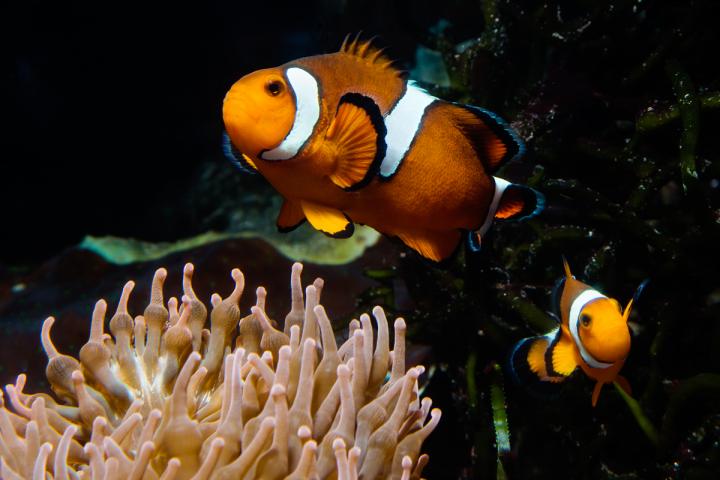
Anemonefish live in pairs on sea anemones in the wild. Female anemonefish are more aggressive than their mates and help protect the nest from intruders. Fathers have a more nurturing role. See video.
“Male anemonefish are spectacular fathers,” said Rhodes, who led the research. “They nourish the eggs by fanning them to provide oxygen and clear debris, and they nip at the eggs to clean them. When a predator is around, they switch their behavior to become aggressive – they try to bite and fight the predators away.”
Previous research focused on only one facet of parental care: either nourishment or defense. The new study aims to understand both aspects together in the presence of intruders.
Two hormones play a role in guiding the trade-off between caring for one’s offspring and defending them. Arginine vasotocin increases aggression, while isotocin boosts egg care. Their effects on parental behavior in the presence of intruders was previously unknown.
The researchers used inhibitory compounds, known as antagonists, to block the binding of arginine vasotocin or isotocin to their receptors in the brain. They injected these compounds into the abdomens of the fish. From there, the antagonists were carried to the brain through the blood.
“Blocking arginine vasotocin reduced aggression and increased parental care in male anemonefish,” DeAngelis said. “This is an unusual result because they are such good dads – we didn’t think it was possible for them to be even better.”
Blocking isotocin had the opposite effect. It increased aggression, and the fish spent less time nipping and fanning their eggs, DeAngelis said.
“The results are similar to what we see in humans,” Rhodes said. “Oxytocin, which is the human version of isotocin, is known to be important for nurturing. Arginine vasopressin, which is the human version of arginine vasotocin, plays a role in social and affiliative behavior in the slightly different context of mating.”
The two hormones have very similar structures and bind to similar receptors in the brain, so the researchers cannot be certain that the antagonist for one isn’t also affecting the other. They also have not yet determined how the hormones specifically modify brain-signaling.
“Individuals across the animal kingdom have to make decisions on how to maximize their fitness, and most of those decisions are based on environmental context,” DeAngelis said. “It is interesting to see that the neurochemical pathways can be modulated by the current social context.”
###
Rhodes is an affiliate of the Beckman Institute for Advanced Science and Technology at the U. of I. The researchers reported their findings in the journal Hormones and Behavior.
Editor’s notes:
To reach Justin Rhodes, email [email protected].
The paper “Nonapeptides mediate trade-offs in parental care strategy” is available online and from the U. of I. News Bureau. [LINK to email
DOI: https:/
Media Contact
Ananya Sen, Science Writer, Univ. of Illinois News Bureau
[email protected]
217-333-5802
Original Source
https:/
Related Journal Article
http://dx.