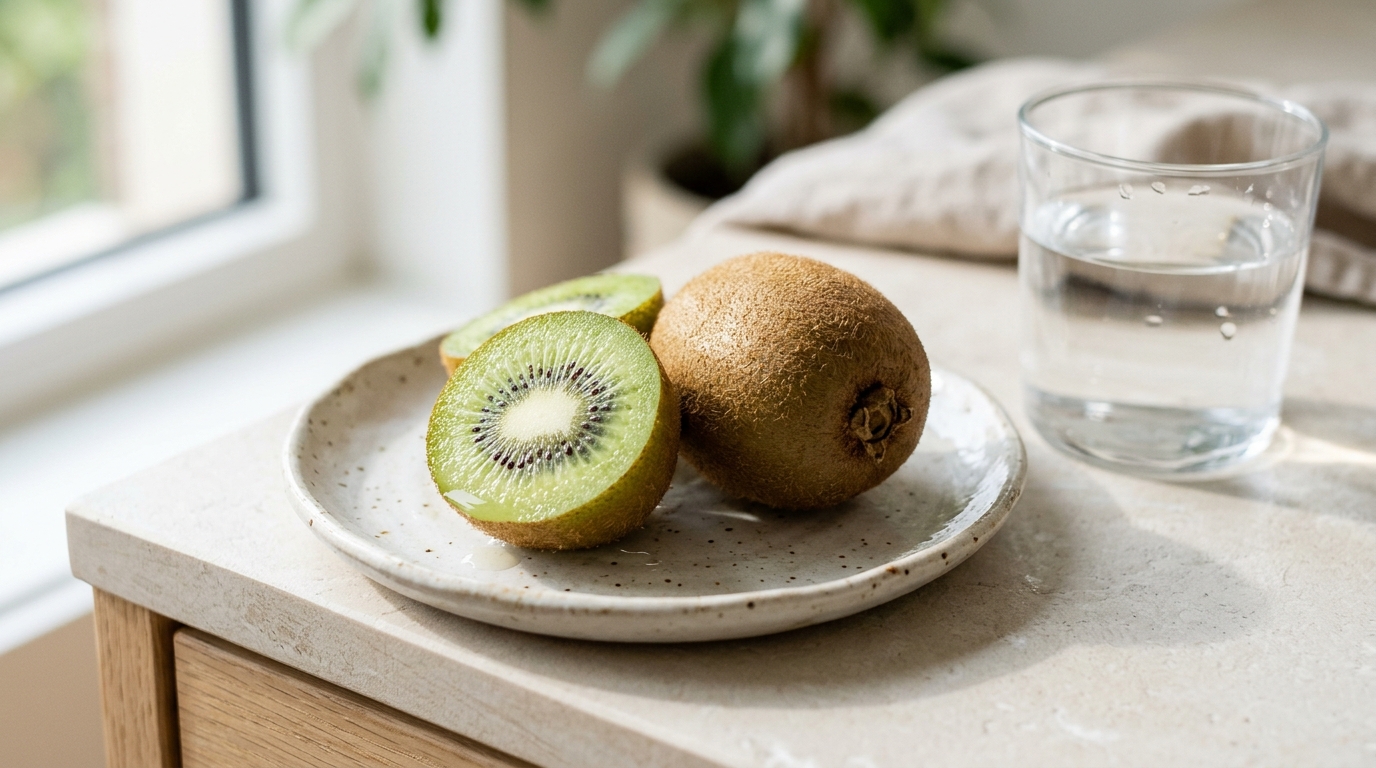
Two fresh green kiwifruits eaten daily for about four weeks have emerged as the best-supported whole-food option for relieving constipation, according to a narrative review published on 4 November 2026 in the open-access journal Food, Nutrition and Health. The review, written by Yohei Okawa, pulled together 33 publications spanning January 1984 to June 2026, drawn from an initial pool of 612 records screened in PubMed and Web of Science. Its central conclusion is strikingly simple: for adults with functional constipation, constipation-predominant irritable bowel syndrome, or chronic constipation, the humble green kiwifruit delivered measurable, patient-centred benefits with generally favourable tolerability.
The strongest clinical signal comes from an international multicentre randomised crossover trial that focused on two constipated groups. In adults with functional constipation, complete spontaneous bowel movements rose by 1.53 per week, while in those with constipation-predominant irritable bowel syndrome the increase was 1.73 per week. Gastrointestinal comfort improved significantly in both groups, and healthy controls served as a reference. An increase of at least one complete spontaneous bowel movement per week is commonly considered clinically meaningful when it is accompanied by improved stool form, less straining, reduced bloating, or better treatment satisfaction, which places these results squarely in the range that matters to patients rather than merely to statisticians.
Supporting evidence comes from two further trials highlighted in the review. In a United States comparative-effectiveness study, green kiwifruit, psyllium, and prunes all improved chronic constipation outcomes, but kiwifruit did not show universal superiority. What distinguished it was its side-effect profile: fewer adverse events, lower dissatisfaction, and favourable acceptability. A New Zealand crossover trial found that two gold kiwifruits and fibre-matched psyllium both improved constipation-related outcomes, with the gold fruit reducing straining and causing fewer intervention-related adverse events. Earlier work had already suggested improved laxation in healthy older adults and in adults with functional constipation, and a controlled trial in adults with irritable bowel syndrome with constipation reported shortened colonic transit time and increased defecation frequency after four weeks of kiwifruit intake.
Why should a fruit outperform expectations? The answer lies in its unusual combination of mechanisms. Green kiwifruit, most commonly the Actinidia deliciosa cultivar Hayward, is not a single-ingredient supplement but a whole-food matrix. Its cell wall polysaccharides contribute bulking capacity, mechanically stimulating the bowel and increasing stool mass. Its pectic polysaccharides act as gel-forming fibres that retain water and help normalise stool consistency. Its oligosaccharides and polyphenol-associated substrates may support microbial fermentation, while the fruit’s intrinsic water and sorbitol may further support stool hydration. Contemporary fibre terminology classifies fibres as bulking, gel-forming, or fermentable, a framework the review argues is more clinically meaningful than the outdated soluble-versus-insoluble dichotomy, because fibres with similar solubilities can have very different effects on stool water, viscosity, gas, and bloating.
Some of these mechanisms rest on more than theory. Magnetic resonance imaging evidence has shown increased intestinal water and colonic volume after kiwifruit consumption, consistent with the fruit’s water-retaining and bulking properties. The review is careful, however, to distinguish plausibility from proof: preclinical findings from in vitro and animal studies, together with short-term human physiology and imaging work, can support biological plausibility but cannot, in isolation, establish clinical benefit in humans. That caution extends to actinidin, the cysteine protease abundant in green Hayward kiwifruit and less active in some gold cultivars. In vitro and animal studies suggest actinidin can enhance the digestion of selected proteins and influence gastric emptying kinetics, and human data indicate it affects the rate of amino acid appearance rather than total absorption after highly digestible protein meals. In the constipation context, the review concludes, actinidin is best interpreted as a supportive feature of the fruit matrix, not the primary or sole laxation mechanism.
Cultivar specificity is a recurring theme. Green kiwifruit is most often represented by the Hayward cultivar, whereas gold kiwifruit trials have commonly used products from Actinidia chinensis var. chinensis. The vitamin C concentration, sweetness, acidity, actinidin activity, and phytochemical profile can differ by cultivar, ripeness, storage, and processing methods. In general, kiwifruit provides dietary fibre, vitamin C, potassium, folate, vitamin E, polyphenols, and organic acids, along with a high water content, but the review insists that claims specify the variety, dose, form, and population studied. Powders, extracts, and gold cultivars have promising but smaller evidence bases and should not be assumed to be clinically equivalent to fresh green fruit.
The review also situates kiwifruit against established dietary strategies. Psyllium, derived from Plantago ovata, is a viscous gel-forming fibre with the clearest role in functional and chronic constipation; the British Dietetic Association recommends at least 10 grams per day, started low and increased gradually with additional fluid, and evidence supports improvements in stool frequency and consistency and reductions in straining, although bloating or distension can limit tolerability in some patients, including those with irritable bowel syndrome with constipation. Prunes supply fibre, sorbitol, and polyphenols; trials have used 100 grams per day, and current guidance suggests roughly 8 to 10 prunes daily for chronic constipation, but their sorbitol and fructan content may aggravate bloating or pain in some patients. A low-FODMAP diet has evidence for reducing global symptoms, abdominal pain, and bloating in irritable bowel syndrome, but it is not an evidence-based treatment for stool frequency or functional constipation itself and should be delivered through structured restriction, reintroduction, and personalisation, ideally with dietetic support, rather than as a broad long-term exclusion diet.
Against this backdrop, kiwifruit’s appeal is practical as much as pharmacological. It adds a palatable, nutrient-dense whole food rather than requiring restriction of multiple food groups or the daily use of a fibre powder, and in comparative trials its improvement in constipation outcomes was broadly similar to that achieved with psyllium or prunes while acceptability and tolerability were favourable for some patients. The review frames it as a low-burden, evidence-based dietary option within individualised constipation care, not a universal substitute for laxatives or dietitian-led irritable bowel syndrome management. Adults with functional constipation or constipation-predominant irritable bowel syndrome who tolerate the fruit may undertake a four-week trial of two fresh green kiwifruits daily while monitoring complete spontaneous bowel movements, stool form, straining, abdominal pain or discomfort, and adverse effects.
The evidence base is not without limits, and the review enumerates them candidly. It is narrative rather than systematic, so it provides no pooled effect estimates or formal risk-of-bias grading, and the included studies vary in population, comparator, cultivar, intervention form, dose, duration, and outcome measures. Several mechanisms rest mainly on in vitro, animal, or short-term human physiology studies. Practical constraints include kiwifruit allergy or oral allergy syndrome, cost, availability, patient preference, renal potassium restrictions in selected patients, and uncertain adherence beyond the four-week periods studied. Patients with alarm symptoms, pelvic floor dysfunction, prominent or worsening pain, food-triggered hypersensitivity, renal disease requiring potassium restriction, or an inadequate response should receive broader medical and dietetic assessment rather than relying on kiwifruit alone.
The remaining research gaps point toward more precise medicine. Future pragmatic trials, the review argues, should compare green and gold cultivars directly, test longer intervention periods, evaluate real-world adherence and cost, and report clinically interpretable outcomes such as complete spontaneous bowel movement responder rates, stool form normalisation, abdominal pain, bloating, patient global assessment, quality of life, and adverse events. A further gap concerns phenotype-specific responses: patients with functional constipation may respond differently from those with constipation-predominant irritable bowel syndrome, slow-transit constipation, pelvic floor dyssynergia, prominent bloating, or food-triggered visceral hypersensitivity. Stratifying future studies by baseline transit, stool form, symptom profile, microbiota features, dietary pattern, and concomitant laxative use would help determine whether kiwifruit works best as first-line dietary advice, an adjunct to fibre or osmotic agents, or a low-burden maintenance strategy after symptoms improve. Until then, the review’s message is measured: a fruit that is pleasant to eat, widely available, and supported by randomised trial data deserves a place in the conversation between clinician and patient, alongside rather than instead of the treatments that already exist.
Subject of Research: Clinical evidence and mechanisms for kiwifruit as a dietary intervention for constipation and gastrointestinal comfort
Article Title: Kiwifruit for constipation and gastrointestinal comfort: mechanisms, clinical evidence, and remaining research gaps
Article References: Okawa, Y. (2026). Kiwifruit for constipation and gastrointestinal comfort: mechanisms, clinical evidence, and remaining research gaps. Food, Nutrition and Health, 3(1), Article 42. https://doi.org/10.1007/s44403-026-00088-7
Image Credits: AI Generated
DOI: 10.1007/s44403-026-00088-7
Keywords: kiwifruit, constipation, functional constipation, IBS-C, dietary fibre, actinidin, psyllium, prunes, low-FODMAP diet, gastrointestinal comfort, gut microbiota, clinical trial
News Source: Ophelia Keating. (November 5, 2026). Two Green Kiwifruits a Day Eased Constipation in Clinical Trials. Scienmag.