• HOME
  • NEWS
  • EXPLORE
    • CAREER
      • Companies
      • Jobs
    • EVENTS
    • iGEM
      • News
      • Team
    • PHOTOS
    • VIDEO
    • WIKI
  • BLOG
  • COMMUNITY
    • FACEBOOK
    • INSTAGRAM
    • TWITTER
Friday, May 15, 2026
BIOENGINEER.ORG
No Result
View All Result
  • Login
  • HOME
  • NEWS
  • EXPLORE
    • CAREER
      • Companies
      • Jobs
        • Lecturer
        • PhD Studentship
        • Postdoc
        • Research Assistant
    • EVENTS
    • iGEM
      • News
      • Team
    • PHOTOS
    • VIDEO
    • WIKI
  • BLOG
  • COMMUNITY
    • FACEBOOK
    • INSTAGRAM
    • TWITTER
  • HOME
  • NEWS
  • EXPLORE
    • CAREER
      • Companies
      • Jobs
        • Lecturer
        • PhD Studentship
        • Postdoc
        • Research Assistant
    • EVENTS
    • iGEM
      • News
      • Team
    • PHOTOS
    • VIDEO
    • WIKI
  • BLOG
  • COMMUNITY
    • FACEBOOK
    • INSTAGRAM
    • TWITTER
No Result
View All Result
Bioengineer.org
No Result
View All Result
Home NEWS Science News Health

Two grants will fund research into neurotechnology, drug delivery system

Bioengineer by Bioengineer
February 21, 2020
in Health
Reading Time: 3 mins read
0
IMAGE
Share on FacebookShare on TwitterShare on LinkedinShare on RedditShare on Telegram

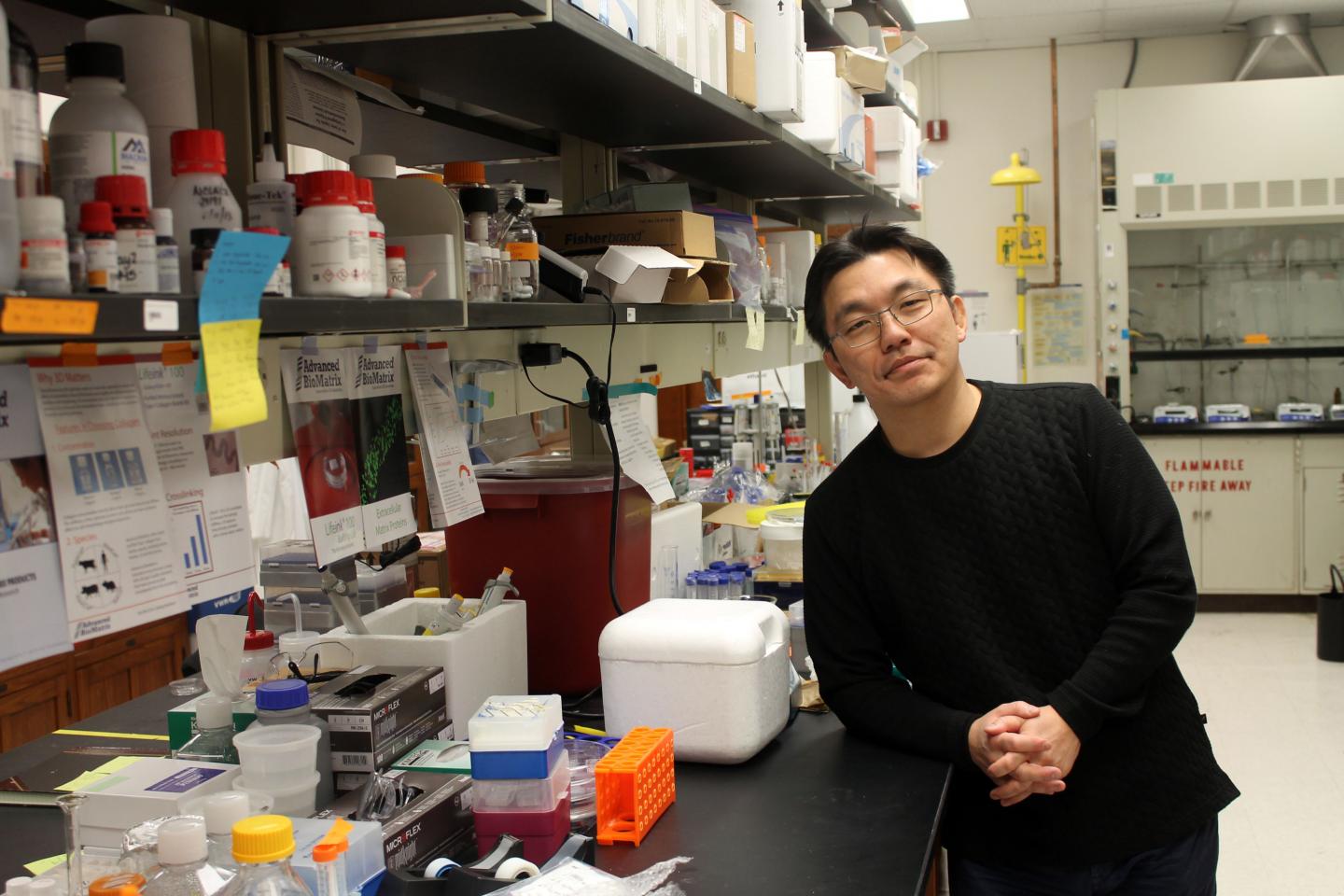
Two grants will fund interdisciplinary research, including a look at how neurons and muscle cells communicate with each other and also to develop a drug delivery system for treatment of Alzheimer’s disease.
IMAGE

Credit: Christine des Garennes, Department of Chemical and Biomolecular Engineering, University of Illinois


Two grants will fund interdisciplinary research at the Beckman Institute for Advanced Science and Technology, including a look at how neurons and muscle cells communicate with each other and also to develop a drug delivery system for treatment of Alzheimer’s
disease.

The grant from the National Science Foundation will facilitate the study of how neurons and muscle cells communicate with each other. “My group is interested in engineering functional muscle and using it to assemble autonomous bioactuator systems,”
said Hyunjoon Kong, a Robert W. Schafer professor of chemical and biomolecular engineering.

“The muscle engineered in vitro is not the same as the muscles in our body because the system does not have any innervating motor neurons. This project is to understand how we can facilitate the innervation of the neurons into the muscle,”
Kong said.

Kong’s lab will collaborate with Gabriel Popescu, a professor of electrical and computer engineering, and Martha Gillette, a professor of cell and developmental biology. All are affiliated with the Beckman Institute.

In addition to studying how the neurons and muscle cells communicate, the Kong group will also look at the interaction between neurons and glial cells, which influence neuronal activity. “Although glial cells are not well characterized, they are
known to provide certain signals that make the neurons transmit their electrical signals,” Kong said.

“I will be working with Martha Gillette’s group, who are experts in neurobiology and can guide us in what type of neural cells to look at,” Kong said. “Popescu group members are experts at imaging intracellular events and we want
to use their imaging techniques to demonstrate the interaction between the neurons and the muscle cells.”

Members of the Kong group hope that the study will enable them to understand how neurons can be reactivated in injured muscle, which can help improve the treatment of various neuromuscular disorders and acute muscle injuries.

The second grant, from the Alzheimer’s Foundation, will fund research by the Kong group in collaboration with Hee Jung Chung, an associate professor of molecular and integrative physiology and Beckman Institute faculty member.

The grant will study how a drug that has the potential to treat Alzheimer’s disease can be delivered into the body. The drug was developed to target tau proteins that, along with β-amyloid proteins, cause the disease. “Historically, researchers
have been focused on treatments that reduce the β-amyloid proteins. However, a large group of patients do not respond to those treatments because the tau proteins are also responsible,” Kong said.

The Kong group hopes to join the research effort that is now focusing on synthesizing nano-sized drug carriers that can target the tau protein. “The drug that targets tau proteins cannot be currently used because it is hydrophobic and therefore
cannot dissolve in water,” Kong said. “As a result, you cannot deliver it orally or through injection.” The group will try to solve the problem by encapsulating the drug in a nanoparticle system that can be used to target the diseased
regions of the brain.

Media Contact
Doris Dahl
[email protected]
217-333-2895

Original Source

https://beckman.illinois.edu/about/news/article/2020/01/29/two-new-grants-awarded-to-neurotechnology-for-memory-and-cognition-center-at-beckman

Tags: AgingAlzheimerBiologyBiomedical/Environmental/Chemical EngineeringCell BiologyMedicine/Healthneurobiology
Share12Tweet8Share2ShareShareShare2

Related Posts

Paraprobiotics Mitigate BPA-Induced Damage to Male Fertility Linked to Plastic Exposure — Medicine

Paraprobiotics Mitigate BPA-Induced Damage to Male Fertility Linked to Plastic Exposure

May 15, 2026

Digital Health Fear Patterns in Older Cancer Patients

May 15, 2026

A*STAR Scientists Unveil Novel Technique to Decipher RNA Structure’s Impact on Health and Disease

May 15, 2026

Comprehensive Study Finds No Clear Association Between Common Antidepressant Use During Pregnancy and Autism or ADHD in Children

May 15, 2026
Please login to join discussion

POPULAR NEWS

  • Research Indicates Potential Connection Between Prenatal Medication Exposure and Elevated Autism Risk

    843 shares
    Share 337 Tweet 211
  • New Study Reveals Plants Can Detect the Sound of Rain

    729 shares
    Share 291 Tweet 182
  • Salmonella Haem Blocks Macrophages, Boosts Infection

    62 shares
    Share 25 Tweet 16
  • Breastmilk Balances E. coli and Beneficial Bacteria in Infant Gut Microbiomes

    58 shares
    Share 23 Tweet 15

About

We bring you the latest biotechnology news from best research centers and universities around the world. Check our website.

Follow us

Recent News

Scientists Create Ceramic Implants That Replicate Natural Bone Through 3D Printing

Paraprobiotics Mitigate BPA-Induced Damage to Male Fertility Linked to Plastic Exposure

Digital Health Fear Patterns in Older Cancer Patients

Subscribe to Blog via Email

Enter your email address to subscribe to this blog and receive notifications of new posts by email.

Join 82 other subscribers
  • Contact Us

Bioengineer.org © Copyright 2023 All Rights Reserved.

Welcome Back!

Login to your account below

Forgotten Password?

Retrieve your password

Please enter your username or email address to reset your password.

Log In
No Result
View All Result
  • Homepages
    • Home Page 1
    • Home Page 2
  • News
  • National
  • Business
  • Health
  • Lifestyle
  • Science

Bioengineer.org © Copyright 2023 All Rights Reserved.