• HOME
  • NEWS
  • EXPLORE
    • CAREER
      • Companies
      • Jobs
    • EVENTS
    • iGEM
      • News
      • Team
    • PHOTOS
    • VIDEO
    • WIKI
  • BLOG
  • COMMUNITY
    • FACEBOOK
    • INSTAGRAM
    • TWITTER
Wednesday, May 13, 2026
BIOENGINEER.ORG
No Result
View All Result
  • Login
  • HOME
  • NEWS
  • EXPLORE
    • CAREER
      • Companies
      • Jobs
        • Lecturer
        • PhD Studentship
        • Postdoc
        • Research Assistant
    • EVENTS
    • iGEM
      • News
      • Team
    • PHOTOS
    • VIDEO
    • WIKI
  • BLOG
  • COMMUNITY
    • FACEBOOK
    • INSTAGRAM
    • TWITTER
  • HOME
  • NEWS
  • EXPLORE
    • CAREER
      • Companies
      • Jobs
        • Lecturer
        • PhD Studentship
        • Postdoc
        • Research Assistant
    • EVENTS
    • iGEM
      • News
      • Team
    • PHOTOS
    • VIDEO
    • WIKI
  • BLOG
  • COMMUNITY
    • FACEBOOK
    • INSTAGRAM
    • TWITTER
No Result
View All Result
Bioengineer.org
No Result
View All Result
Home NEWS Science News Health

Tuberculosis: New insights into the pathogen

Bioengineer by Bioengineer
October 9, 2019
in Health
Reading Time: 2 mins read
0
IMAGE
Share on FacebookShare on TwitterShare on LinkedinShare on RedditShare on Telegram

IMAGE

Credit: Sebastian Geibel


Tuberculosis is a highly contagious infectious disease that is typically spread through aerosols and mainly affects the lungs. According to the World Health Organization (WHO), an estimated 1.7 million people die from such an infection worldwide every year. In addition, a quarter of the world’s population carries a form of tuberculosis that lies dormant without symptoms for a long time, but can break out eventually.

Nanomachines in the cell envelope

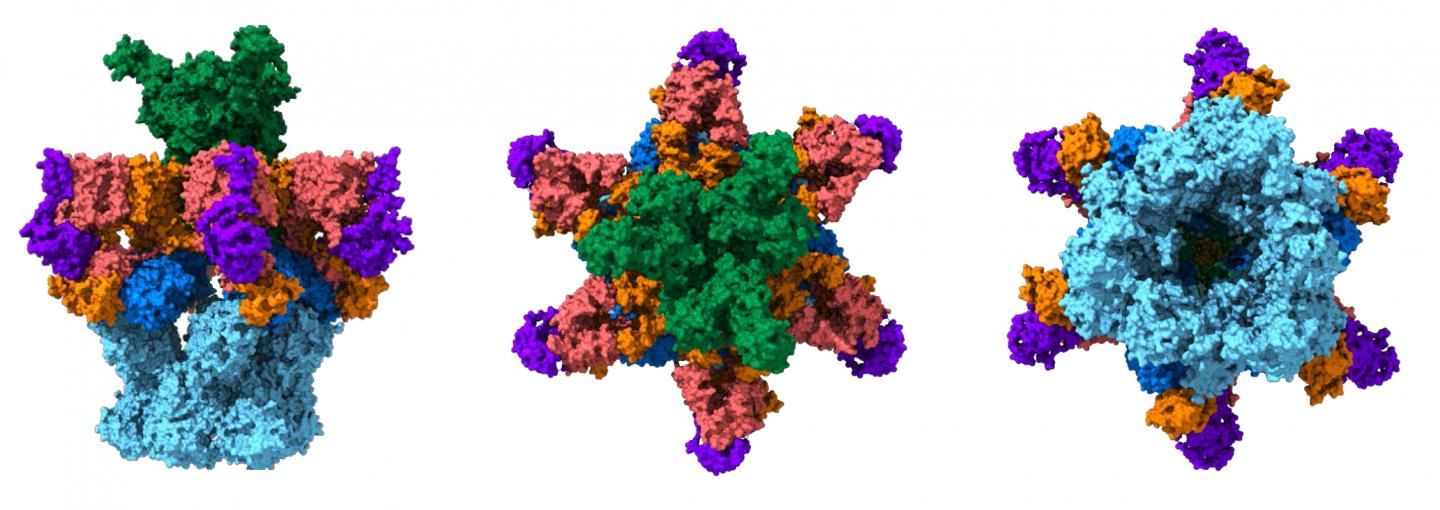
During infection Mycobacterium tuberculosis, the main causative agent of tuberculosis, secretes a large number of effector proteins through type VII secretion systems – small nanomachines which are composed of proteins that reside in the cell envelope. The effector proteins are specialized in fighting the immune defense or enable the uptake of nutrients to ensure the bacterial survival in the host. How these central secretion systems work, is still poorly understood.

Scientists from the Julius-Maximilians-Universität Würzburg (JMU) and the Spanish Cancer Research Centre CNIO (Centro Nacional de Investigaciones Oncológicas) have now succeeded in deciphering the molecular architecture of these nanomachines. Dr. Sebastian Geibel, who heads a research group at the Institute of Molecular Infection Biology funded by the Bavarian Elite Network and who is also affiliated with the Rudolf Virchow Centre of the JMU, was in charge of this work. The scientists have published their work in the current issue of the journal Nature.

Measurements at very low temperatures

Over the past five years, the research group of Dr. Geibel has worked intensively on the stable reconstitution of one of these secretion machines and the preparation of the sensitive sample for measurements on the cryo electron microscope, which requires the protein complexes to be shock frozen under defined conditions.

In collaboration with the research group of Oscar Llorca in Madrid, which computed three-dimensional maps of the protein complex using a sophisticated data processing strategy, the researchers from Würzburg were able to create a model of its molecular structure. The researchers were able to identify important elements of the nanomachine that form the transport pore as well as to locate elements that convert chemical energy into motion and thus drive the transport of effector proteins through the pore.

New approach for new drugs

The findings of the researchers lead to a deeper functional understanding of Type VII secretion systems. In times of rising resistance of mycobacteria to the antibiotics in use and no effective vaccination against tuberculosis in place, the researcher provide an important basis for the development of novel antibiotics that target the assembly or function of the type VII secretion systems.

###

Media Contact
Dr. Sebastian Geibel
[email protected]
49-931-318-4590

Related Journal Article

http://dx.doi.org/10.1038/s41586-019-1633-1

Tags: BacteriologyBiologyCell BiologyInfectious/Emerging DiseasesMedicine/Health
Share13Tweet8Share2ShareShareShare2

Related Posts

Bacterial Lipopeptides Block IL-33 Release, Easing Dermatitis

May 13, 2026

MICU Proteins Drive Calcium-Based Mitochondrial Energy Control

May 13, 2026

Bronchiectasis and NTM Care Center Network Grows to 62 Centers

May 13, 2026

Successful Launch of the Largest BL3 and ABL3 Special Laboratories for Domestic Universities Accompanied by a Symposium

May 13, 2026
Please login to join discussion

POPULAR NEWS

  • Research Indicates Potential Connection Between Prenatal Medication Exposure and Elevated Autism Risk

    842 shares
    Share 337 Tweet 211
  • New Study Reveals Plants Can Detect the Sound of Rain

    728 shares
    Share 290 Tweet 182
  • Salmonella Haem Blocks Macrophages, Boosts Infection

    62 shares
    Share 25 Tweet 16
  • Breastmilk Balances E. coli and Beneficial Bacteria in Infant Gut Microbiomes

    57 shares
    Share 23 Tweet 14

About

We bring you the latest biotechnology news from best research centers and universities around the world. Check our website.

Follow us

Recent News

Bacterial Lipopeptides Block IL-33 Release, Easing Dermatitis

Choline’s Crucial Impact on Brain Development

MICU Proteins Drive Calcium-Based Mitochondrial Energy Control

Subscribe to Blog via Email

Enter your email address to subscribe to this blog and receive notifications of new posts by email.

Join 82 other subscribers
  • Contact Us

Bioengineer.org © Copyright 2023 All Rights Reserved.

Welcome Back!

Login to your account below

Forgotten Password?

Retrieve your password

Please enter your username or email address to reset your password.

Log In
No Result
View All Result
  • Homepages
    • Home Page 1
    • Home Page 2
  • News
  • National
  • Business
  • Health
  • Lifestyle
  • Science

Bioengineer.org © Copyright 2023 All Rights Reserved.