• HOME
  • NEWS
  • EXPLORE
    • CAREER
      • Companies
      • Jobs
    • EVENTS
    • iGEM
      • News
      • Team
    • PHOTOS
    • VIDEO
    • WIKI
  • BLOG
  • COMMUNITY
    • FACEBOOK
    • INSTAGRAM
    • TWITTER
Friday, December 19, 2025
BIOENGINEER.ORG
No Result
View All Result
  • Login
  • HOME
  • NEWS
  • EXPLORE
    • CAREER
      • Companies
      • Jobs
        • Lecturer
        • PhD Studentship
        • Postdoc
        • Research Assistant
    • EVENTS
    • iGEM
      • News
      • Team
    • PHOTOS
    • VIDEO
    • WIKI
  • BLOG
  • COMMUNITY
    • FACEBOOK
    • INSTAGRAM
    • TWITTER
  • HOME
  • NEWS
  • EXPLORE
    • CAREER
      • Companies
      • Jobs
        • Lecturer
        • PhD Studentship
        • Postdoc
        • Research Assistant
    • EVENTS
    • iGEM
      • News
      • Team
    • PHOTOS
    • VIDEO
    • WIKI
  • BLOG
  • COMMUNITY
    • FACEBOOK
    • INSTAGRAM
    • TWITTER
No Result
View All Result
Bioengineer.org
No Result
View All Result
Home NEWS Science News

Tropical nations worst hit by climate-related fish shifts

Bioengineer by Bioengineer
February 26, 2020
in Science News
Reading Time: 2 mins read
0
IMAGE
Share on FacebookShare on TwitterShare on LinkedinShare on RedditShare on Telegram

IMAGE

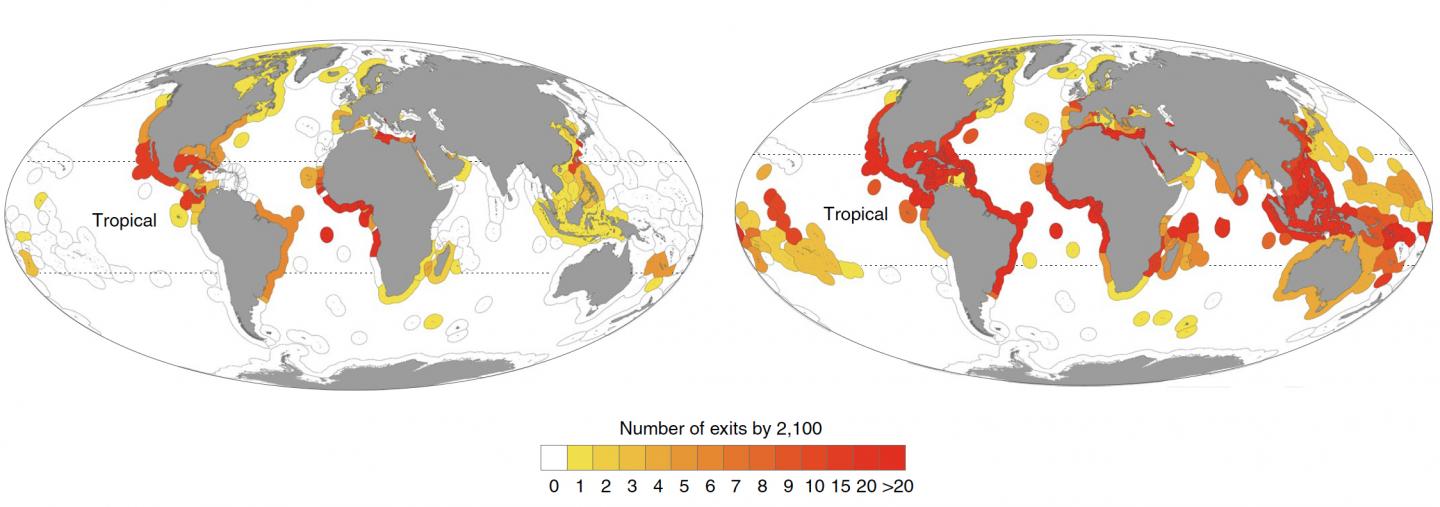
Credit: Kimberly L. Oremus et al., Nature Sustainability. Feb. 24, 2020

Policymakers will need to step up to the challenges caused by significant shifts in fish species distributions caused by climate change.

Tropical countries stand to lose the most fish species due to climate change, with few if any stocks replacing them, according to a study published in the journal Nature Sustainability. This could pose a serious governance challenge that warrants careful policy-making, the researchers say.

As sea temperatures rise, fish species migrate towards cooler waters to maintain their preferred thermal environments.

Jorge García Molinos of Hokkaido University and colleagues in Japan and the USA developed a computer model to project how the ranges of 779 commercial fish species will expand or contract under a moderate and more severe greenhouse gas emissions scenario between 2015 and 2100, compared to their 2012 distribution.

The model showed that, under a moderate emissions scenario, tropical countries could lose 15% of their fish species by the year 2100. If a more high-end emissions scenario were to occur, they could lose more than 40% of their 2012 species.

The model projects northwest African countries could lose the highest percentage of species; while Southeast Asia, the Caribbean, and Central America could experience steep species declines under the worst of the two climate scenarios.

The scientists wondered if existing regional, multi-lateral or bilateral policies contain the necessary provisions to adequately manage climate-driven fish stock exits from each countries’ jurisdictional waters (exclusive economic zones [EEZs]). They analyzed 127 publicly available international fisheries agreements. None contained language directly related to climate change, fish range shifts, or stock exits. Although some included mechanisms to manage short-term stock fluctuations, existing agreements also failed to contain long-term policies that prevent overfishing by nations losing fish stocks.

García Molinos and his colleagues suggest fair multilateral negotiations may be necessary among countries benefiting from the shift in fish species and those losing from it. Tropical nations in particular should highlight compensation for fishery damage during these negotiations recurring to international frameworks such as the Warsaw International Mechanisms for Loss and Damage, which aims to address losses caused by climate change. This information should also be highlighted to other financial schemes, such as the Green Climate Fund, which have been set up to assist developing countries to adapt to and mitigate the effects of climate change.

“The exit of many fishery stocks from these climate-change vulnerable nations is inevitable, but carefully designed international cooperation together with the strictest enforcement of ambitious reductions of greenhouse gas emissions, especially by the highest-emitter countries, could significantly ease the impact on those nations,” García Molinos concludes.

###

Media Contact
Naoki Namba
 @hokkaidouni

81-117-062-185

Original Source

https://www.global.hokudai.ac.jp/blog/tropical-nations-worst-hit-by-climate-related-fish-shifts/

Related Journal Article

http://dx.doi.org/10.1038/s41893-020-0476-y

Tags: Climate ChangeComputer TheoryEarth ScienceGeographyOceanographyPolicy/EthicsTemperature-Dependent PhenomenaTheoretical Sciences
Share12Tweet8Share2ShareShareShare2

Related Posts

Gut Microbes Predict Malaria Severity in Monkeys, Humans

December 19, 2025
Choosing Models: Linking Cat Intake to Socioeconomics

Choosing Models: Linking Cat Intake to Socioeconomics

December 19, 2025

Social Determinants Impact Tobacco Cessation in Veterans

December 19, 2025

Palmitoylation in Spermine Metabolism Fuels Prostate Cancer

December 19, 2025
Please login to join discussion

POPULAR NEWS

  • Nurses’ Views on Online Learning: Effects on Performance

    Nurses’ Views on Online Learning: Effects on Performance

    70 shares
    Share 28 Tweet 18
  • NSF funds machine-learning research at UNO and UNL to study energy requirements of walking in older adults

    70 shares
    Share 28 Tweet 18
  • Unraveling Levofloxacin’s Impact on Brain Function

    53 shares
    Share 21 Tweet 13
  • MoCK2 Kinase Shapes Mitochondrial Dynamics in Rice Fungal Pathogen

    72 shares
    Share 29 Tweet 18

About

We bring you the latest biotechnology news from best research centers and universities around the world. Check our website.

Follow us

Recent News

Gut Microbes Predict Malaria Severity in Monkeys, Humans

Choosing Models: Linking Cat Intake to Socioeconomics

Social Determinants Impact Tobacco Cessation in Veterans

Subscribe to Blog via Email

Enter your email address to subscribe to this blog and receive notifications of new posts by email.

Join 70 other subscribers
  • Contact Us

Bioengineer.org © Copyright 2023 All Rights Reserved.

Welcome Back!

Login to your account below

Forgotten Password?

Retrieve your password

Please enter your username or email address to reset your password.

Log In
No Result
View All Result
  • Homepages
    • Home Page 1
    • Home Page 2
  • News
  • National
  • Business
  • Health
  • Lifestyle
  • Science

Bioengineer.org © Copyright 2023 All Rights Reserved.