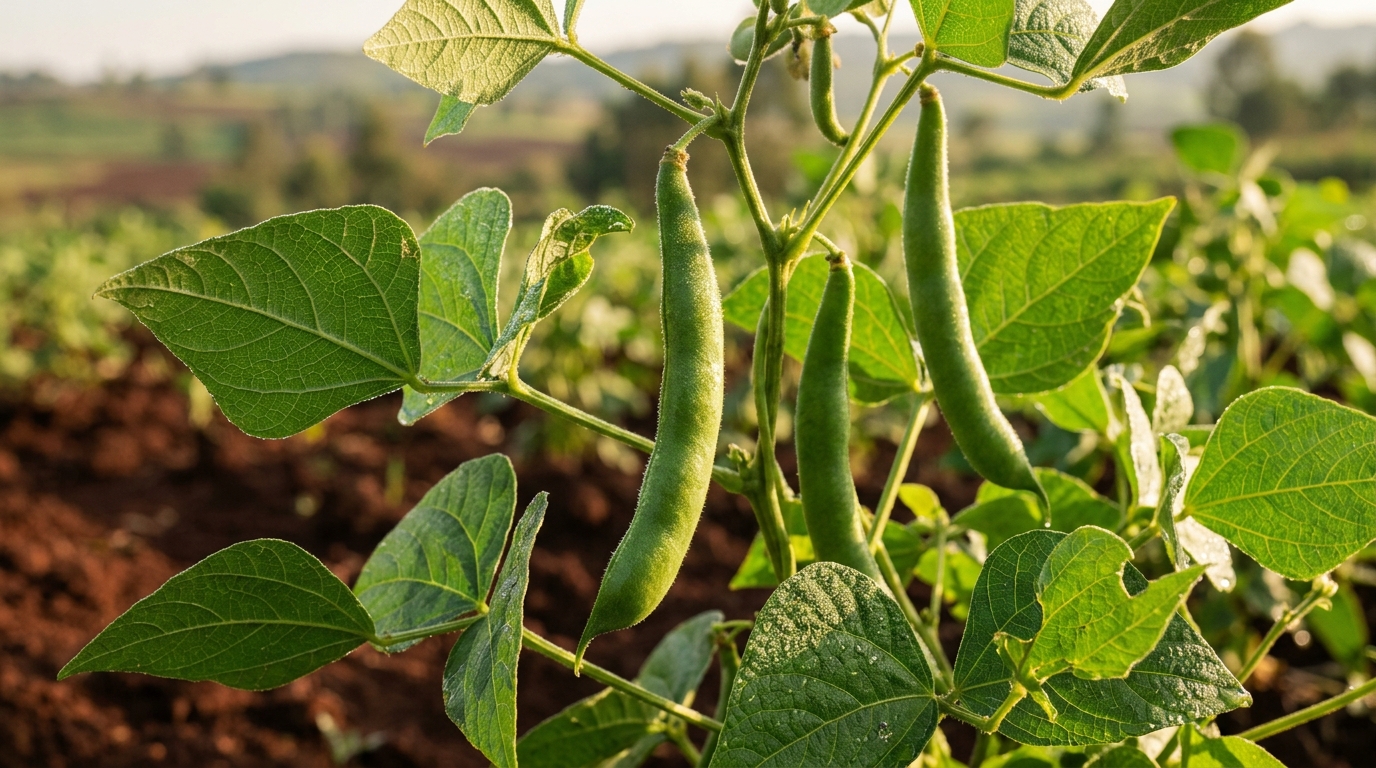
Common bean fields across three districts in southern Ethiopia are carrying a heavy burden of anthracnose, a fungal disease that can strip leaves, rot pods and ruin seeds, and a new survey has now mapped where the pressure is worst and which local practices are linked to it. The study, conducted in the Gedeo and West Guji zones, found the highest disease incidence at 61.23 percent and severity at 29.95 percent in Wonago district, while Abbaya district recorded the lowest levels at 43.42 percent incidence and 24.62 percent severity. The research, published in the Egyptian Journal of Biological Pest Control, also tested five species of the beneficial fungus Trichoderma against the pathogen in laboratory assays and found that all of them significantly suppressed its mycelial growth, with Trichoderma viride achieving a maximum inhibition of 90.34 percent.
The survey covered 63 fields spread across Dilla Zuria and Wonago in the Gedeo Zone and Abbaya in West Guji, with 18 to 24 fields sampled per district along major roads at intervals of five to six kilometres. Sampling took place in July and August during the peak growing season, and each field was divided into five one-metre-square quadrats arranged in an X pattern. Within each quadrat, researchers counted the total number of bean plants and the number showing typical anthracnose symptoms, then collected diseased leaves and transported them to the laboratory in a cool box for pathogen isolation within 24 hours. Disease incidence was calculated as the percentage of infected plants out of the total assessed, while severity was scored on a standard one-to-nine scale in which a score of one means no symptoms and a score of nine means more than half the leaf area affected with severe defoliation and stem lesions.
Altitude emerged as a powerful factor shaping disease levels. Fields situated above 2,000 metres above sea level recorded the highest incidence at 64.19 percent and the highest severity at 32.16 percent, and logistic regression confirmed that elevation above this threshold was a significant predictor of both high incidence and high severity with a p-value below 0.001. The authors attribute this pattern to the cool temperatures and high humidity characteristic of high-elevation sites, conditions that favour conidial germination and disease development in the anthracnose pathogen. Wonago district stood out as a disease hotspot in the statistical model, with farms there showing a significantly higher probability of high disease incidence compared with other districts.
Crop and soil management practices were also strongly associated with disease intensity. Sole cropping carried a significantly increased probability of higher incidence and severity compared with intercropping, a result the researchers link to a dilution effect in which mixed plantings disrupt spore dispersal. Local bean varieties showed higher disease intensity, with 54.12 percent incidence and 28.43 percent severity, than improved varieties, which recorded 38.75 percent and 21.14 percent respectively, and the logistic model confirmed that local varieties carried a higher likelihood of high incidence with a p-value of 0.045. Fields where no fertiliser was applied had a significantly greater probability of high incidence, and broadcast sowing was associated with a higher likelihood of high incidence than row sowing, which the authors suggest improves air circulation, reduces canopy humidity and shortens leaf wetness duration. Poor weed management was one of the strongest risk factors, significantly increasing the probability of high incidence, possibly because weeds serve as alternative reservoirs for the pathogen and raise humidity within the crop canopy. The authors caution that because this was an observational survey, these associations do not establish causal relationships and would need experimental verification under controlled conditions.
From the symptomatic leaf samples, the team isolated fifteen cultures of Colletotrichum lindemuthianum, the fungus responsible for anthracnose. Morphological characterisation revealed considerable variability among the isolates. Growth rate differed markedly, with 66.7 percent of isolates slow-growing and 33.3 percent moderate-growing, while colony texture was velvety in 60 percent of isolates and cottony in 40 percent. Colony colour also varied, with grey the most common on the upper surface at 26.7 percent and dark grey the most common on the reverse at 40 percent. The authors note that this predominance of slow-growing isolates may reflect adaptation to cool highland conditions, although they stress that identification rested entirely on morphological features and that molecular sequencing of regions such as ITS or TEF1-alpha would be required for definitive species confirmation and to assess genetic diversity.
Conidial measurements added further evidence of diversity within the local pathogen population. Spore length ranged from 11.9 to 18.4 micrometres and width from 3.7 to 5.9 micrometres, with significant variation among isolates; the isolates Kara-002 and Sis-002 produced the largest conidia while Hand-001 and Tum-002 produced the smallest. Most conidia, 66.7 percent, were cylindrical in shape, a form characteristic of Colletotrichum lindemuthianum and frequently linked to effective dissemination and infection, while the remaining 33.3 percent were slightly curved. The researchers suggest that larger conidial size may indicate higher sporulation potential or adaptability to particular conditions, though this remains an interpretation rather than a demonstrated outcome.
The biological control component of the study was conducted entirely under laboratory conditions using a dual culture assay on potato dextrose agar. A five-millimetre mycelial disc from a seven-day-old pathogen culture was placed on one side of a nine-centimetre Petri dish, with a matching disc of one of five Trichoderma species placed opposite, six centimetres away. The five species tested were Trichoderma harzianum, Trichoderma viride, Trichoderma atroviride, Trichoderma longibrachiatum and Trichoderma asperellum, all obtained from the Ambo Agricultural Research Center. Control plates contained the pathogen alone. Plates were incubated at 22 degrees Celsius, and after seven days the radial growth of the pathogen towards the antagonist was measured in two perpendicular directions, allowing inhibition percentages to be calculated relative to unchecked growth in the control plates.
Every Trichoderma species significantly inhibited the pathogen’s mycelial growth, but efficacy varied significantly among species and, crucially, in their interaction with different pathogen isolates. Trichoderma viride was the most effective antagonist overall, reaching a maximum mycelial inhibition of 90.34 percent, followed in descending order by Trichoderma asperellum, Trichoderma atroviride, Trichoderma harzianum and Trichoderma longibrachiatum. The maximum inhibition was recorded when Trichoderma viride was paired with the pathogen isolate Goll-002, while the minimum inhibition of 59.39 percent occurred when the same antagonist faced the isolate Han-002. This highly significant species-by-isolate interaction demonstrates that biocontrol performance is specific to both the antagonist strain and the pathogen strain it encounters, meaning that even the most potent species can be modulated by the particular pathogen isolate present. The authors argue that this specificity underscores the need to screen and select Trichoderma strains against the prevalent local pathogen populations rather than relying on broad species-level assumptions.
The mechanisms behind the observed antagonism likely involve several processes acting together. Visible overgrowth and colonisation of the pathogen by Trichoderma point to mycoparasitism, while clear inhibition zones between the two fungi suggest the production of diffusible antifungal metabolites. Both are well-documented modes of action for Trichoderma species, which are also known to suppress fungal pathogens through competition and the induction of plant defence responses. The superior performance of Trichoderma viride in these assays is consistent with recent reports highlighting its strong antagonistic and growth-promoting activities.
The authors are careful to frame these results as in vitro findings only, noting that field efficacy may differ substantially due to environmental factors, formulation stability and the complex interactions among plant, pathogen and antagonist that laboratory plates cannot capture. They call for field-based evaluations to validate the biocontrol potential under natural conditions before any practical application can be recommended. In the meantime, the survey data themselves offer actionable insights for farmers in the region: the study’s conclusions point toward adopting resistant bean varieties, implementing intercropping and row sowing, applying balanced fertilisation and improving weed management as integrated measures against a disease that remains widespread and severe across the Gedeo and West Guji zones. Future research, the authors suggest, should emphasise molecular characterisation of local pathogen populations and the development of farmer-friendly biocontrol formulations validated in the field, steps they view as essential for translating laboratory promise into sustainable anthracnose management.
Subject of Research: Field survey and laboratory evaluation of Trichoderma species as biological control agents against common bean anthracnose in southern Ethiopia
Article Title: Assessment, characterization and biological control of common bean anthracnose (Colletotrichum lindemuthianum) using Trichoderma spp. in Gedeo and West Guji Zones, Ethiopia
Article References: Kuma, A. K., Mekuria, T. M., & Tafesse, B. D. (2026). Assessment, characterization and biological control of common bean anthracnose (Colletotrichum lindemuthianum) using Trichoderma spp. in Gedeo and West Guji Zones, Ethiopia. Egyptian Journal of Biological Pest Control, 36(1), Article 13. https://doi.org/10.1186/s41938-026-00893-4
Image Credits: AI Generated
DOI: 10.1186/s41938-026-00893-4
Keywords: common bean, anthracnose, Colletotrichum lindemuthianum, Trichoderma, biological control, Ethiopia, Gedeo Zone, West Guji Zone, disease survey, dual culture assay, mycelial inhibition, crop management
News Source: Alan Morgan. (November 5, 2026). Trichoderma fungus shows strong lab suppression of bean anthracnose in southern Ethiopia. Scienmag.