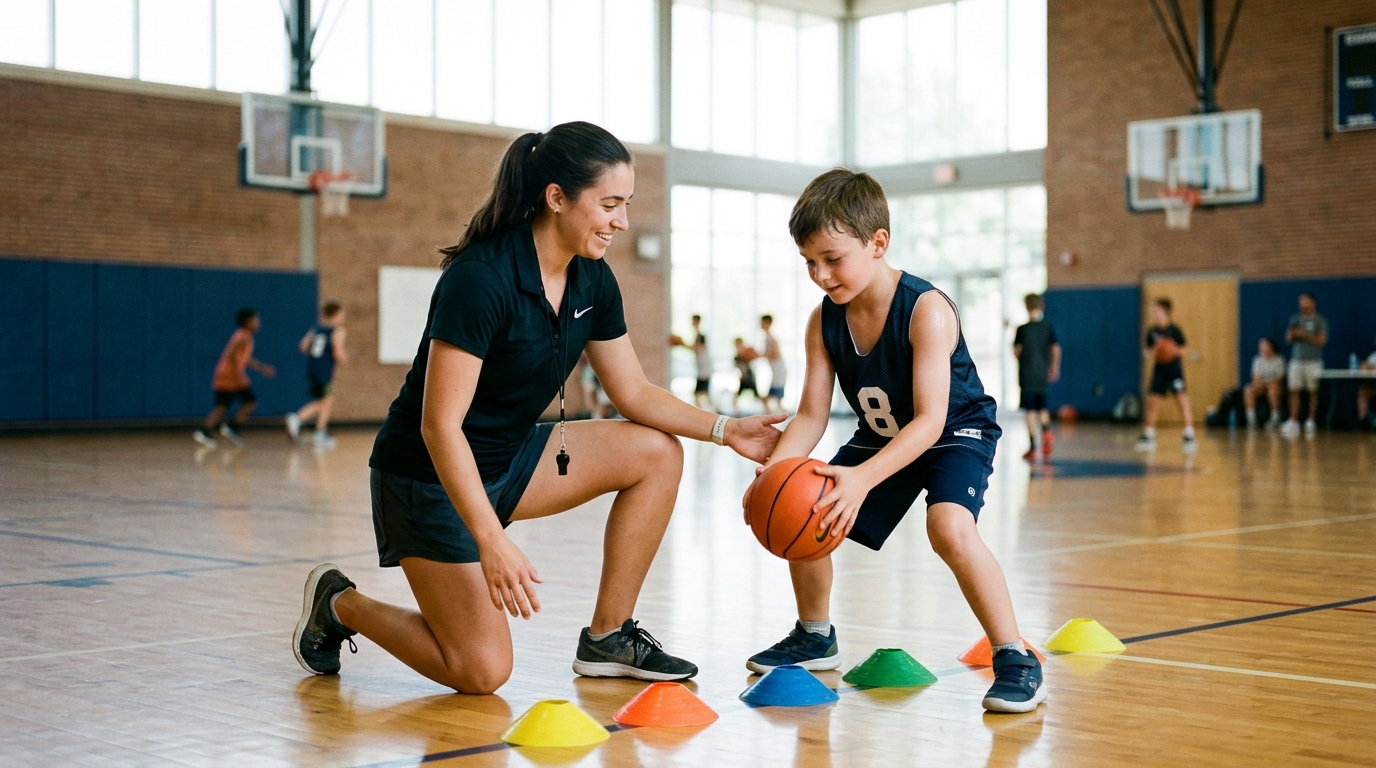
In a single-site, open-label, block-randomized exploratory trial, a multicomponent sport-based intervention incorporating mother–child and peer interaction was associated with greater reductions in several mother-reported questionnaire scores than fundamental movement skill training among Han Chinese boys aged 7 to 10 years with autism spectrum disorder. The complete-case analysis of 55 participants demonstrated that the experimental group achieved a 16.44-point mean decrease on the primary outcome, the mother-reported Social Responsiveness Scale total score, compared to a 2.86-point decrease in the control group. This between-group difference in change of −13.59 points (95% CI −18.05 to −9.12) reflected a statistically significant group × time interaction, F(1, 53) = 37.23, p < 0.001, partial η² = 0.413.
The study enrolled 56 boys aged 7 to 10 years who had autism spectrum disorder and Childhood Autism Rating Scale scores of 30 to 36, with 27 experimental and 28 control participants completing the trial after one experimental participant withdrew post-baseline. Over a 12-week period, the experimental group engaged in the multicomponent sport program twice weekly for 80 minutes per session, while the control group received fundamental movement skill training matching the same frequency and duration. On secondary mother-reported measures, the mean Autism Behavior Checklist total score decreased by 18.26 points in the experimental group versus 7.86 points in the control group, yielding a between-group difference in change of −10.40 points (95% CI −15.21 to −5.59, F(1, 53) = 18.80, p < 0.001, partial η² = 0.262). Additionally, the Repetitive Behavior Scale–Revised total score decreased by 5.74 points compared to 2.71 points in controls, producing a difference in change of −3.03 points (95% CI −4.15 to −1.91, F(1, 53) = 29.41, p < 0.001, partial η² = 0.357).
Secondary and subscale evaluations were exploratory, and corrected post-intervention between-group contrasts revealed no statistically significant differences for the Autism Behavior Checklist Body and Object Use subscale, the Social Responsiveness Scale Social Awareness subscale, the Social Responsiveness Scale Autistic Mannerisms subscale, or the Repetitive Behavior Scale–Revised Stereotyped Behavior subscale. Background context notes that autism spectrum disorder involves persistent social-communication difficulties and restricted or repetitive behaviors, with limited prior evidence regarding interventions that combine physical games with mother–child and peer interaction.
The trial authors concluded that the findings carry a high risk of expectancy and measurement bias and should not be interpreted as definitive evidence of objective or clinically meaningful improvement. Contributing methodological constraints include that mothers were aware of group allocation and directly participated in the experimental intervention, the conditions were not matched for adult attention or social contact, and the trial was registered retrospectively in the Chinese Clinical Trial Registry (ChiCTR2600132866) on September 19, 2026, following the completion of participant recruitment and intervention.
Subject of Research: Multicomponent sport-based intervention incorporating parent–child and peer interaction in autism spectrum disorder
Article Title: Effects of a multicomponent sport-based intervention incorporating parent–child and peer interaction on social impairment and stereotyped behaviors in children with autism spectrum disorder
Article References: Li, X., Liu, Y., Zhang, T., Wang, B., Liu, H., Qiu, Y., & Wan, Y. (2026). Effects of a multicomponent sport-based intervention incorporating parent–child and peer interaction on social impairment and stereotyped behaviors in children with autism spectrum disorder. BMC Psychiatry. https://doi.org/10.1186/s12888-026-08818-z
Image Credits: AI Generated
DOI: 10.1186/s12888-026-08818-z
Keywords: autism spectrum disorder, sport-based intervention, parent-child interaction, peer interaction, exploratory trial, Social Responsiveness Scale, Autism Behavior Checklist, Repetitive Behavior Scale-Revised, Effects, multicomponent, sport-based, intervention
News Source: Glenn Wilkins. (November 5, 2026). Trial Evaluates Interactive Sports Program for Boys With Autism Spectrum Disorder. Scienmag.