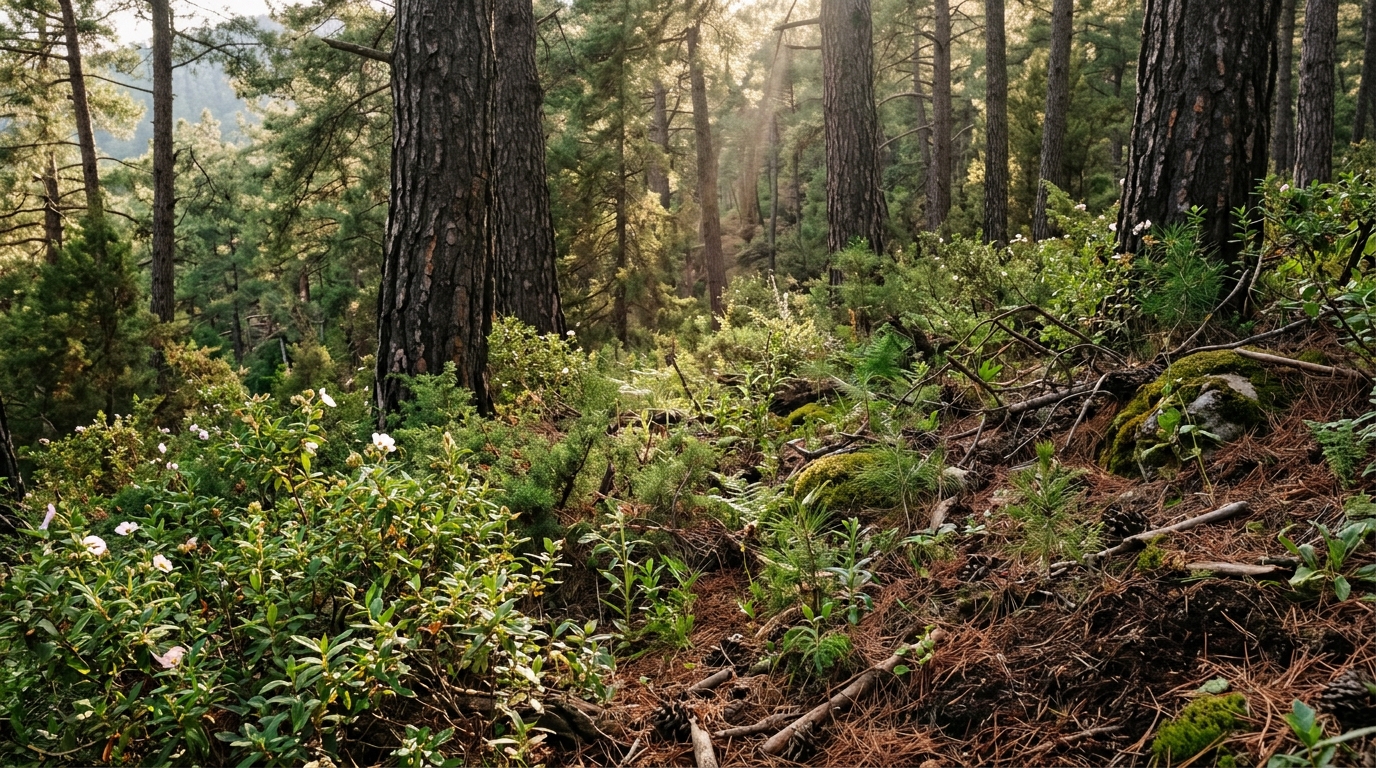
Seventy-five years after fire, the tree species planted in a Turkish forest are still leaving their mark on the plants growing beneath them. A study of historical reforestation plots in Türkiye found that stands of native and non-native conifers differ markedly in understory species richness, composition and beta diversity, and that the cover of a fire-associated shrub, Cistus laurifolius, declines as the canopy closes. The work was published in Plant Biosystems in November 2026, and its findings suggest that decisions made when replanting burned land can echo through the herb and shrub layer for three-quarters of a century.
The study, authored by Süleyman Çoban, Alican Doğru and Alper H. Çolak, aimed to determine how tree species identity and canopy structure are associated with long-term understory diversity. They sampled forty 2 × 2 m subplots within eight historical experimental plots (P1–P8) of varying present-day dimensions, nested in three historical blocks (B1–B3). These plots represent stands of Pinus sylvestris, Abies nordmanniana subsp. equi-trojani and Cedrus libani, and were compared with the adjacent native Pinus nigra subsp. pallasiana stands.
They measured canopy cover and assessed species richness, or alpha diversity, alongside beta diversity, which captures how much species composition turns over from one subplot to another. To link the vegetation to its light environment, they evaluated species–environment relationships along a canopy-related light gradient using Detrended Correspondence Analysis and correlation analysis.
The starkest result came from the fir stands. Dense Abies nordmanniana subsp. equi-trojani plantations with 88 to 97 percent canopy closure showed markedly reduced understory diversity: only 24 species were recorded there, with 3.2 to 7.0 species per 4 square metres across Blocks B1 and B2. What little vegetation persisted was dominated by shade-tolerant species associated with low-light, mesic conditions.
The other stand types told a different story. Stands of Pinus sylvestris, Pinus nigra subsp. pallasiana and Cedrus libani supported higher species richness, with 36 to 43 species recorded. Even so, compositional heterogeneity varied among these stand types, meaning that similar richness totals could hide different internal patterns of turnover.
Beta diversity, the measure of how species composition shifts between subplots, varied substantially among stand types. The highest values appeared in the Trojan fir stands, at 1.57 to 2.44, and in Cedrus libani stands, at 1.95, while Pinus nigra subsp. pallasiana and Pinus sylvestris showed comparatively lower values, 0.96 to 1.10 and 1.16 to 1.38 respectively. Detrended Correspondence Analysis revealed pronounced species turnover along the primary ordination gradient (4.13 SD).
One species provided a particularly telling signal. Cistus laurifolius, a rockrose shrub typical of post-fire environments, declined significantly in abundance as canopy closure increased, with a correlation coefficient of r = −0.38 and a p-value of 0.015. The persistence of Cistus laurifolius further reflects its association with canopy development and post-fire succession.
Taken together, the findings indicate that post-fire reforestation can leave persistent ecological legacies. Tree species identity, through its associated differences in canopy structure and light availability, contributes to long-term variation in understory diversity and composition. The authors argue that tree species selection and structural heterogeneity should therefore be considered in biodiversity-oriented restoration, beyond the simple re-establishment of tree cover.
Subject of Research: Long-term effects of tree species identity and canopy structure on understory plant diversity in post-fire reforestation stands in Türkiye
Article Title: Tree species identity and canopy structure are associated with long-term understory diversity 75 years after post-fire reforestation in Türkiye
Article References: Çoban, S., Doğru, A., & Çolak, A. H. (2026). Tree species identity and canopy structure are associated with long-term understory diversity 75 years after post-fire reforestation in Türkiye. Plant Biosystems, 160(6), Article 304. https://doi.org/10.1007/s44473-026-00325-z
Image Credits: AI Generated
DOI: 10.1007/s44473-026-00325-z
Keywords: understory diversity, post-fire reforestation, tree species identity, canopy structure, beta diversity, Cistus laurifolius, Pinus nigra, Abies nordmanniana, light availability, Türkiye, forest restoration, Plant Biosystems
News Source: Drew Townsend. (November 5, 2026). Tree choice 75 years after fire still shapes forest understory in Türkiye. Scienmag.