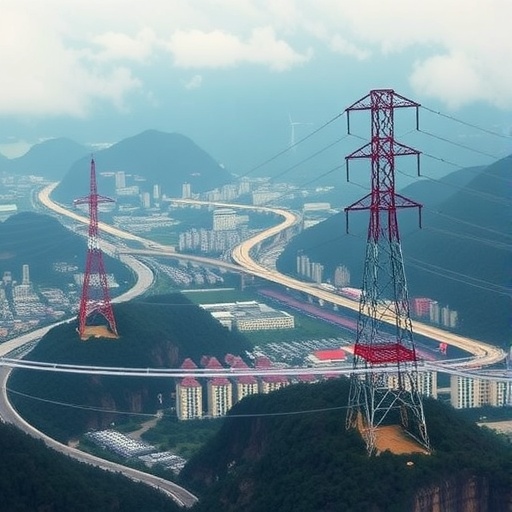
In a groundbreaking article recently published in the prestigious journal Engineering, researchers have mapped out transformative pathways for China’s power grid, aiming for a comprehensive overhaul by the year 2030. This critical timeline aligns with the nation’s ambitious Nationally Determined Contributions (NDCs), highlighting a transformative vision toward a low-carbon and highly reliable energy system. The study, conducted by experts from the China Electric Power Research Institute under the State Grid Corporation of China, delivers a scenario-oriented blueprint illuminating sweeping changes in energy generation, grid architecture, and consumption patterns, while charting key innovation priorities to guide the future power system.
The electrical landscape in China is undergoing a seismic shift, driven predominantly by rapid expansion in wind and solar capacities. Such swift growth introduces novel challenges in maintaining grid stability and balancing supply and demand. This drive towards renewable energy sources disrupts traditional, technology-centric innovation trajectories, which have historically been constrained by path dependence—where new developments rely heavily on legacy systems and frameworks. The researchers identify three defining macro trends for this transition: a pivot to clean and low-carbon power generation, profound transformations in grid morphology, and significant restructuring of end-use electricity consumption patterns.
Central to this transformation is the evolving role of new energy. Once considered supplementary, renewable energy sources are poised to dominate both installed capacity and overall generation. Meanwhile, coal-fired power plants, traditionally the backbone of baseload supply, will transition to playing a more flexible role. Rather than operating continuously as providers of steady power, these units will increasingly function as dynamic resources capable of regulation and support, providing critical inertia and voltage stability to the grid. This paradigm shift signals a fundamental departure from traditional power plant operation paradigms.
Infrastructure changes accompany this generation evolution. Cross-regional transmission capacity is expected to exponentially grow, showcasing a surge in ultra-high-voltage direct current (UHVDC) line deployments. These lines will facilitate power delivery from resource-abundant regions—like vast sandy deserts and offshore wind farms—to dense load centers. Distribution networks will no longer be passive conduits; instead, they will morph into proactive platforms empowered by distributed photovoltaics (PV), energy storage units, and electric vehicle (EV) charging infrastructure. This transition requires sophisticated management to harness localized resources efficiently.
Electricity demand patterns will experience steady growth but with growing complexity. Peaks in seasonal electricity use will become more pronounced, driven by heating and cooling needs alongside rising vulnerabilities to extreme weather events. This introduces further uncertainty into load forecasting and grid management, demanding advanced predictive tools capable of navigating increasingly volatile consumption dynamics. The traditional deterministic load profiles will give way to probabilistic models that incorporate weather extremes while maximizing operational resilience.
To translate these sweeping trends into actionable engineering targets, the researchers delineated five representative grid scenarios envisioned for 2030. These include: large-scale wind-solar base transmission across challenging geographic areas such as sandy, rocky, and desert terrains; deep-sea offshore wind power transmission on an unprecedented scale; hydropower-based transmission systems centered in Southwest China; cross-regional UHVDC power influx into heavily industrialized load centers; and scenarios prioritizing integration of highly distributed renewable energy assets. These scenarios collectively encapsulate the multidimensional challenges posed by centralized and distributed renewable integration across varied geographical and technical contexts.
Each scenario brings to light a spectrum of formidable technical challenges. The intermittent nature of renewables exacerbates difficulties in maintaining real-time energy balance across the grid. The prevalence of weak grid segments, dense deployments of DC feeds, and a reduction in synchronous inertia heighten vulnerabilities related to voltage and frequency stability. Moreover, equipment deployed in harsh environments—ranging from turbulent deep-sea zones to seismically active regions—must meet elevated standards of reliability, durability, and maintainability, pressing the envelope of current engineering capabilities.
Confronting these challenges, the article emphasizes three critical technical innovation frontiers. First, ensuring a reliable power supply requires probabilistic approaches to power balance, sophisticated assessments of flexible resources such as energy storage and flexible loads, optimized dispatching of traditional generation units, and the development of ultra-precise forecasting models for renewables that factor in extreme weather uncertainties. Second, advancing grid security and stability demands new stability mechanisms tailored to power-electronic-dominated systems, comprehensive modeling suites capable of capturing complex grid dynamics, coordinated multi-layer control systems, fault defense strategies, and the deployment of grid-forming technologies that enable renewables to emulate conventional synchronous generators.
Third, the performance and longevity of equipment must improve amid the challenging operating conditions expected. This necessitates breakthroughs in reliability engineering, real-time condition monitoring utilizing advanced sensors and diagnostic algorithms, and the employment of adaptive materials engineered to withstand environmental stresses. The combined focus on these dimensions strives to maintain uninterrupted power delivery while minimizing operational costs and environmental footprint.
Recognizing that technical ingenuity alone cannot realize this transformation, the study advocates for supportive policy frameworks that prioritize scenario-oriented technology planning at the highest levels. These plans should promote system-level breakthroughs addressing core technology gaps, foster intensified fundamental and interdisciplinary research collaborations, and leverage the power of digital and intelligent tools to enhance grid observability, predictability, and control precision. This integrative approach sets the stage for China to achieve a secure, efficient, and carbon-neutral power system aligned with 2030 climate imperatives.
This visionary roadmap and its associated technical insights offer a compelling model for other nations navigating the complexities of energy transition in an era defined by climate urgency and technological innovation. The delicate balancing act between integrating variable renewables, maintaining grid stability, and meeting rising demand underpins a new frontier in power system engineering. As China advances toward this goal, this research stands as a beacon illuminating pathways to resilient, adaptable, and sustainable grid architectures indispensable for the future of energy worldwide.
Subject of Research: China’s power grid transformation toward 2030, focusing on integration of renewable energy, grid morphology evolution, and new technical requirements.
Article Title: Typical Scenarios and Technical Requirements of China’s Power Grid Towards 2030 for Power System Transformation
News Publication Date: 15-Apr-2026
Web References:
Full article: https://doi.org/10.1016/j.eng.2025.10.007
Journal Engineering: https://www.sciencedirect.com/journal/engineering
Image Credits: Qiang Zhao, Yuqiong Zhang, Ziwei Chen, Xiaoxin Zhou, Jiameng Gao, Honghua Yang
Keywords
Energy transition, renewable integration, ultra-high-voltage direct current, grid stability, power system transformation, China energy policy, wind and solar power, distributed energy resources, grid-forming technology, smart grid, probabilistic forecasting, equipment reliability
Tags: China Electric Power Research Institute studyChina power grid transformation 2030clean power generation transitionelectricity consumption pattern changes Chinaenergy system innovation Chinafuture grid architecture innovationsgrid stability with renewable energylow-carbon energy systems ChinaNationally Determined Contributions China energyrenewable energy integration challengesState Grid Corporation of China initiativeswind and solar capacity expansion China