A new open-access study in Autonomous Intelligent Systems introduces T-3MS Fusion, a transformer-based middle-fusion framework that reaches 74.9% NDS and 72.8% mAP on the nuScenes 3D object detection benchmark while relying on a Velodyne VLP-32C LiDAR and a consumer-grade 360-degree camera rather than the multi-sensor rigs that typically cost more than $50,000. The framework, developed by Badri Raj Lamichhane, Teerayut Horanont, and Gun Srijuntongsiri at Sirindhorn International Institute of Technology, Thammasat University, eliminates test-time augmentation and model ensembling, two computational tricks that most competing methods depend on to reach their reported scores.
The central problem the researchers attack is the widening gap between laboratory-grade perception and deployable perception. The most accurate 3D detection frameworks typically require expensive multi-sensor suites exceeding $50,000 and computationally intensive platforms with substantial power demands, which constrains scalability in cost-sensitive domains such as emerging markets, last-mile delivery services, and large-scale fleet operations. Cameras provide dense semantic and textural information but struggle with depth estimation and photometric variation, while LiDAR delivers precise geometric measurements through spatially sparse point clouds. Fusion architectures combine these complementary strengths, yet existing paradigms carry trade-offs: early fusion struggles with spatiotemporal alignment and sacrifices semantic richness, late fusion neglects geometric context, and middle fusion remains susceptible to sensor noise and calibration uncertainties.
T-3MS Fusion addresses these limitations through a transformer-based middle-deep fusion architecture built on three innovations. First, gated residual transformers with adaptive feature reactivation dynamically recover suppressed yet critical intermediate-level features, using gradient-informed gating to suppress unreliable channels while preserving geometric cues. A Gradient Confidence Score computed for each channel quantifies task sensitivity, allowing the model to suppress weak or noisy channels and achieve content-driven fusion. Second, hierarchical shortcut pathways across bird’s-eye-view scales preserve fine-grained LiDAR geometry while enriching it with camera semantics at each resolution. Third, sparse BEV processing coupled with quantization-aware training reduces memory footprint and latency without compromising accuracy, enabling real-time inference on embedded platforms.
The architecture treats fusion as an adaptive decision process rather than a fixed operation. When the gating factor approaches zero under conditions such as rain, fog, or occlusion, fusion is suppressed and the system reverts to the LiDAR feature; when the factor approaches one, transformer-augmented features dominate. This conditional residual bypass establishes a fail-safe mechanism that mitigates noise amplification, unlike static fusion strategies such as BEVFusion or TransFusion. A bidirectional cross-attention module further enables mutual interaction between LiDAR and camera features, allowing each modality to attend to the other for fine-grained geometric-textural alignment, while a learnable affine transformation maps LiDAR BEV coordinates into the camera BEV space to ensure geometric consistency.
On the nuScenes benchmark, which comprises 1000 annotated scenes with over 400,000 frames from urban environments in Boston and Singapore, T-3MS achieves the highest validation NDS score of 73.7, matching the best test NDS of 74.9, with an mAP of 71.6 on validation. The authors report these results were obtained without test-time augmentation or ensembling. The model is comparable to the Swin-T-based PolFusion while utilizing substantially fewer parameters. Precision-recall curves across trucks, cars, motorcycles, bicycles, and pedestrians show consistently high precision across a broad recall range, and cumulative distribution analysis reveals that approximately 90% of detections achieve center errors below 20 pixels.
Ablation studies quantify the contribution of each component. Early fusion establishes a baseline of 68.2% NDS and 65.7% mAP, while the complete T-3MS framework reaches 73.7% NDS and 72.8% mAP, surpassing early fusion by 5.5 and 7.1 percentage points respectively. Chamfer Distance analysis, computed with LiDAR BEV as the reference, shows Camera BEV at 2.34 due to monocular depth estimation limitations, while T-3MS Fusion achieves a substantially lower 0.67, indicating improved spatial consistency through the integration of camera semantics and LiDAR geometry.
To test generalization beyond urban benchmarks, the team conducted an ablation study on the Waymo Open Dataset, which features challenging rural and highway scenarios with sparse object density and long-range perception demands. The early fusion baseline there achieved 61.4% NDS and 59.8% mAP, and the complete T-3MS framework reached 67.9% NDS, 65.3% mAP, and 0.88 m localization error through integrated shortcut connections, adaptive fusion, and hierarchical refinement.
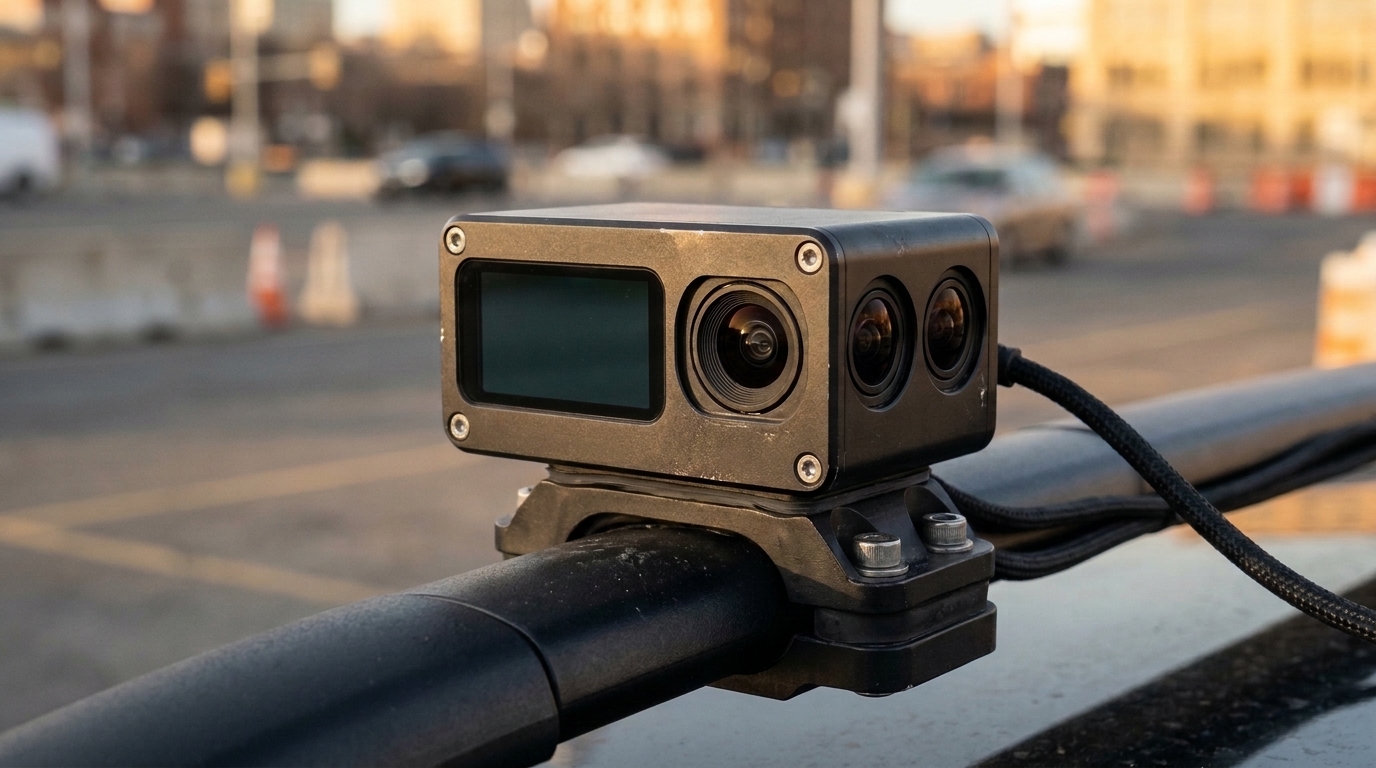
The most distinctive evaluation used a self-collected semi-urban dataset captured around the SIIT Bangkadi Campus in Thailand with a total hardware budget of approximately $8,200, comprising a Velodyne VLP-32C LiDAR at around $7,000 and an Insta360 X4 panoramic camera at around $1,200, both rigidly mounted on a vehicle roof. The dataset comprises approximately 4000 temporally synchronized frames annotated for vehicles, pedestrians, and motorcycles, acquired under high-density intersections, shadowed narrow passages, partial occlusion, and illumination ranging from direct sunlight to twilight. Training on this dataset produced 69.3% NDS and 67.8% mAP, while competing models trained under identical conditions declined notably: BEVFusion to 62.1 NDS, TransFusion to 64.7 NDS, and MonoDETRNext to 58.3 NDS. The average distance estimation error was 0.48 meters for dynamic vehicles and 0.31 meters for static roadside objects.
Category-level results on the local dataset show detection accuracy of 71.8% for cars, declining to 64.5% for smaller or partially occluded targets such as pedestrians. Fused camera-LiDAR operation achieved the highest F1 scores and mAP for both cars (0.80, 79.76%) and pedestrians (0.71, 76.83%), outperforming single-sensor setups. The authors also document a consistent failure case: detecting small pedestrians beyond 50 meters during heavy rainfall and low-light conditions, where pedestrian detection NDS drops to 48.2% from 64.5% under normal conditions. They attribute this to precipitation reducing LiDAR point density and raindrops and lens glare obscuring camera textures, characterizing it as a fundamental sensing limitation rather than an architectural deficiency, noting the framework fails gracefully instead of generating false positives.
The authors acknowledge that the current reliance on camera and LiDAR modalities excludes radar, which provides complementary velocity information and resilience under adverse weather such as fog, heavy rain, or snow. The framework has been predominantly validated on structured urban datasets, which may limit generalizability to unstructured or off-road environments, and the current design assumes precisely synchronized and calibrated sensor streams. From a systems perspective, the framework is tailored for high-performance GPU environments and has yet to be fully optimized for resource-constrained, low-power automotive platforms, with future work directed toward pruning, quantization, knowledge distillation, temporal fusion mechanisms, and cooperative perception through vehicle-to-vehicle and vehicle-to-infrastructure communication.
Subject of Research: A transformer-based middle-fusion framework for real-time 3D object detection in autonomous driving that combines LiDAR and camera data on affordable sensor hardware, validated on nuScenes, Waymo Open Dataset, and a self-collected semi-urban dataset.
Article Title: T-3MS fusion: gradient-aware transformer-guided middle-fusion for real-time 3D object detection on affordable sensor suite
Article References: Lamichhane, B. R., Horanont, T., & Srijuntongsiri, G. (2026). T-3MS fusion: gradient-aware transformer-guided middle-fusion for real-time 3D object detection on affordable sensor suite. Autonomous Intelligent Systems, 6(1), Article 5. https://doi.org/10.1007/s43684-026-00128-1
Image Credits: AI Generated
DOI: 10.1007/s43684-026-00128-1
Keywords: 3D object detection, autonomous driving, sensor fusion, transformer architecture, LiDAR, bird's-eye view, nuScenes benchmark, quantization-aware training, cross-attention, affordable sensors, embedded deployment, multimodal perception
News Source: Denise Maddox. (November 5, 2026). Transformer-guided fusion brings real-time 3D object detection to affordable sensors. Scienmag.