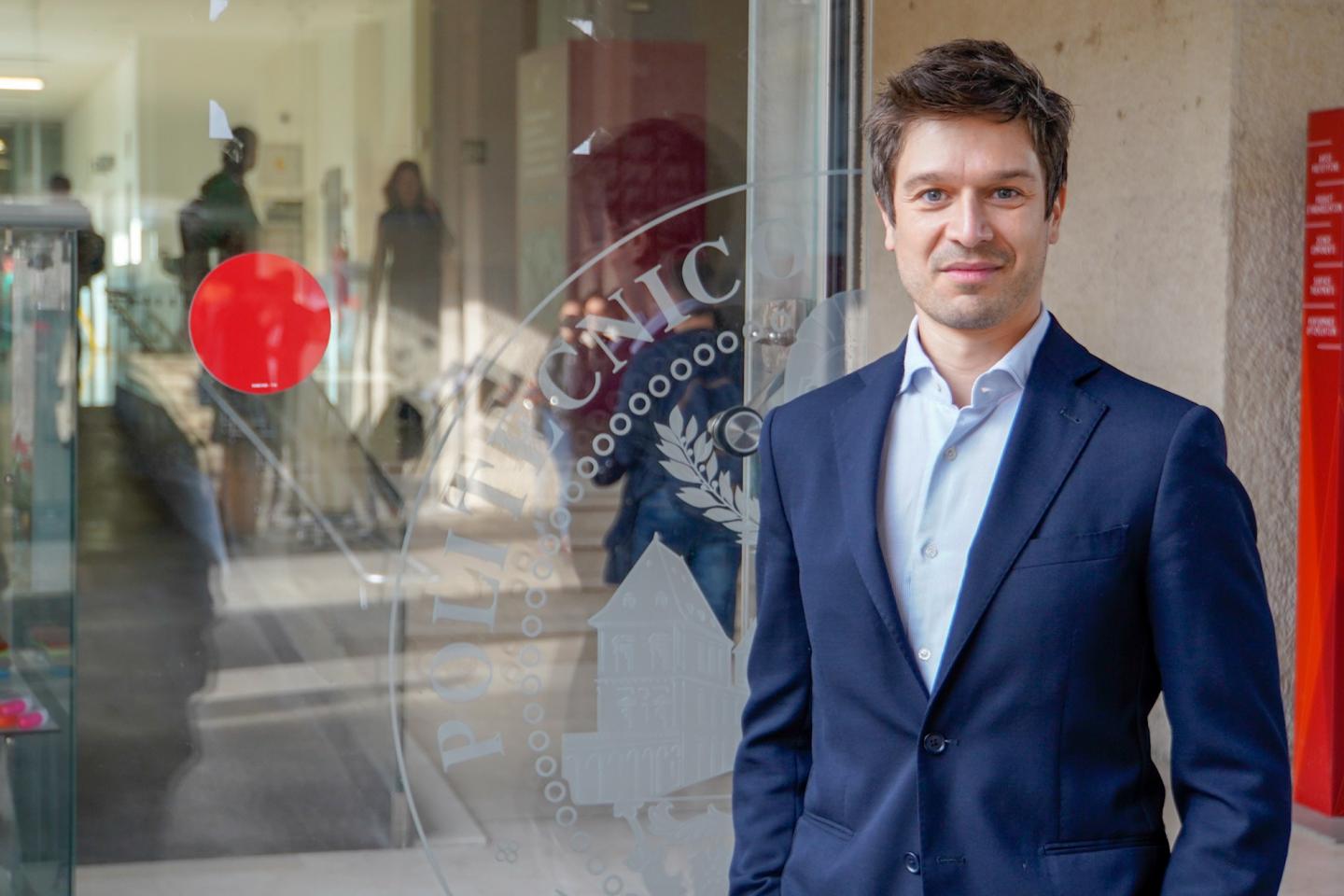
Credit: Politecnico di Torino
The ability to conceive and develop new types of materials has determined the development of humanity from the stone, bronze and iron ages to our current world, dominated by electronic materials and semiconductors (silicon, etc.). The DYNAPOL project will explore new routes to design new types of artificial materials for various technological applications.
Giovanni Maria Pavan – Full Professor at Politecnico di Torino since 2019 will develop his DYNAPOL research project in five years thanks to the 2 million of funding. An ambitious research program spanning several scientific fields: molecular simulation, computational physics-chemistry, supramolecular chemistry, bioinspired materials and machine learning. Prof. Pavan’s research group will develop multiscale molecular models and will use advanced computational simulation and machine learning techniques to investigate the fundamental chemical-physical principles to design new classes of artificial materials with bioinspired dynamic properties, that is similar to those of materials living. The models developed will be validated through continuous comparison with experimental data from various international collaborations.
The research that has its roots in the observation of nature and in the way this builds complex materials possessing unique properties, such as the ability to actively respond to external stimuli of various kinds – environmental (such as temperature, salt, pressure), biological (specific interactions with proteins or tissues), chemical, physical, etc. -, capable of performing complex functions working out of the thermodynamic equilibrium (consuming and transforming energy) and, in general, possessing a dynamic and “living” behavior. DYNAPOL is a so-called “paradigm breaker” project: the objective is in fact to understand how to create new classes of bioinspired artificial materials through chemical-physical concepts different from those on which the common materials for technological use are based, that is via self-assembly.
“The nature has always inspired technology innovation allowing mankind to exceed its limits. We have built airplanes allowing us to fly, boats to move in the water – says Giovanni Maria Pavan – imagine learning from nature how to build new types of materials with unprecedented dynamical properties, active materials able to perform complex functions, to receive and exchange information communicating with the environment in a dynamic way. Those smart materials would represent a revolution in many fields. The goal of this project is to explore new ways to build bioinspired materials and to pave new routes in material sciences”.
The results of this project will find applications in various research and technologic areas of great current interest, such as biomedical, pharmaceutical, energy, chemical, as well as tracing completely new applications not yet envisaged in the field of innovative materials.
Professor Pavan has chosen Politecnico di Torino to develop his research: “We are very proud that another young researcher has chosen our university: Politecnico di Torino is more and more considered a high-quality research center at the international level and our attraction policies are effective. Our university offers a stimulating research environment, attractive work conditions and an excellent quality of life”, says the Rector Guido Saracco. The Rector concludes saying “I wish to Giovanni to consolidate in our Institution a strong research team, to inspire students and young researchers minds and to establish fruitful collaborations with other Politecnico di Torino professors and researchers”.
###
Media Contact
Elena Foglia Franke
[email protected]
Original Source
http://www.