Credit: Bessie Terrones, Penn State MRI
Adding noise to enhance a weak signal is a sensing phenomenon common in the animal world but unusual in manmade sensors. Now Penn State researchers have added a small amount of background noise to enhance very weak signals in a light source too dim to sense.
In contrast to most sensors, for which noise is a problem that should be suppressed, they found that adding just the right amount of background noise can actually increase a signal too weak for sensing by normal sensors, to a level that can reach detectability.
Although their sensor, based on a two-dimensional material called molybdenum disulfide, detects light, the same principle can be used to detect other signals, and because it requires very little energy and space compared to conventional sensors, could find wide adaptation in the coming Internet of Things (IoT). IoT will deploy tens of millions of sensors to monitor conditions in the home and factories, and low energy requirements would be a strong bonus.
“This phenomenon is something that is frequently seen in nature,” says Saptarshi Das, an assistant professor of engineering science and mechanics. “For example, a paddlefish that lives in muddy waters cannot actually find its food, which is a phytoplankton called Daphnia, by sight. The paddlefish has electroreceptors that can pick up very weak electric signal from the Daphnia at up to 50 meters. If you add a little bit of noise, it can find the Daphnia at 75 meters or even 100 meters. This ability adds to the evolutionary success of this animal.”
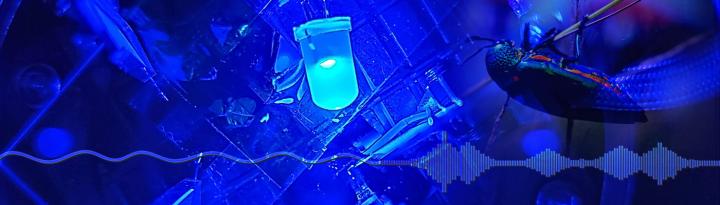
Another interesting example is the jewel beetle, which can detect a forest fire at 50 miles distance. The most advanced infrared detector can only detect at 10 to 20 miles. This is due to a phenomenon these animals use called stochastic resonance.
“Stochastic resonance is a phenomenon where a weak signal which is below the detection threshold of a sensor can be detected in the presence of a finite and appropriate amount of noise,” according to Akhil Dodda, a graduate student in engineering science and mechanics and co-first author on a new paper appearing this week in Nature Communications.
In their paper, the researchers demonstrate the first use of this technique to detect a subthreshold photonic signal.
One possible use being considered is for troops in combat. Army personnel in the field already carry very bulky equipment. It is unfeasible to add the heavy, power-hungry equipment required to enhance a subthreshold signal. Their technique is also applicable in resource-constrained environments or beneath the ocean where people want to monitor very weak signals. It could also be used in volcanic locations or to monitor earthquakes in time to give an alarm.
“Who would have thought that noise could play a constructive role in signal detection? We have challenged tradition to detect otherwise undetectable signals with miniscule energy consumption. This can open doors to a totally unexplored and ignored field of noise enhanced signal detection,” said Aaryan Oberoi, a graduate student from the Department of Engineering Science and Mechanics and co-first author on the paper.
Their next step is to demonstrate this technique on a silicon photodiode, which would make the device very scalable. Any state-of-the art sensor can be enhanced by this concept, Das says.
###
The team has filed a provisional patent application with a full patent to follow.
Other authors on the paper, titled “Stochastic Resonance in MoS2 Photodetector,” are graduate student Tanushree H Choudhury, materials science and engineering, and Joan Redwing, professor of materials science and engineering and electrical engineering, all of Penn State.
The work was partially funded by the Air Force Office of Scientific Research.
Media Contact
A’ndrea Elyse Messer
[email protected]
Related Journal Article
http://dx.