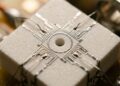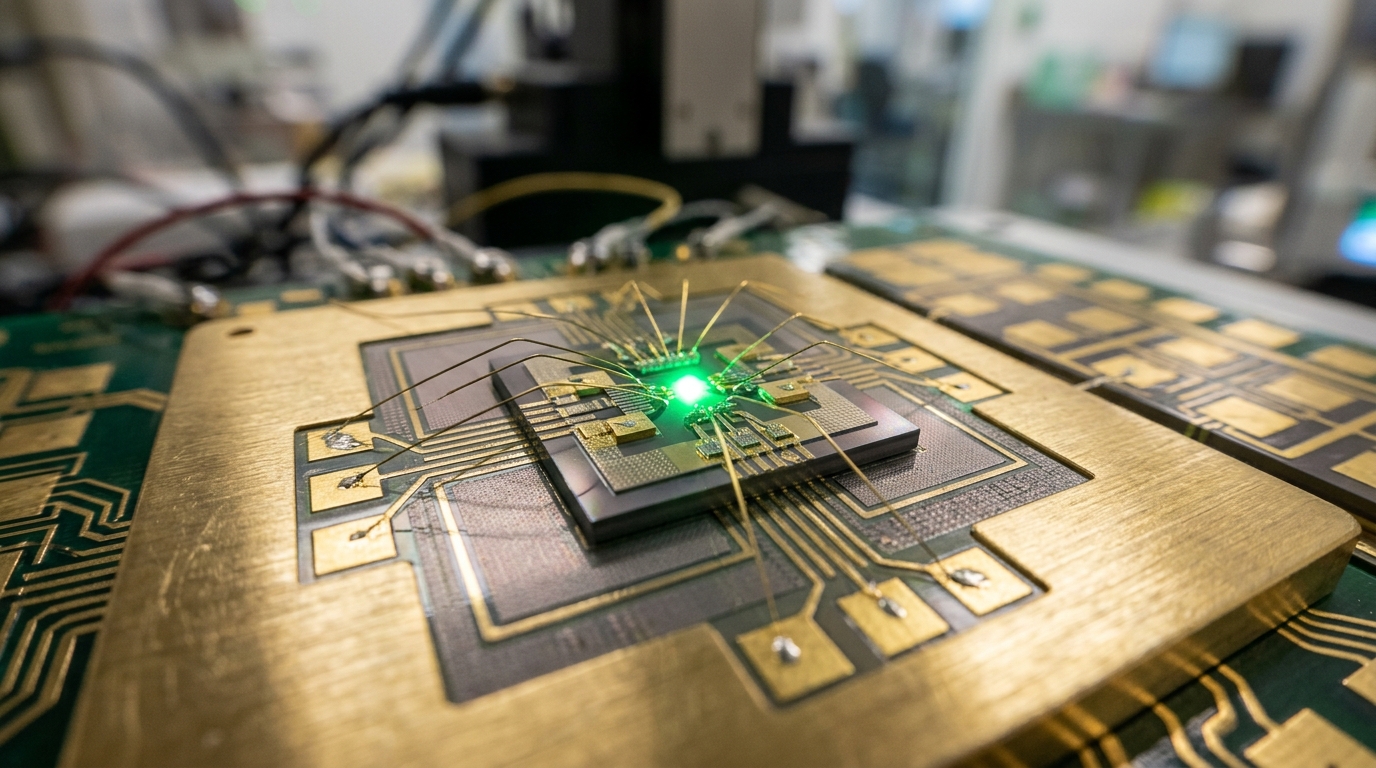
Engineers have built a semiconductor device that converts faint, invisible infrared light into a visible amber glow using a driving voltage as low as 1.4 volts, and the resulting visible output is more than 17,000 times brighter than the infrared light that enters it. The device, described in Nature Photonics, is an InGaAs/InP avalanche heterojunction phototransistor wired directly to an amber LED, and it achieves this upconversion at an incident infrared intensity of just 6.4 nanowatts per square centimetre, a level the researchers note is close to that of natural nightglow.
The work addresses a long-standing challenge in photonics: turning low-energy, invisible photons into high-energy, visible ones. Nonlinear optical processes can accomplish this, but they typically demand bulky optical crystals, strong optical pumping and deliver low efficiency. A more compact solid-state alternative is to detect low-energy photons with a high-gain photodetector made from a narrow-bandgap semiconductor, generating enough photocurrent to drive a visible-light LED. Previous attempts, however, struggled to satisfy the stringent requirements of infrared sensitivity, high gain and low driving voltage at the same time.
The new device resolves that tension through an internal positive feedback loop built into the phototransistor itself. According to the researchers, the loop couples the transistor’s amplification with avalanche gain, an intrinsic gain mechanism that supplies the photocurrent needed to power the LED without external amplification stages. This coupling produces the remarkably low breakdown voltage of 1.4 volts and enables an avalanche upconversion mode with what the team describes as ultrahigh conversion efficiency.
The phototransistor is engineered from indium gallium arsenide, a narrow-bandgap semiconductor sensitive to short-wavelength infrared light, combined with indium phosphide. The researchers report that the avalanche phototransistor shows ultrahigh and broadband responsivity in the short-wavelength infrared band, allowing it to respond to the dim infrared backgrounds found in low-light environments.
The practical significance lies in what that sensitivity corresponds to in the real world.
The researchers highlight wearable applications as a key motivation. The team also positions the mechanism as a general and scalable pathway for photon upconversion across a broad infrared spectral range, suggesting the same feedback-driven design principle could be adapted to detect and convert other infrared wavelengths beyond the specific band demonstrated here.
Beyond night vision, the abstract identifies medical imaging and optogenetics among the essential applications that depend on converting low-energy photons to visible ones. The device’s low operating voltage and high gain distinguish it from earlier upconversion attempts that could not combine these properties in a single solid-state unit.
Their results underscore the potential of solid-state solutions for wearable, direct-view night vision and mark a step toward compact photon upconversion devices that operate at voltages low enough for portable and wearable platforms.
Subject of Research: Infrared-to-visible photon upconversion using a low-voltage avalanche heterojunction phototransistor
Article Title: Low-voltage avalanche heterojunction phototransistor for infrared-to-visible upconversion
Article References: Lee, S., Montealegre, D. A., Song, Y., Deng, H., Han, Z., Chen, J., White, R. C., Chen, I.-T., Kim, B., Kim, M., Lee, M. L., Xia, F., & Li, M. (2026). Low-voltage avalanche heterojunction phototransistor for infrared-to-visible upconversion. Nature Photonics. https://doi.org/10.1038/s41566-026-02046-3
Image Credits: AI Generated
DOI: 10.1038/s41566-026-02046-3
Keywords: infrared upconversion, avalanche phototransistor, InGaAs, InP, night vision, LED, photonics, low voltage, nightglow, short-wavelength infrared, solid-state upconversion, wearable devices
News Source: Denise Maddox. (November 5, 2026). Tiny Phototransistor Turns Invisible Infrared into Visible Light at Just 1.4 Volts. Scienmag.