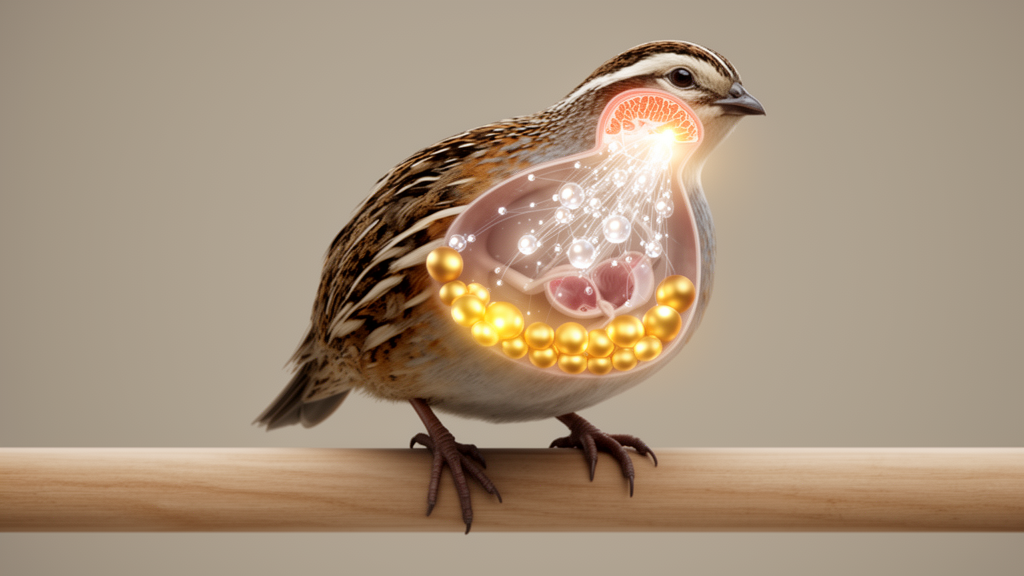
A single small protein made in the hypothalamus can tip the balance of an animal’s entire energy budget, according to a new study in Japanese quail. Researchers at Hiroshima University report that chronic delivery of neurosecretory protein GM, or NPGM, an 83-amino-acid hypothalamic factor, drove marked fat deposition in both sexes while simultaneously dampening gonadal development and sex hormone levels. The findings, published in Frontiers in Neuroscience, position NPGM as a neuroendocrine switch that appears to divert resources away from reproduction and toward lipid storage during the critical window of sexual maturation.
Energy homeostasis is governed centrally by the brain, which integrates nutritional, hormonal, and environmental signals to decide how calories are spent. In vertebrates, hypothalamic neuropeptides coordinate feeding behavior, energy expenditure, and lipid metabolism, and this coordination becomes especially visible in species that respond to seasonal cues. Reproduction is among the most energetically expensive events in an animal’s life cycle, and the onset of sexual maturation demands a coordinated redistribution of resources from growth and storage toward gonadal development. Yet the specific hypothalamic factors that decide whether energy flows into fat reserves or reproductive tissue have remained poorly defined, particularly in birds, where some neuropeptides act in ways that differ from their roles in mammals.
NPGM was first identified as a novel secretory protein in the chicken hypothalamus, and its gene is conserved across vertebrates including chickens, quails, rats, and humans. In Japanese quail, NPGM-expressing cells sit in the medial mammillary nucleus and project neural fibers to the median eminence. Previous work showed that chronic central administration of NPGM induced fat accumulation without overeating in neonatal chicks, while in mice, acute injection of NPGM or stimulation of NPGM-expressing neurons promoted feeding. NPGM has a paralogous gene, NPGL, encoding neurosecretory protein GL; chronic administration or hypothalamic overexpression of NPGL induces obesity in chicks and rodents, whereas double knockout of both genes produces lean mice with reduced food intake and elevated energy expenditure. Together, the two proteins appear to constitute an independent peptide family central to energy regulation.
To probe NPGM’s role during puberty, the team turned to Japanese quail, which reach sexual maturity rapidly under simple photoperiod manipulation and retain seasonal migratory behavior, making them an ideal model. Five-week-old quails at the onset of puberty received continuous intracerebroventricular infusion of synthetic NPGM at 15 nanomoles per day for 13 days via osmotic pumps connected to cannulas targeting the lateral ventricle. The researchers monitored body mass, food intake, and water intake daily, then measured tissue and organ masses, serum metabolites including glucose, fatty acids, triglycerides, testosterone, and 17β-estradiol, hepatic triglyceride content, and gene expression profiles across the hypothalamus, liver, and abdominal fat.
The results in males were striking. NPGM infusion significantly increased body mass gain, cumulative food intake, and cumulative water intake, and enlarged subcutaneous, abdominal, and gizzard fat depots. The liver, pancreas, and heart were heavier in treated males, although muscle masses were unchanged. Crucially, testicular mass relative to body mass fell significantly, and serum testosterone dropped while serum and hepatic triglycerides rose. Gene expression analysis revealed a corresponding molecular signature: hepatic SCD1, a lipogenic enzyme, was upregulated, while CGI-58, PPARγ, SLC2A2, and CD36 were downregulated. In abdominal fat, LPL expression decreased significantly. These patterns suggest that NPGM-induced fat gain in males stems not from enhanced fatty acid uptake but from suppressed lipid mobilization and utilization, compounded by reduced testosterone, which in humans and rodents is a recognized risk factor for visceral fat accumulation.
Females told a different story. NPGM-treated females accumulated subcutaneous and abdominal fat without any increase in food intake, body mass gain, or hepatic triglyceride content. Ovarian mass showed a decreasing trend relative to body mass, and serum 17β-estradiol levels fell. In the liver, expression of VTG2 and APOV1, genes encoding yolk protein precursors produced in response to estrogen, was significantly reduced. In abdominal fat, the lipolytic and transport genes ATGL, LPL, and FATP were all downregulated. The authors interpret this as a shift in lipid allocation: with yolk precursor synthesis dampened, lipids that would normally be routed to developing follicles are instead retained in adipose tissue. This fits with observations that visceral fat mass normally declines in laying hens as lipids are redirected toward yolk production.
Hypothalamic gene expression added another layer of intrigue. NPGM administration reduced expression of AGRP, an orexigenic neuropeptide, in both sexes, while NPY was additionally reduced in females. Notably, expression of GnRH and GnIH, the two key hypothalamic neuropeptides controlling reproductive function, remained unchanged in both sexes, suggesting that NPGM’s effects on gonads and sex hormones are not mediated through direct regulation of the canonical reproductive axis. The downstream signaling pathway of NPGM remains unclear, although GPR83 has been proposed as a candidate receptor based on in vitro binding assays, and NPGM appears to be co-expressed in a subset of AgRP neurons in mice.
The sex-specific responses raise broader questions about how hypothalamic feeding circuits are wired differently in males and females. In mammals, the orexigenic actions of NPY and AgRP are modulated by sex hormones, particularly estradiol, and anorexigenic POMC neurons show enhanced activity in females. Similar sex differences in feeding-related gene expression have been documented in chickens. Because basal NPGM expression does not differ between male and female quails, the authors suggest that the divergent effects likely reflect differences in the neural networks or hormonal environments through which NPGM acts, rather than differences in the peptide itself. Interestingly, while NPGM gene expression responds to fasting in both birds and mammals, pharmacological administration has produced opposite effects on feeding in the two groups, in chicks suppressing intake and in mice stimulating it, a puzzle the authors flag for future evolutionary study.
The study has limitations the authors acknowledge. Male and female experiments were conducted independently, precluding direct statistical comparison between sexes, and the work relied on chronic administration of exogenous NPGM, leaving the physiological role of endogenous NPGM unresolved. Future studies using avian adeno-associated virus-mediated overexpression and genome editing to generate loss-of-function models in quail are planned. Moreover, because quail are long-day breeders with strong photoperiodic responses, and the experiments were run exclusively under long-day conditions, it remains unknown whether NPGM’s actions hold under short-day states. Given that seasonally breeding species enhance fat deposition after the breeding season to prepare for migration or overwintering, NPGM may prove to be a seasonal gatekeeper coordinating energy allocation among storage, reproduction, and migration.
For now, the study delivers a clear message: a single hypothalamic microprotein can reorganize an animal’s metabolic priorities at puberty, pushing resources into fat depots at the expense of gonadal maturation, and doing so through distinct molecular routes in each sex. As obesity research increasingly looks to the brain’s energy-allocation circuitry, NPGM and its paralog NPGL offer a fresh and evolutionarily conserved entry point into one of biology’s oldest trade-offs.
Subject of Research: Role of hypothalamic neurosecretory protein GM in energy allocation, fat deposition, and gonadal hormone regulation during sexual maturation in Japanese quail
Article Title: Hypothalamic neurosecretory protein GM causes fat deposition and affects gonadal hormones in Japanese quail
Article References: Kato, M., Iwakoshi-Ukena, E., Furumitsu, M., Narimatsu, Y., Yatsuda, C., Nakamura, Y., & Ukena, K. (2026). Hypothalamic neurosecretory protein GM causes fat deposition and affects gonadal hormones in Japanese quail. Frontiers in Neuroscience, 20, Article 1980898. https://doi.org/10.3389/fnins.2026.1980898
Image Credits: AI Generated
DOI: 10.3389/fnins.2026.1980898
Keywords: NPGM, hypothalamus, Japanese quail, fat deposition, sexual maturation, testosterone, 17β-estradiol, lipid metabolism, neuropeptide, energy homeostasis, reproduction, neuroendocrinology
News Source: Ophelia Keating. (October 17, 2026). Tiny Hypothalamic Protein NPGM Redirects Energy From Reproduction to Fat in Quail. Scienmag.