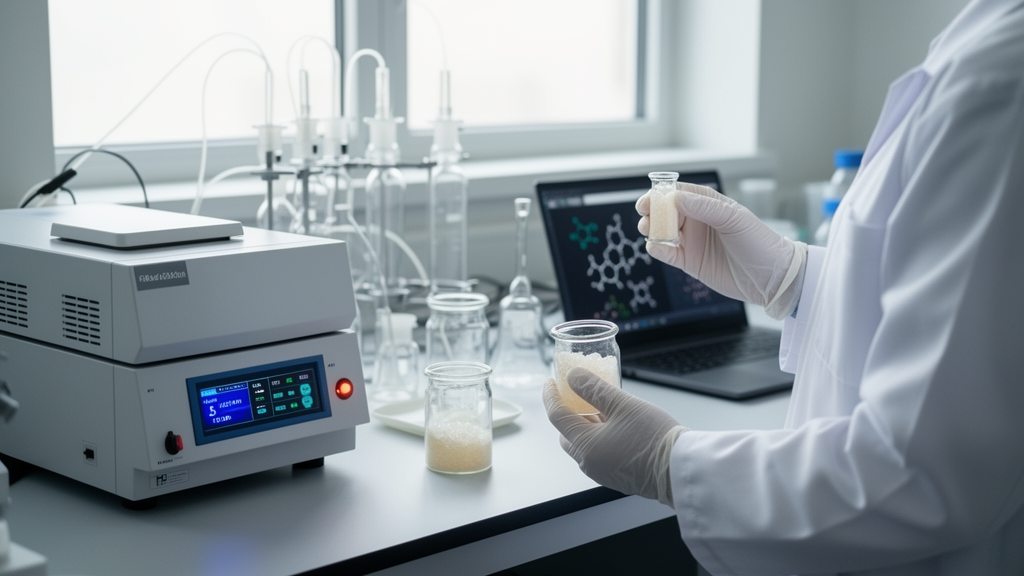
Scientists have mapped the lipophilic fingerprints of thirty-one newly synthesized stilbene derivatives inspired by the natural anticancer agent combretastatin A-4, combining five reversed-phase high performance liquid chromatography systems with computational prediction and chemometric pattern recognition. The study, published in the journal Pharmacia, offers a detailed physicochemical portrait of a promising class of hybrid molecules that merge the microtubule-destabilizing pharmacophore of combretastatin A-4 with a benzoxazolone heterocycle, a scaffold known for antitumor, antiviral, antidepressant, antioxidant, and anti-inflammatory activity.
Lipophilicity, conventionally expressed as the logarithm of the partition coefficient between n-octanol and water, log P o/w, is one of the most influential parameters in early drug discovery. It governs how readily a molecule crosses cell membranes, binds to plasma proteins, and distributes through tissues, thereby shaping absorption, distribution, metabolism, excretion, and toxicity. According to Lipinski’s rule of five, orally administered small-molecule candidates should ideally fall between 0 and 5 on this scale. Values above that window are frequently associated with poor aqueous solubility, excessive plasma protein binding, tissue accumulation, receptor promiscuity, and elevated in vivo toxicity, while insufficient lipophilicity undermines the same pharmacokinetic machinery from the opposite direction.
Measuring that property experimentally has traditionally relied on the OECD shake flask method, a liquid-liquid extraction procedure that is slow, material-hungry, and unforgiving of impure samples. Reversed-phase HPLC has emerged as a faster and more economical alternative, requiring only tiny amounts of compound and tolerating impurities. Because different stationary phases, from conventional C18 silica to polymer-based supports, present distinct hydrophobic surfaces and residual silanol populations, running a candidate across several columns yields a richer picture of lipophilic behavior than any single system can provide.
In the new work, the researchers dissolved each of the thirty-one cis- and trans-styrylbenzoxazolone derivatives and injected them onto three different C18 columns operated with either methanol-water or acetonitrile-water mobile phases, generating five distinct chromatographic systems. Isocratic elution ran from 95 percent down to 60 percent organic modifier at 0.75 ml/min and 35 °C, with a diode array detector recording at 254, 274, 292, and 305 nm. Because direct measurement in pure water would demand prohibitively long run times, the team measured retention factors at each eluent composition and extrapolated the linear or quadratic relationship between log k and the organic fraction back to zero organic modifier, yielding the chromatographic hydrophobicity index log kw.
Choosing between the linear Snyder-Soczewinski model and its quadratic extension is not trivial, since the quadratic coefficients proved vanishingly small across all systems. The authors therefore applied Mandel’s test, the IUPAC-recommended Fisher F-test comparison of residual variances, to decide which regression form best described each analyte. After extending the mobile phase interval with additional 65 and 75 percent compositions, the test confirmed linear behavior for only a handful of compound-system pairs, including S55-Z in system A, S67-Z in system B, S44-E in system C, and S48-E in system D. Notably, no derivative required a linear model on system E, whose endcapped stationary phase suppresses unwanted secondary interactions and treats all the stilbenes uniformly.
The solvent itself left a clear imprint on the results. Methanol, a protonic solvent capable of hydrogen bonding, strengthens interactions between analyte and the hydrophobic C18 chains, prolonging retention, whereas aprotic, low-polarity acetonitrile competes more effectively in the mobile phase and elutes compounds faster. Accordingly, log kw values were consistently higher in the three methanol-water systems than in their acetonitrile counterparts. System C, built on a polymer-based matrix with wide 300 Å pores, showed the weakest retention, since large pores reduce diffusional obstruction and ease desorption, and the polymeric backbone changes the interaction mechanism altogether. System D, also polymeric and wide-pored, similarly produced the lowest retention values among the acetonitrile systems.
Molecular geometry mattered as well. In reversed-phase HPLC, retention mirrors the way a molecule threads itself between nonpolar stationary phase chains, a process favored by planar, elongated structures and nonpolar fragments. The trans, or E, isomers, being more extended than their cis counterparts, were expected to retain more strongly, and indeed every E-isomer outperformed its Z-partner on system A. Only scattered inversions appeared on the other systems, and two isomer pairs, S61-Z/S62-E on system D and S77-Z/S78-E on system E, converged to identical extrapolated log kw values despite different retention profiles across the mobile phase compositions.
On the computational side, the team used SwissADME to gather predictions from five algorithms: XLOGP3, an atomistic method with corrective factors and a knowledge-based library; WLOGP, a purely atomistic fragmental approach; MLOGP, a topological model built on thirteen molecular descriptors; SILICOS-IT, a hybrid of twenty-seven fragments and seven topological descriptors; and iLOGP, a physics-based method deriving free solvation energies in octanol and water through a Generalized-Born and surface area model. Their arithmetic mean forms the consensus clog P. The consensus values ranged narrowly from 3.10 to 3.24, placing every derivative comfortably within the Lipinski window. Compounds bearing three methoxy groups on ring A were the most polar, while those with a single methoxy group were the most lipophilic, and most E-isomers edged out their Z-analogues, with the largest isomer gap appearing at position 7 of the styryl residue.
Correlating experiment with theory revealed a decisive pattern. The methanol-water systems A, C, and E produced statistically significant agreement between clog P and chromatographic lipophilicity at p < .05, while the acetonitrile systems ranged from moderate (system B, p ≈ .05) to poor (system D, p > .05). The strongest correspondences appeared on the silica-based columns with methanol eluents, marking those configurations as the most reliable predictors of lipophilicity for this compound family, and singling out the polymer-based, wide-pore system D as the least suitable for these analytes.
Chemometrics then consolidated the picture. Hierarchical clustering analysis, visualized as a dendrogram built from a bottom-up merging algorithm and validated with the Sneath-Sokal dissimilarity index, split the compounds into two main clusters that loosely tracked the position of the styryl fragment on ring B. All 3,5-dimethoxy derivatives fell into cluster I, whereas the 3,4-dimethoxy analogues, with one exception, grouped into cluster II, which also harbored most of the Z-isomers and the lower-lipophilicity members of the set. Principal component analysis, using the Kaiser eigenvalue criterion and a statistically validated loading threshold based on p-values rather than arbitrary cut-offs, extracted two components explaining 41.98 and 23.69 percent of total variance. The first component behaved as a silica factor dominated by systems A, B, and E, while the second, shaped by the wide-pored polymeric systems C and D, acted as a polymeric factor. The score biplot confirmed the clustering and flagged S44-E and S74-E as the most strongly retained outliers across all five systems. Together, the chromatographic, computational, and chemometric results deliver a robust framework for steering future ADME-oriented optimization of these anticancer candidates.
Subject of Research: Lipophilicity characterization of novel combretastatin A-4 stilbene derivatives by reversed-phase HPLC and computational prediction
Article Title: Investigation of lipophilicity of new stilbene derivatives with chromatographic and computational approaches
Article References: Georgieva, S., Voyslavov, T., Chanev, C., & Petrov, O. (2026). Investigation of lipophilicity of new stilbene derivatives with chromatographic and computational approaches. Pharmacia, 73, Article e200443. https://doi.org/10.3897/pharmacia.73.e200443
Image Credits: AI Generated
DOI: 10.3897/pharmacia.73.e200443
Keywords: lipophilicity, combretastatin A-4, stilbene derivatives, reversed-phase HPLC, log P, benzoxazolone, chemometrics, principal component analysis, hierarchical clustering, ADME, drug discovery, SwissADME
News Source: Ophelia Keating. (October 17, 2026). New Combretastatin A-4 Stilbene Derivatives Profiled for Lipophilicity by Chromatography and Computation. Scienmag.