• HOME
  • NEWS
  • EXPLORE
    • CAREER
      • Companies
      • Jobs
    • EVENTS
    • iGEM
      • News
      • Team
    • PHOTOS
    • VIDEO
    • WIKI
  • BLOG
  • COMMUNITY
    • FACEBOOK
    • INSTAGRAM
    • TWITTER
Thursday, September 24, 2026
BIOENGINEER.ORG
No Result
View All Result
  • Login
  • HOME
  • NEWS
  • EXPLORE
    • CAREER
      • Companies
      • Jobs
        • Lecturer
        • PhD Studentship
        • Postdoc
        • Research Assistant
    • EVENTS
    • iGEM
      • News
      • Team
    • PHOTOS
    • VIDEO
    • WIKI
  • BLOG
  • COMMUNITY
    • FACEBOOK
    • INSTAGRAM
    • TWITTER
  • HOME
  • NEWS
  • EXPLORE
    • CAREER
      • Companies
      • Jobs
        • Lecturer
        • PhD Studentship
        • Postdoc
        • Research Assistant
    • EVENTS
    • iGEM
      • News
      • Team
    • PHOTOS
    • VIDEO
    • WIKI
  • BLOG
  • COMMUNITY
    • FACEBOOK
    • INSTAGRAM
    • TWITTER
No Result
View All Result
Bioengineer.org
No Result
View All Result
Home NEWS Science News Biology

Tiny fly from Los Angeles has a taste for crushed invasive snails

Bioengineer by Bioengineer
April 1, 2020
in Biology
Reading Time: 3 mins read
0
IMAGE
Share on FacebookShare on TwitterShare on LinkedinShare on RedditShare on Telegram

IMAGE

Credit: Kat Halsey

As part of their project BioSCAN – devoted to the exploration of the unknown insect diversity in and around the city of Los Angeles – the scientists at the Natural History Museum of Los Angeles County (USA) have already discovered numerous insects that are new to science, but they are still only guessing about the lifestyles of these species.

“Imagine trying to find a given 2 mm long fly in the environment and tracking its behavior: it is the smallest imaginable needle in the largest haystack. So when researchers discover new life histories, it is something worth celebrating,” explains Dr. Brian Brown, lead author of a recent paper, published in the scholarly open-access Biodiversity Data Journal.

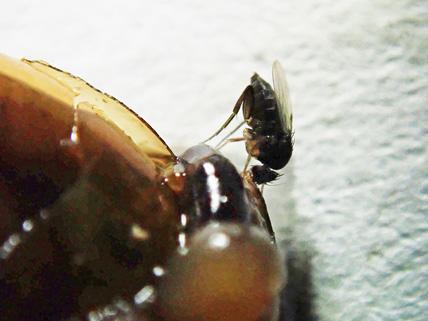
However, Brown and Maria Wong, former BioSCAN technician, while doing field work at the L.A. County Arboretum, were quick to reveal a curious peculiarity about one particular species discovered as part of the project a few years ago. They successfully lured female phorid flies by means of crushing tiny, invasive snails and using them as bait. In comparison, the majority of phorid flies, whose lifestyles have been observed, are parasitoids of social insects like ants.

Within mere seconds after the team crushed tiny invasive snails (Oxychilus draparnaudi), females representing the fly species Megaselia steptoeae arrived at the scene and busied themselves feeding. Brown and Wong then collected some and brought them home alive along with some dead snails. One of the flies even laid eggs. After hatching, the larvae were observed feeding upon the rotting snails and soon they developed to the pupal stage. However, none was reared to adulthood.

Interestingly, the host species – used by the fly to both feed on and lay eggs inside – commonly known as Draparnaud’s glass snail, is a European species that has been introduced into many parts of the world. Meanwhile, the studied fly is native to L.A. So far, it is unknown when and how the mollusc appeared on the menu of the insect.

To make things even more curious, species of other snail genera failed to attract the flies, which hints at a peculiar interaction worth of further study, point out the scientists behind the study, Brown and Jann Vendetti, curator of the NHM Malacology collection. They also hope to lure in other species of flies by crushing other species of snails.

###

In recent years, the BioSCAN project led to other curious discoveries from L.A., also published in Biodiversity Data Journal. In 2016, a whole batch of twelve previously unknown scuttle fly species was described from the heart of the city. A year later, another mysterious phorid fly was caught ovipositing in mushroom caps after Bed & Breakfast owners called in entomologists to report on what they had been observing in their yard.

Original source:

Brown BV, Vendetti JE (2020) Megaselia steptoeae (Diptera: Phoridae): specialists on smashed snails. Biodiversity Data Journal 8: e50943. https://doi.org/10.3897/BDJ.8.e50943

Media Contact
Dr. Brian Brown
[email protected]

Related Journal Article

http://dx.doi.org/10.3897/BDJ.8.e50943

Tags: BiodiversityBiologyEcology/EnvironmentEntomologyZoology/Veterinary Science
Share12Tweet8Share2ShareShareShare2

Related Posts

Gut Bacteria Turn Sugarcane Waste into Fuel Gold in Biorefinery Breakthrough

Gut Bacteria Turn Sugarcane Waste into Fuel Gold in Biorefinery Breakthrough

September 24, 2026
New AI framework DePass cleans and merges multi-omics data across cells and tissues

New AI framework DePass cleans and merges multi-omics data across cells and tissues

September 24, 2026

Hidden Infections and Scarred Livers: Urban Schistosomiasis Runs Deeper Than Brazil’s Official Numbers Suggest

September 24, 2026

Malaria Parasite Membrane Enzymes Emerge as Promising New Drug Targets

September 24, 2026
Please login to join discussion

POPULAR NEWS

  • How Tumor Metabolism Decides Whether Colorectal Cancer Immunotherapy Works

    29 shares
    Share 12 Tweet 7
  • MicroRNA miR-196a Clears Toxic Huntington’s Protein Clumps by Suppressing Rad23b

    29 shares
    Share 12 Tweet 7
  • Stem Cell Screening Platform Hunts for Drugs to Halt Cardiac Fibrosis

    29 shares
    Share 12 Tweet 7
  • Sierra Leone finds outbreak response, not detection, is where precious days are lost

    29 shares
    Share 12 Tweet 7

About

We bring you the latest biotechnology news from best research centers and universities around the world. Check our website.

Follow us

Recent News

How Tumor Metabolism Decides Whether Colorectal Cancer Immunotherapy Works

MicroRNA miR-196a Clears Toxic Huntington’s Protein Clumps by Suppressing Rad23b

Stem Cell Screening Platform Hunts for Drugs to Halt Cardiac Fibrosis

Subscribe to Blog via Email

Enter your email address to subscribe to this blog and receive notifications of new posts by email.

Join 85 other subscribers
  • Contact Us

Bioengineer.org © Copyright 2023 All Rights Reserved.

Welcome Back!

Login to your account below

Forgotten Password?

Retrieve your password

Please enter your username or email address to reset your password.

Log In
No Result
View All Result
  • Homepages
    • Home Page 1
    • Home Page 2
  • News
  • National
  • Business
  • Health
  • Lifestyle
  • Science

Bioengineer.org © Copyright 2023 All Rights Reserved.