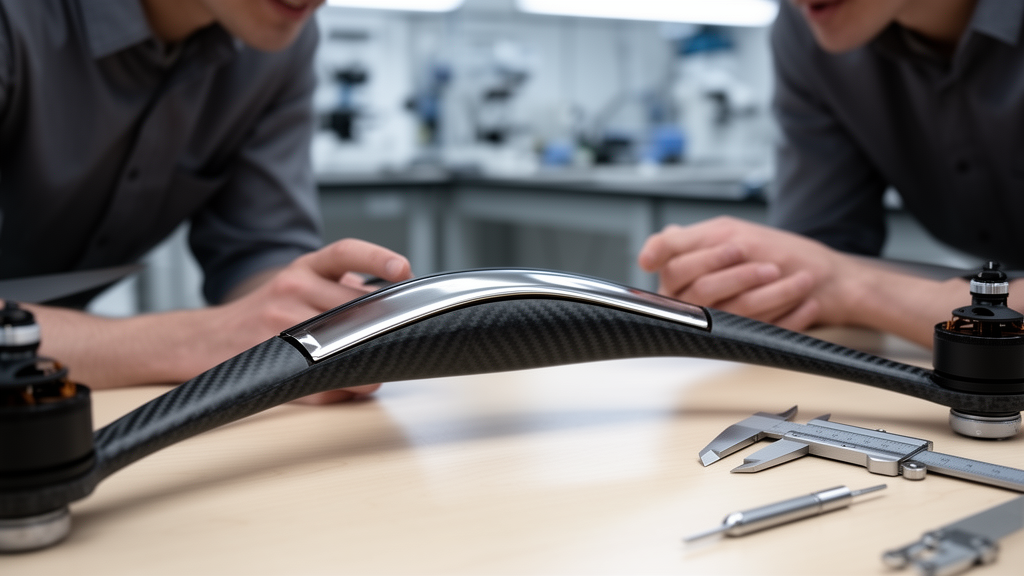
Researchers at the Korea Advanced Institute of Science and Technology have developed a structural lithium-sulfur battery cathode capable of maintaining stable electrical performance inside curved and hollow structures. Led by Professor Il-Kwon Oh from the Department of Mechanical Engineering, the research team fabricated the electrode by growing ultrafine nanowires directly onto woven carbon cloth, creating a monolithically integrated scaffold designed to serve simultaneously as a mechanical support and an energy storage medium for drones and robotic systems.
In robotics and unmanned aerial vehicle engineering, maximizing energy storage capacity while minimizing device weight and occupied volume remains a primary design constraint. Conventional vehicle architectures rely on separate structural airframes and discrete, rigid battery packs, restricting the extent to which overall platform weight can be reduced. Structural energy storage addresses this challenge by converting load-bearing airframe parts, such as landing gear or robotic limbs, into functional battery components.
Implementing multifunctional structural batteries in practice requires energy storage cells that conform to non-planar structural geometries. Unmanned aerial vehicle landing legs and robotic support frames frequently incorporate curved, hollow, or tubular surfaces that cannot accommodate conventional flat battery configurations. To resolve this geometric restriction, the KAIST team focused on engineering an electrode architecture capable of conforming to tightly curved, three-dimensional enclosures without sacrificing mechanical durability or electrochemical activity.
The engineering team selected a lithium-sulfur electrochemical system, which utilizes sulfur as the active cathode material. Lithium-sulfur chemistries provide theoretical potential for high energy storage capacity at a relatively low material weight compared to traditional alternatives. Within this system, the cathode acts as a critical functional electrode that governs the redox reactions occurring during electrical charge and discharge cycles.
Despite these theoretical storage advantages, lithium-sulfur systems encounter operational obstacles that hinder long-term performance. Elemental sulfur has poor electrical conductivity, and intermediate compounds termed lithium polysulfides dissolve into the electrolyte during operation. The migration of these dissolved polysulfides away from the cathode disrupts the reversible electrochemical reactions required for efficient energy retention, accelerating capacity loss over repeated cycling.
Conventional electrode fabrication techniques introduce additional structural vulnerabilities when subjected to physical movement. Active materials are typically applied as a surface slurry coating onto a conductive substrate, making the layer susceptible to cracking or complete delamination under repeated bending or external mechanical stress. When active material detaches from the underlying current collector, the electrical pathways are severed and the electrode degrades rapidly.
To overcome delamination and polysulfide migration simultaneously, the KAIST researchers grew nickel cobalt selenide nanowires directly on the surfaces of interwoven carbon fibers. Nanowires are ultrafine structures with dimensions measured on the scale of nanometers, where one nanometer represents one billionth of a meter. The nickel cobalt selenide compound, consisting of nickel, cobalt, and selenium, catalyzes sulfur-related redox reactions while chemically anchoring lithium polysulfides to limit their dissolution and migration away from the reaction zone.
Because the nickel cobalt selenide nanowires are grown directly out of the woven carbon cloth substrate rather than spread as a secondary surface coating, the cathode establishes firmly anchored, continuous electrical conduction pathways. In cyclic mechanical deformation tests, the monolithic electrode underwent 1,000 bending cycles at a tight curvature radius of 2.5 millimeters. Following testing, the nanowires remained intact and securely attached to the carbon fiber surfaces, displaying no structural collapse, cracking, or material detachment.
To verify the practical viability of the electrode within non-planar enclosures, the researchers assembled the material into functional lithium-sulfur pouch cells. They incorporated the resulting cells into multiple curved and angular housings, including oval, square, and drone-leg structural components. In each configuration, the integrated lithium-sulfur battery successfully powered a light-emitting diode, demonstrating reliable electrical discharge across varied structural contours.
The team also subjected the integrated structural battery to external mechanical load testing to evaluate electrical stability under severe mechanical strain. When installed within a cylindrical housing, the battery retained 99.8 percent of its initial operational voltage even under external mechanical forces sufficient to fracture the surrounding structural frame. In a parallel loading evaluation, a connected light-emitting diode maintained steady illumination without flickering or interruption during structural failure.
Looking toward practical deployment, the authors noted that the electrode architecture could eventually be paired with load-bearing composite materials, such as carbon fiber and resin matrices, to construct multifunctional drone legs and robotic airframes. However, the researchers emphasized that further experimental research remains necessary to quantify precisely how much structural weight can be eliminated and the degree to which operational flight times or robot mission durations can be extended in operational conditions.
The study, titled “Monolithically integrated NiCo2Se4 nanowire–carbon cloth cathode scaffolds for non-planar lithium-sulfur structural-battery integration,” was published in the journal Advanced Composites and Hybrid Materials. The paper was first-authored by KAIST doctoral candidate Jawon Ha, with Professor Il-Kwon Oh and Professor Leif E. Asp of Chalmers University of Technology serving as co-corresponding authors, supported by grants from the National Research Foundation of Korea and the Ministry of Science and ICT.
The formal announcement of the research came from the Korea Advanced Institute of Science and Technology under the leadership of President Choongsik Bae. The project brought together researchers across international institutions, pairing the Department of Mechanical Engineering at KAIST with Chalmers University of Technology in Sweden. Within this international collaboration, doctoral candidate Jawon Ha carried out the experimental investigations as the study’s first author. Professor Il-Kwon Oh of KAIST and Professor Leif E. Asp of Chalmers University of Technology directed the investigation as co-corresponding authors, publishing their peer-reviewed findings in volume nine of the journal Advanced Composites and Hybrid Materials.
Explaining the engineering rationale behind the design, Professor Oh highlighted the geometric constraints in autonomous hardware. “Drones and robots contain many curved and hollow components, so it is essential for batteries to operate reliably when integrated into these structures,” said Professor Il-Kwon Oh. “Our study demonstrates the potential for drone legs and robotic frames to serve not only as structural components but also as energy storage systems.” By transforming load-bearing appendages into functional energy storage, mobile platforms can overcome the spatial limitations imposed by conventional separate internal battery packs.
At the foundation of the cathode scaffold is woven carbon cloth composed of interwoven carbon fibers. This textile architecture acts as a mechanically robust, flexible, and electrically conductive foundation capable of withstanding physical distortion. Rather than applying active compounds through conventional post-fabrication slurry coatings that frequently detach under repeated stress, the research team directly grew ultrafine nickel cobalt selenide nanowires across the carbon fiber surfaces. Nanowires represent exceptionally thin, wire-like structures measured on the scale of nanometers, with a single nanometer corresponding to one billionth of a meter. By synthesizing these ternary structures directly from the carbon fibers, the monolithic design maintains continuous electrical pathways even when subjected to substantial physical bending.
The selection of nickel cobalt selenide specifically addresses the underlying electrochemical vulnerabilities that historically constrain lithium-sulfur energy storage systems. Lithium-sulfur chemistries are favored because sulfur cathodes provide high energy storage capacity at a relatively low weight, functioning as the central site for electrochemical reactions during charge and discharge cycles. However, sulfur suffers from inherently poor electrical conductivity, and intermediate compounds called lithium polysulfides tend to dissolve into the electrolyte and migrate away from the electrode during cycling. This migration disrupts necessary electrochemical reactions and diminishes storage performance. The nickel cobalt selenide compound, consisting of nickel, cobalt, and selenium, provides a dual remedial mechanism by facilitating sulfur-related electrochemical reactions while capturing lithium polysulfides to limit their migration.
The structural cathode demonstrated high mechanical durability when subjected to rigorous bending evaluations designed to test integration inside tight spaces. In laboratory trials, the electrode completed 1,000 repeated bending cycles at a curvature radius of only 2.5 millimeters. Following these cycles, the nanowires remained firmly anchored to the underlying carbon fiber surfaces without showing visible signs of damage or structural collapse. To verify operational feasibility, the researchers assembled the cathode into lithium-sulfur pouch cells and inserted them into multiple non-planar component shapes, including oval and square enclosures as well as curved drone landing legs. In every geometry, the integrated battery successfully delivered electrical power to illuminate a light-emitting diode, confirming reliable electrical output across diverse physical geometries.
To evaluate performance as a structural battery under mechanical strain, the team tested the cell installed inside a cylindrical structure subjected to external loads. When subjected to a load sufficient to fracture the surrounding structural frame, the battery retained 99.8% of its initial voltage. In a separate loading evaluation, an LED powered by the battery remained illuminated without interruption or flickering, confirming that the cell maintained stable electrical delivery during severe physical loading.
Looking ahead, the authors noted that this technology could be combined with load-bearing composite materials, such as carbon fibers and resins, to fabricate drone legs and robotic frames that provide both structural support and energy storage. However, the researchers emphasized that further research is needed to determine how much weight could be saved and how significantly flight times or operating durations could be extended in practical applications. The research received funding from the National Research Foundation of Korea funded by the Ministry of Science and ICT, and the Nano & Material Technology Development Program. Additional support was provided by the Human Resource Development Program for Industrial Innovation through the Korea Institute for Advancement of Technology, funded by the Ministry of Trade, Industry and Energy, and the Brain Pool Program.
Subject of Research: Structural lithium-sulfur battery cathodes for curved drone and robotic components
Article Title: KAIST develops Li-S structural battery electrode that turns curved drone legs into energy storage spaces
Article References: KAIST develops Li-S structural battery electrode that turns curved drone legs into energy storage spaces. Original publication (Bibliographic details unavailable.)
Image Credits: AI Generated
DOI: Not provided
Keywords: lithium-sulfur batteries, structural batteries, KAIST, nickel cobalt selenide, nanowires, carbon cloth, cathode scaffolds, drone components, non-planar energy storage, lithium polysulfides, mechanical durability, bending tests, Department of Mechanical Engineering, Il-Kwon Oh, Advanced Composites and Hybrid Materials, composite materials
News Source: Faith Mcneil. (November 18, 2026). Engineers Develop Curved Lithium-Sulfur Battery Electrodes for Drone Frame Energy Storage. Scienmag.