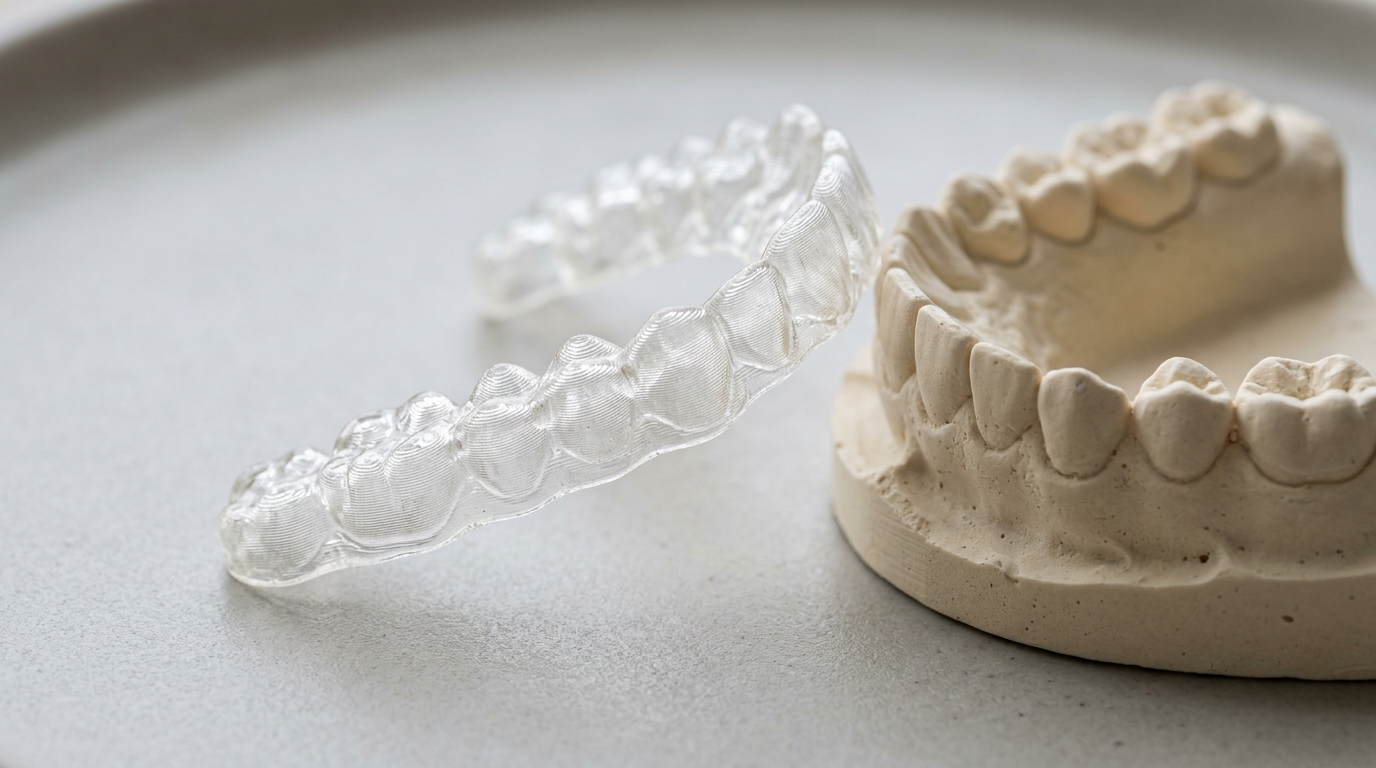
Direct-printed clear aligners have been promoted as a way to fine-tune orthodontic force delivery by thickening specific regions of the plastic shell. A laboratory study now suggests that this design freedom may matter less than expected. When researchers systematically thickened 3D-printed aligners in different areas and measured the forces produced during simulated lowering of the lower front teeth, the modifications made essentially no difference to the forces and moments generated.
The study, published in the journal Digital and Aligner Orthodontics, evaluated direct-printed aligners, or DPAs, made from a shape-memory photopolymer resin called TA-28. The researchers compared six thickness configurations against a conventional thermoformed aligner, or TFA, control during programmed intrusion of the mandibular incisors, the movement used to level an exaggerated curve of Spee, the upward arc formed by the lower teeth. Their central question was whether local or global thickening of the printed plastic could improve the predictability of this clinically difficult movement.
Each aligner was designed to intrude the four lower incisors by 0.5 millimetres. The six DPA groups included uniform shells of 0.5 millimetres and 1.0 millimetre, as well as selectively reinforced designs with extra thickness added to the buccal, incisal, or lingual surfaces, or combinations of these. The reinforced regions extended across the canine-to-canine segment to avoid abrupt stiffness transitions, although the canines themselves remained passive and only the incisors were programmed to move. The thermoformed control was fabricated with a lower programmed activation of 0.25 millimetres, described as the maximum clinically recommended displacement for conventional systems, because prior work indicates that even 0.3 millimetres can generate excessive, non-physiological forces in thermoformed plastic.
To capture the biomechanics, the team built an in vitro apparatus from a digital scan of a master typodont, mounting five multi-axis force and moment transducers on individual teeth: the lower right and left central incisors, the lower right and left lateral incisors, and the lower right first molar. The assembly sat inside a climate-controlled chamber held at 37 degrees Celsius to mimic intraoral conditions. Aligners were stored sealed before testing, and the DPA specimens were heated to their glass transition temperature of 69.4 degrees Celsius to activate their shape-memory properties before seating. After the sensors were zeroed and the force readings stabilised, data were recorded continuously for 40 seconds at a sampling frequency of 10 hertz.
The results were unambiguous on the thickness question. Across the six DPA configurations, no statistically significant differences emerged in the forces or moments generated, meaning that neither localized nor global thickening measurably influenced force delivery. Force magnitudes across all DPA groups remained low and consistent. The control group with uniform 0.5 millimetre thickness produced forces within what the authors describe as the optimal biological range, with minimal unwanted tipping, torque, or rotation. The researchers attribute this stability to the intrinsic properties of the TA-28 material, whose higher elastic modulus and dimensional stability appear to confer sufficient rigidity that geometric reinforcement adds nothing measurable.
The thermoformed control told a different story. Despite its lower programmed activation, the TFA generated significantly higher and more variable forces and moments than every printed group across most measured axes. On the lower right central incisor, the differences were driven primarily by the thermoformed group, which produced greater buccolingual force, mesiodistal force, vertical force, and rotational moment. On both lateral incisors, all six movement components differed significantly among groups, with the thermoformed aligner substantially higher on every parameter and producing a considerable lingual force that the printed aligners did not. On the lower right first molar, where no movement was programmed at all, the thermoformed aligner again showed markedly higher forces and moments, particularly in rotational and tipping components, indicating substantial unintended biomechanical effects on a tooth meant to serve purely as anchorage.
A consistent asymmetry emerged within the anterior segment. In every DPA configuration, the lateral incisors experienced significantly higher intrusive forces than the central incisors, even though both had been programmed for identical 0.5 millimetre intrusion. The authors interpret this as an anchorage relationship: the central incisors, positioned centrally in the arch and mechanically reinforced by bilateral contacts and proximity to the midline, resist vertical displacement and function as anchorage units, while the laterals, sitting slightly distal at the arch curvature, are less constrained and express the majority of the programmed movement. The same pattern appeared only slightly in the thermoformed group, and only on the lower right central incisor.
Buccolingual behaviour followed a similar divide. Buccal forces across the printed groups remained minimal and uniform, with no significant differences among the thickness designs, whereas the thermoformed aligner produced significantly higher and more variable buccal forces, including a substantial lingual force on the lower left lateral incisor despite high buccal forces on the other three incisors. Crown torque showed the same contrast: printed groups held torque magnitudes consistently low and near baseline, while the thermoformed group displayed significantly higher torque with a marked side-dependent difference, generating lingual crown torque on the right lateral incisor and severe buccal crown torque on the left. Because all aligners were made from the same master model and tested on the same apparatus, the authors suggest this repeatable pattern likely reflects a systematic asymmetry in crown morphology, initial inclination, contacts, or sensor alignment rather than random manufacturing variation, although the study could not isolate the individual contributions.
The findings place thickness modification in context against prior literature. Earlier work with a more flexible resin, TC-85, did find that changing labial and lingual thickness altered forces and moments, and other studies have shown that increasing thermoformed aligner thickness proportionally increases force. The current authors argue that the stiffer TA-28 resin already provides enough mechanical rigidity and energy control that localized geometric changes become irrelevant. They also note that the results align with previous reports that direct-printed aligners deliver lighter, more physiological forces than thermoformed ones, including findings that printed aligners stabilise forces between 0.7 and 1.7 newtons at intraoral temperature while similarly activated thermoformed aligners can reach 15 newtons, well beyond physiological limits, with forces that rise exponentially rather than minimally as displacement increases.
The study carries clear limitations. It was a static in vitro model without occlusal loading, periodontal dynamics, or ligament-mediated stress dissipation, and the authors note that the molar forces recorded likely overestimate clinical conditions, where functional bite contacts tend to stabilise posterior teeth. Only simultaneous intrusion of the mandibular incisors in a well-aligned dentition was evaluated; canine intrusion and multiple simultaneous tooth movements were not tested, and the proposed staging approach requires further investigation. The 40-second recording window also precluded assessment of stress relaxation and time-dependent force decay. Additionally, some very low-magnitude non-programmed force components in the DPA groups approached the sensor’s single-sample resolution limit and should be read as very low force levels rather than precise absolute values. The authors conclude that, once a favourable force system is achieved through material properties, additional geometric modification may offer limited benefit, and that staged sequencing of the anterior teeth, intruding the lateral incisors before the centrals, may help balance load and improve the predictability of curve of Spee leveling with direct-printed aligners.
Subject of Research: Biomechanical forces generated by variable-thickness direct-printed aligners during mandibular incisor intrusion compared with thermoformed aligners
Article Title: Biomechanical analysis of variable thickness direct-printed aligners for mandibular intrusion
Article References: Clary, C. W., Faria, T. V., Kim, Y. J., McCray, J., Foley, P., Miranda, G., & Kim, K. B. (2026). Biomechanical analysis of variable thickness direct-printed aligners for mandibular intrusion. Digital and Aligner Orthodontics, 1(1), Article 13. https://doi.org/10.1007/s44525-026-00017-1
Image Credits: AI Generated
DOI: 10.1007/s44525-026-00017-1
Keywords: direct-printed aligners, thermoformed aligners, clear aligner therapy, curve of Spee, mandibular incisor intrusion, orthodontic biomechanics, TA-28 resin, aligner thickness, force measurement, anchorage, 3D printing, in vitro study
News Source: Ophelia Keating. (November 5, 2026). Thickness Tweaks Fail to Change Forces From 3D-Printed Aligners. Scienmag.