
image:
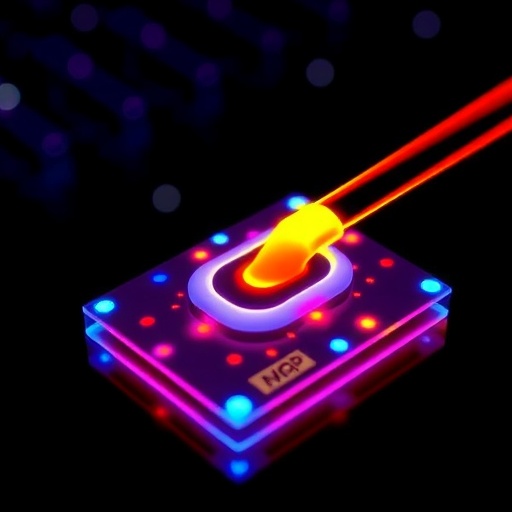
Thermal treatment of ZnMgO nanoparticles reduces the density of oxygen vacancies and increases the nanoparticle size, enabling quantum dot light-emitting diode (QLED) devices to achieve uniform electroluminescence with high efficiency, bright luminance and longer operating lifetime.
view more
Credit: Nano Research, Tsinghua University Press
Self-emissive quantum dot light-emitting diodes (QLEDs) are widely regarded as a next-generation display technology due to their narrow emission bandwidth, wide color gamut, and low-cost solution processability. However, the commercialization of QLEDs is severely restricted by a critical issue: the conventional acid-induced positive aging process is difficult to control, causing uneven luminescence, accelerated degradation, and poor batch-to-batch reproducibility.
A research team led by Xiang-Bing Fan, Zhuo Chen, and Yanzhao Li from BOE Technology Group Co., Ltd. proposed a simple and effective solution-processed thermal engineering method to modify ZnMgO nanoparticles used as electron transport layers in QLEDs. The team reported their findings in the journal Nano Research on May 22.
Characterization results showed that thermal treatment reduces the density of oxygen vacancies on ZnMgO by about 25% and increases nanoparticle size by nearly 30%. These modifications effectively weaken the dependence on acid-induced positive aging and enhance structural stability against acid corrosion.
Consequently, the optimized QLED devices exhibited significantly improved electroluminescence uniformity. The luminance reached over 60,000 cd/m² at 3 V, and the power efficiency exceeded 40 lm/W. More importantly, the device lifetime (T95 @ 1000 cd/m²) was tripled from about 5,400 hours to approximately 20,000 hours, meeting key industrial requirements for display applications.
“Traditional positive aging relies on acidic components from encapsulation resins, which causes uncontrollable reactions and limits device reliability. Our thermal treatment pre-passivates defects at the material level, making the fabrication process more stable and suitable for mass production,” said Xiang-Bing Fan, the first and corresponding author of the study.
The team verified the universality of this strategy in red, green, and blue QLEDs, as well as with different commercial UV-curable resins. All devices showed consistent improvements in luminescence uniformity, brightness, and stability.
This innovation solves the bottlenecks caused by uncontrollable positive aging and greatly promotes the industrial application of QLED displays. The researchers plan to further combine this electron transport layer engineering with optimized post-treatment techniques to achieve fully controllable aging for large-area AMQLED panels.
This work was supported by internal funding from the BOE Central Research Institute.
DOI Link:
About Nano Research
Nano Research is a peer-reviewed, open access, international and interdisciplinary research journal, sponsored by Tsinghua University and the Chinese Chemical Society, published by Tsinghua University Press on the platform SciOpen. It publishes original high-quality research and significant review articles on all aspects of nanoscience and nanotechnology, ranging from basic aspects of the science of nanoscale materials to practical applications of such materials. After 18 years of development, it has become one of the most influential academic journals in the nano field. Nano Research has published more than 1,000 papers every year from 2022, with its cumulative count surpassing 8,000 articles. In 2025 InCites Journal Citation Reports, its 2025 IF is 9.4 (8.3, 5 years), and it continues to be the Q1 area among the four subject classifications. Nano Research Award, established by Nano Research together with TUP and Springer Nature in 2013, and Nano Research Young Innovators (NR45) Awards, established by Nano Research in 2018, have become international academic awards with global influence.
Journal
Nano Research
DOI
10.26599/NR.2026.94908564
Article Title
Thermal engineering of ZnMgO enables high-reliability and long-lifetime quantum dot light-emitting diodes
Article Publication Date
22-May-2026
Media Contact
Mengdi Li
Tsinghua University Press
Office: 86-108-347-0580
Journal
Nano Research
DOI
10.26599/NR.2026.94908564
Article Title
Thermal engineering of ZnMgO enables high-reliability and long-lifetime quantum dot light-emitting diodes
Article Publication Date
22-May-2026