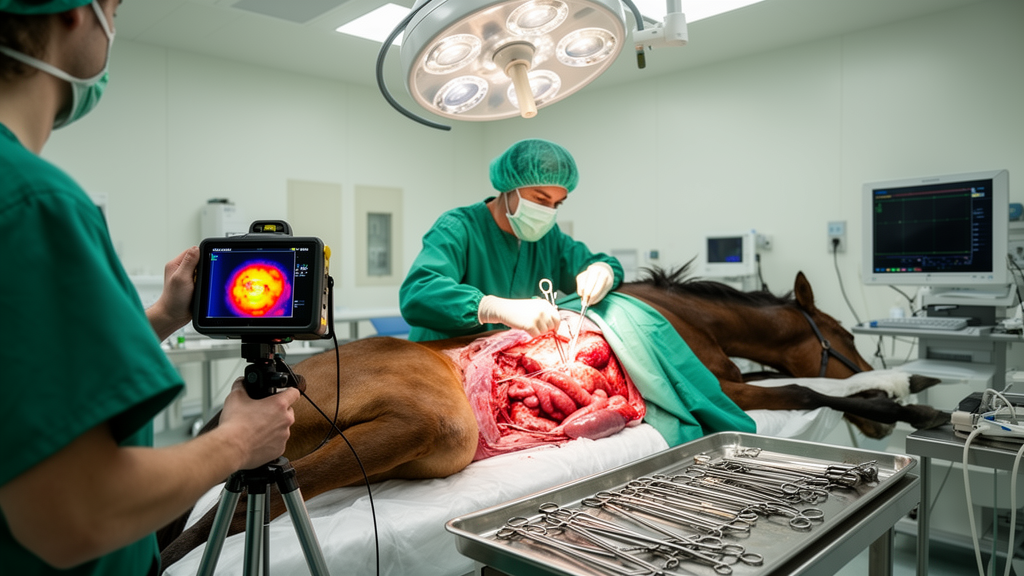
A 13-year-old Italian Saddle mare that arrived at a clinic with severe, unrelenting colic turned out to have a wooden stick lodged in her jejunum, where it had obstructed the bowel and perforated the intestinal wall. The case, reported in Frontiers in Veterinary Science, is notable not only for the unusual culprit but also for the technique the surgical team used alongside conventional judgment: a handheld infrared thermal camera that mapped surface temperatures of the intestine in real time while the surgeons decided how much bowel to remove.
The mare, weighing 422 kilograms, had been ill for roughly 24 hours before referral. She had already received medication on her home farm, including N-butylscopolammonium bromide combined with metamizole sodium and flunixin meglumine, but the pain persisted and worsened. On admission she was depressed and in marked abdominal discomfort. Her heart rate was 53 beats per minute, her respiratory rate 30 breaths per minute, her mucous membranes congested, and her capillary refill time exceeded three seconds. Rectal temperature was 38.8 degrees Celsius, and abdominal auscultation revealed markedly reduced gut sounds in all four quadrants. Rectal palpation identified multiple distended loops of small intestine, with no abnormalities detected in the colon or cecum.
Blood work reinforced the picture of a seriously compromised patient. The mare had marked leukocytosis of 16,600 cells per cubic millimeter, a packed cell volume of 35 percent, a total plasma protein concentration of 8 grams per deciliter, and severe hyperlactatemia of 15 millimoles per liter. Based on the heart rate, respiratory rate, leukocytosis, and elevated lactate, the clinicians judged that she met the criteria for Systemic Inflammatory Response Syndrome. Transabdominal ultrasonography confirmed multiple markedly distended small intestinal loops in the ventral abdomen and inguinal region. The team noted, however, that without measurements of markers such as serum amyloid A or fibrinogen, and without peritoneal fluid analysis, they could not definitively distinguish septic from non-septic systemic inflammation. With a primary differential diagnosis of a strangulating small intestinal lesion, emergency exploratory laparotomy was indicated.
Inside the abdomen, the intestinal loops were normally positioned, but a firm, irregular mass approximately 10 centimeters in diameter was found involving a jejunal segment and its mesentery. The mass had an uneven surface, and the surrounding tissue showed a localized chronic inflammatory reaction with minimal fibrin deposition and adhesions strictly confined to the lesion site. Crucially, there was no generalized peritonitis, free fluid, or severe peritoneal contamination, because the sealed-off reaction had prevented leakage into the abdominal cavity. The affected segment was exteriorized and isolated from the rest of the abdominal contents for closer evaluation.
Assessing whether bowel is alive enough to keep is one of the classic judgment calls in equine abdominal surgery. Traditionally, surgeons rely on subjective parameters: serosal color, intestinal motility, mesenteric arterial pulsation, and wall temperature. The problem, as the authors note, is that the macroscopic appearance of the intestine may not accurately reflect mucosal integrity or microvascular perfusion, and preservation of mucosal viability is considered the principal determinant of postoperative survival in horses with small intestinal disease. Infrared thermography offers a potential adjunct because tissue surface temperature is closely associated with local blood perfusion: warm loops generally indicate preserved microvascular flow, while persistently cool areas may suggest ischemic injury.
In this case, thermal images were captured with a FLIR ThermaCam E8, an uncooled microbolometer camera with a resolution of 320 by 240 pixels, a thermal sensitivity of 0.08 degrees Celsius at 30 degrees Celsius, and a stated accuracy of plus or minus 2 degrees Celsius. Images were acquired at a fixed distance of one meter and at approximately a 90-degree angle to the intestinal surface, with emissivity set at 0.98 and automatic corrections applied for reflected ambient temperature, distance, humidity, and atmospheric transmissivity. Ambient temperature in the operating room ranged from 20 to 24 degrees Celsius with roughly 60 percent relative humidity, and the surgeon paused for a few seconds between acquisitions, with about 10 seconds elapsing after removing his hands, to limit artifacts from manipulation and evaporative cooling.
The measurements were taken at three time points: T0 immediately after exteriorization of the affected segment, T1 during assessment of the resection margins, and T2 just before the bowel was returned to the abdomen. At baseline, the viable jejunal segment showed a mean surface temperature of 35.1 degrees Celsius, while the affected segment averaged 33.2 degrees Celsius, a thermal gradient of 1.9 degrees Celsius. At T1 the gradient narrowed to 0.4 degrees Celsius, with means of 34.6 and 34.2 degrees Celsius, and by T2 it had fallen to just 0.1 degrees Celsius, with means of 34.8 and 34.7 degrees Celsius. Based on the overall intraoperative assessment, including these findings, the selected stump was deemed suitable as a resection margin.
The surgeons performed a segmental enterectomy proximal and distal to the obstruction, preserving adequately perfused margins, and joined the ends with a simple full-thickness continuous suture of absorbable braided material. When the resected mass was later opened, it was found to contain a small wooden stick embedded in the intestinal wall. The mare’s recovery was uneventful. Her pain score on the Horse Grimace Scale, assessed independently by three observers, fell from 1.7 at admission to 0.7 eight hours after surgery and 0.3 at 24 hours. She was fed small amounts of hay starting 18 to 24 hours after surgery, discharged in good health 10 days later, and according to telephone follow-up had returned to regular riding within a few weeks, with no recurrence of colic reported 13 months after the operation.
The authors are careful about what the thermographic numbers do and do not prove. The 0.1-degree difference at T2 should not be read as evidence of equivalent microvascular perfusion, given that the camera’s stated accuracy was plus or minus 2 degrees Celsius, far larger than the measured gradient. Thermal sensitivity, the ability to detect small differences, is distinct from absolute measurement accuracy. No histopathology was performed on the resected margins, so the thermal patterns could not be correlated with microscopic evidence of ischemia or vascular injury, and no validated thermographic reference values or diagnostic thresholds exist for equine intestinal viability. Intraoperative factors such as tissue exposure, evaporative cooling, and camera geometry can also shift surface temperatures independently of perfusion. The resection decision rested on conventional clinical criteria, with IRT as a complement, and the authors describe their findings as preliminary and hypothesis-generating rather than validation of any specific temperature threshold.
Context from prior work supports the plausibility of the approach: previous studies have reported small intestinal surface temperatures in obstruction cases running roughly 2.4 to more than 5 degrees Celsius below well-perfused tissue, and experimental work in rats with severe intestinal lesions found differentials of about 1 to 2 degrees Celsius between compromised and uncompromised loops. On the diagnostic side, the case underscores how hard these foreign bodies are to find before surgery. Rectal palpation detects objects in segments such as the small colon only about half the time according to prior reports, and jejunal objects are typically unreachable rectally. Wooden material, with echogenic properties different from metal and a tendency to be masked by intestinal gas, is particularly difficult to identify on ultrasound. The authors conclude that foreign body perforation belongs on the differential list for horses with severe small intestinal colic that fails to respond to medical therapy, and that intraoperative thermography may serve as a promising complementary tool, pending larger studies with standardized protocols.
Subject of Research: Intraoperative infrared thermography for assessing intestinal viability during colic surgery in a horse with a jejunal wooden foreign body perforation
Article Title: Case Report: Incidental finding of a perforating wooden foreign body in the jejunum during surgical treatment of colic in a horse: use of intraoperative infrared thermography
Article References: Nanci, C., Biglietti, G., Hernández Avalos, I., Garbagnati, B., Liguori, P. L., Rizzo, M., Giannetto, C., & Interlandi, C. (2026). Case Report: Incidental finding of a perforating wooden foreign body in the jejunum during surgical treatment of colic in a horse: use of intraoperative infrared thermography. Frontiers in Veterinary Science, 13, Article 1911195. https://doi.org/10.3389/fvets.2026.1911195
Image Credits: AI Generated
DOI: 10.3389/fvets.2026.1911195
Keywords: horses, colic, jejunum, foreign body, intestinal perforation, infrared thermography, enterectomy, intestinal viability, veterinary surgery, case report, tissue perfusion, laparotomy
News Source: Ophelia Keating. (October 29, 2026). Thermal camera guides colic surgery after wooden stick perforates horse’s jejunum. Scienmag.