


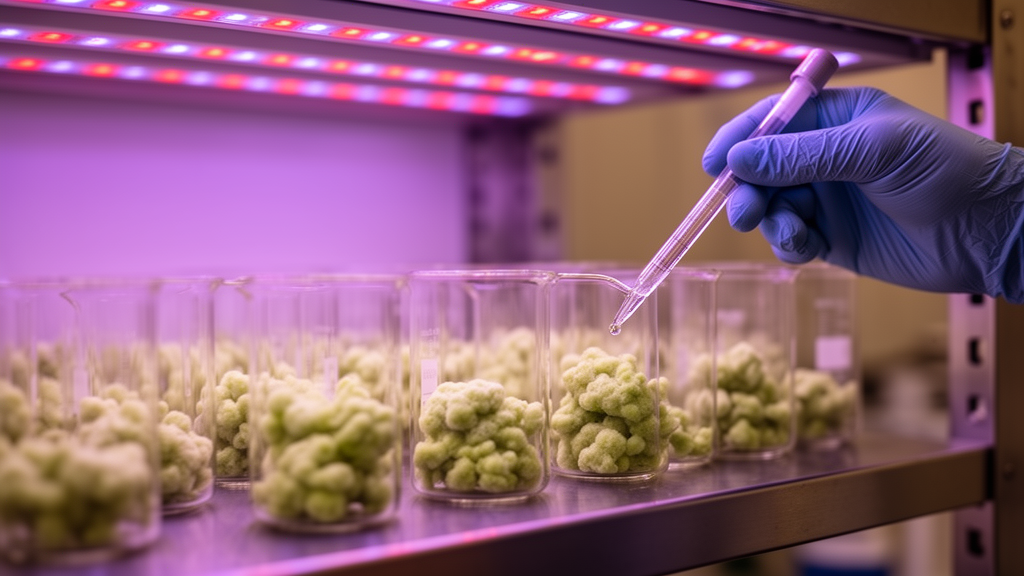
Scientists have developed an in vitro callus culture system for Stephania pierrei Diels, a medicinal plant valued for cepharanthine, a bioactive bisbenzylisoquinoline alkaloid with diverse pharmaceutical properties. Natural production of the compound is limited by the plant’s slow growth and inconsistent metabolite accumulation, prompting the researchers to optimize culture age, elicitor treatment, and light quality in sequence.
The study, published in BMC Plant Biology, found that callus cultures accumulated biomass rapidly between 15 and 35 days after subculture, while cepharanthine content peaked at 40 days. This developmental timing established the stage at which elicitor and light treatments were subsequently applied.
Among the elicitors tested, 100 µM methyl jasmonate (MeJA) applied for 6 days was the most effective at enhancing cepharanthine accumulation.
Light quality then provided a further boost. Under MeJA elicitation, a balanced blue-to-red LED ratio (B50R50) significantly increased cepharanthine accumulation to 1532.15 ± 52.67 µg g⁻¹ DW. The same treatment also promoted extracellular release of the alkaloid into the culture medium, a potentially useful feature for harvesting.
At the molecular level, quantitative RT-PCR showed strong upregulation of two biosynthetic genes in the benzylisoquinoline alkaloid pathway, 6OMT and CNMT, under the B50R50 light condition. The authors state that the targeted HPLC and transcriptional results support a MeJA-light-associated response under the tested conditions.
Exploratory GC-MS profiling of control and treated samples provided tentative annotations of lipid-, sterol-, and furan-related features. The researchers emphasize that these qualitative observations were not used to infer quantitative metabolite changes or pathway relationships, and the profiles do not establish causality.
Antioxidant assays and MTT-based cell-viability testing revealed treatment-dependent differences in the crude callus extract. However, the authors caution that these in vitro bioactivities cannot be attributed to cepharanthine alone, since the assays were performed on crude extracts containing many compounds.
The study concludes that sequential optimization of callus developmental stage, MeJA elicitation, and light quality offers an effective in vitro strategy for increasing cepharanthine accumulation in S. pierrei callus cultures. The authors note that the biological activities of the crude extracts require compound-specific validation before any attribution to cepharanthine and assessment of its pharmaceutical potential.
As an open-access article published on 23 October 2026, the work is being shared early as a peer-reviewed, accepted version that is citable and carries a permanent DOI, subject to further edits before the final Version of Record.
Subject of Research: Enhancing cepharanthine production in Stephania pierrei callus cultures through elicitor treatment and LED light quality optimization
Article Title: Elicitor and LED spectral engineering enhance sustainable production of Cepharanthine in Stephania pierrei Diels callus cultures
Article References: Laksana, C., Sophiphun, O., Nualkaew, S., & Chanprame, S. (2026). Elicitor and LED spectral engineering enhance sustainable production of Cepharanthine in Stephania pierrei Diels callus cultures. BMC Plant Biology. https://doi.org/10.1186/s12870-026-10070-2
Image Credits: AI Generated
DOI: 10.1186/s12870-026-10070-2
Keywords: Stephania pierrei, cepharanthine, callus culture, methyl jasmonate, LED light quality, plant biotechnology, bisbenzylisoquinoline alkaloid, secondary metabolites, HPLC, qRT-PCR, in vitro culture, medicinal plant
News Source: Drew Townsend. (October 29, 2026). LED Light and Methyl Jasmonate Boost Cepharanthine in Stephania Callus Cultures. Scienmag.



