


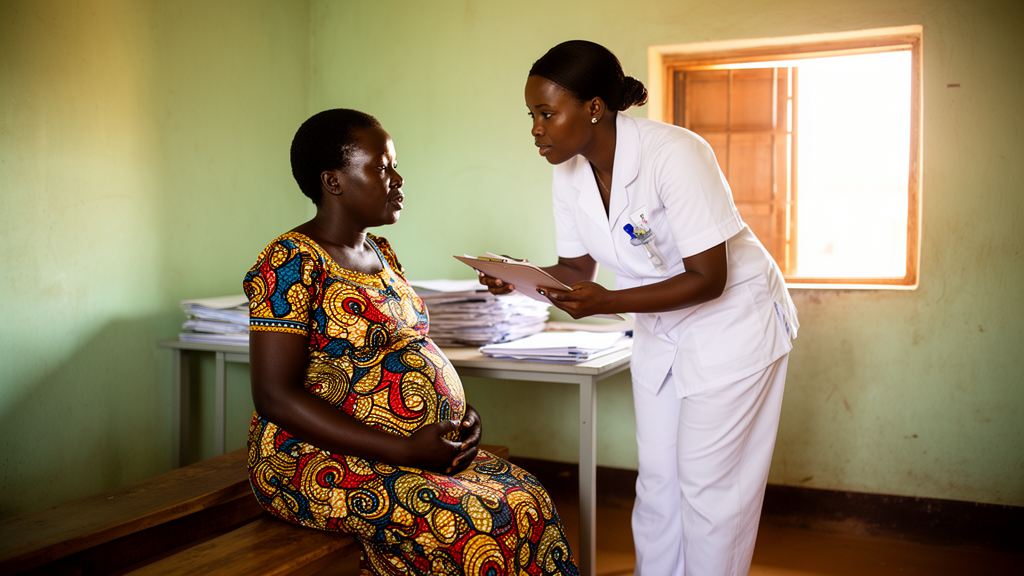
HIV testing during pregnancy remains a major public health priority in Burkina Faso, and a new machine learning analysis of national survey data offers a detailed map of who is being missed and which interventions might close the gap. Using the 2021 Burkina Faso Demographic and Health Survey, researchers identified and ranked the strongest predictors of HIV testing uptake among pregnant women and then simulated how targeted interventions could raise predicted testing rates across the country’s regions.
The study, published in AIDS Research and Therapy, was a cross-sectional secondary analysis covering 4,703 women aged 15 to 49 who had given birth in the two years preceding the survey. HIV testing uptake was defined as having been tested for HIV and having received the result, either during antenatal care or before delivery. Overall, 55.0 percent of women reported such testing, with a 95 percent confidence interval of 52.7 to 57.3 percent.
Beneath that national average lay stark regional disparities. Testing uptake ranged from 17.0 percent in the Est region, with a confidence interval of 11.2 to 22.9 percent, to 81.0 percent in the Centre region, with a confidence interval of 76.5 to 85.4 percent.
To understand what drives these differences, the team trained and evaluated four machine learning algorithms: penalized logistic regression, Random Forest, Extreme Gradient Boosting, and a Support Vector Machine with a radial basis function kernel. Model performance was assessed using weighted AUC-ROC and other standard classification metrics. The Random Forest model achieved the best cross-validated discrimination, with an AUC-ROC of 0.785, and showed comparable performance on an independent test dataset, with an AUC-ROC of 0.792.
The Random Forest model then ranked the relative importance of each predictor. Region topped the list with a relative importance of 100 percent, followed by knowledge of HIV and prevention of vertical transmission at 95.6 percent, wealth index at 43.1 percent, mother’s occupation at 37.4 percent, and area of residence at 32.3 percent. The prominence of knowledge, a modifiable factor, stood out against structural determinants such as geography and economic status.
Building on these rankings, the researchers ran scenario-based intervention simulations using the best-performing model to estimate potential gains from improving modifiable predictors. One scenario projected that raising the coverage of good HIV and prevention-of-vertical-transmission knowledge to 80 percent could increase predicted HIV testing uptake by 8.6 percent, with a 95 percent confidence interval of 6.9 to 10.6 percent.
The simulations also tested combined strategies. Compared with knowledge-only interventions at corresponding knowledge targets, a combined scenario incorporating media exposure and education yielded modest additional relative gains across regions, ranging from 0.6 percent to 13.8 percent.
The authors conclude that HIV testing uptake among pregnant women in Burkina Faso is characterized by substantial regional inequalities, and that knowledge of HIV and prevention of vertical transmission emerged as the dominant modifiable predictor. They propose that combining national efforts to improve knowledge with region-specific strategies targeting media exposure and educational attainment may offer a promising approach for developing context-specific interventions to increase testing uptake and reduce regional disparities.
As with any cross-sectional secondary analysis of survey data, the findings capture associations at a single point in time and the intervention results are model-based predictions rather than outcomes of implemented programs.
Subject of Research: Machine learning prediction of HIV testing uptake among pregnant women in Burkina Faso using 2021 Demographic and Health Survey data
Article Title: Optimizing HIV testing uptake among pregnant women in Burkina Faso: machine learning prediction and scenario-based intervention simulations using 2021 Demographic and Health Survey data
Article References: Fassinou, L. C., Teyi, J. K., Kirakoya-Samadoulougou, F., Barche, B., Sanou, H., Drabo, M. K., & Samadoulougou, S. (2026). Optimizing HIV testing uptake among pregnant women in Burkina Faso: machine learning prediction and scenario-based intervention simulations using 2021 Demographic and Health Survey data. AIDS Research and Therapy. https://doi.org/10.1186/s12981-026-00952-8
Image Credits: AI Generated
DOI: 10.1186/s12981-026-00952-8
Keywords: HIV testing, pregnant women, Burkina Faso, machine learning, Demographic and Health Survey, antenatal care, prevention of vertical transmission, regional disparities, Random Forest, intervention simulations, public health, health inequalities
News Source: Harold Sullivan. (October 29, 2026). Machine Learning Flags Knowledge Gaps as Key Barrier to HIV Testing in Burkina Faso Pregnancy Care. Scienmag.



