• HOME
  • NEWS
  • EXPLORE
    • CAREER
      • Companies
      • Jobs
    • EVENTS
    • iGEM
      • News
      • Team
    • PHOTOS
    • VIDEO
    • WIKI
  • BLOG
  • COMMUNITY
    • FACEBOOK
    • INSTAGRAM
    • TWITTER
Saturday, July 4, 2026
BIOENGINEER.ORG
No Result
View All Result
  • Login
  • HOME
  • NEWS
  • EXPLORE
    • CAREER
      • Companies
      • Jobs
        • Lecturer
        • PhD Studentship
        • Postdoc
        • Research Assistant
    • EVENTS
    • iGEM
      • News
      • Team
    • PHOTOS
    • VIDEO
    • WIKI
  • BLOG
  • COMMUNITY
    • FACEBOOK
    • INSTAGRAM
    • TWITTER
  • HOME
  • NEWS
  • EXPLORE
    • CAREER
      • Companies
      • Jobs
        • Lecturer
        • PhD Studentship
        • Postdoc
        • Research Assistant
    • EVENTS
    • iGEM
      • News
      • Team
    • PHOTOS
    • VIDEO
    • WIKI
  • BLOG
  • COMMUNITY
    • FACEBOOK
    • INSTAGRAM
    • TWITTER
No Result
View All Result
Bioengineer.org
No Result
View All Result
Home NEWS Science News Biology

Therapeutic and diagnostic functions of one antibody for pancreatic cancer

Bioengineer by Bioengineer
January 24, 2019
in Biology
Reading Time: 2 mins read
0
IMAGE
Share on FacebookShare on TwitterShare on LinkedinShare on RedditShare on Telegram

Osaka University researchers base biomarker detection and targeted therapy on the same protein from pancreatic cancer patients
IMAGE

Credit: Osaka University


Osaka, Japan – Of all gastrointestinal cancers, pancreatic cancer is one of the most aggressive. Because of this, it has a very low 5-year survival rate of just 5% and a median survival time below 6 months. Additionally, treatment is difficult, with only surgery shown to provide a cure. However, the vast majority of patients have tumors that cannot be removed surgically or their cancer is too advanced or spread too far to be treatable.

Current chemotherapy for pancreatic cancer is ineffective long-term. Therefore, to improve the prognosis and as a novel treatment, Osaka University researchers identified a marker protein that could be used in molecular targeted therapy and companion diagnostics. Such a tool can determine how suitable a treatment is for a specific patient, enabling tailored therapy to be administered.

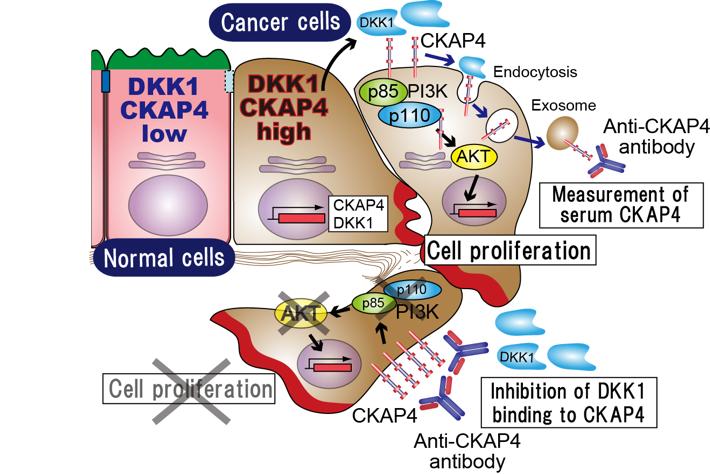
The team studied CKAP4, a plasma membrane protein that functions as a receptor for the secreted protein DKK1 and promotes tumorigenesis. They found that CKAP4 was released from pancreatic cancer cells in exosomes, which are tiny membranous sacs produced by tumor cells to communicate with each other. An advantage of secreted membranous proteins is that they are fairly simple to detect because of their accessibility, so two related techniques were developed to do just this.

“We generated anti-CKAP4 monoclonal antibodies that we used to develop ELISAs for the detection of CKAP4 released by tumors,” says first author Hirokazu Kimura. “These were successfully able to measure CKAP4 protein in the serum of pancreatic cancer patients, and expression levels were shown to match those determined in the tumors themselves.”

These same monoclonal antibodies had the added advantages of blocking signaling in pancreatic tumor cells and preventing them from proliferating and migrating in the laboratory. The team then analyzed the effects of the antibodies on mouse tumors that had developed from the transplantation of human pancreatic cancer cells. Some of the antibodies inhibited tumor growth and stopped the spread of tumors to the lymph nodes, thus crucially prolonging the life of the mice.

“Our work on developing monoclonal antibody preparations against pancreatic cancer offers the dual benefits of diagnosing and treating the disease,” explains corresponding author Akira Kikuchi. “As a next step, we hope to develop screening methods for patients carrying the CKAP4 antigen biomarker who will benefit from therapeutic interventions using anti-CKAP4 antibodies.”

###

The article, “CKAP4, a DKK1 receptor, is a biomarker in exosomes derived from pancreatic cancer and a molecular target for therapy” was published in Clinical Cancer Research at DOI: https://doi.org/10.1158/1078-0432.CCR-18-2124.

Media Contact
Saori Obayashi
[email protected]
81-661-055-886

Original Source

https://resou.osaka-u.ac.jp/en/research/2019/20190115_1

Related Journal Article

http://dx.doi.org/10.1158/1078-0432.CCR-18-2124

Tags: BiochemistrycancerMedicine/HealthMolecular Biology
Share12Tweet8Share2ShareShareShare2

Related Posts

Evolution-Inspired Biosensors Revolutionize Lipid Tracking in Real Time — Biology

Evolution-Inspired Biosensors Revolutionize Lipid Tracking in Real Time

July 2, 2026
New Study Reveals How to Reduce Risk of Dangerous Wildlife Encounters This Summer — Biology

New Study Reveals How to Reduce Risk of Dangerous Wildlife Encounters This Summer

July 2, 2026

Hepatic IFRD1 Alleviates Metabolic Dysfunction-Linked Steatohepatitis Through the GLUD1/α-KG Pathway

July 2, 2026

Intricate Food Webs Support Ecosystem Health and Stability

July 2, 2026
Please login to join discussion

POPULAR NEWS

  • Detection of EDCs in Breast Milk and Infant Urine Up to Six Months Highlights Early Exposure Risks

    77 shares
    Share 31 Tweet 19
  • Saying Goodbye to PGY-6: Pediatric Fellowship Realities

    103 shares
    Share 41 Tweet 26
  • New Drug Candidate Developed at McMaster Shows Potential for Treating Brain Cancer

    58 shares
    Share 23 Tweet 15
  • KTU Researchers Explore Ultrasound’s Role in Enhancing Blood Flow Beyond Diagnostics

    53 shares
    Share 21 Tweet 13

About

We bring you the latest biotechnology news from best research centers and universities around the world. Check our website.

Follow us

Recent News

Quasi-Bound States Boost Quantum Well Photoresponse

Lysine Pyruvylation Links Glycolysis to Epigenetics

Multiphysics Coupling: Single vs. Multiple DeepONet Branches

Subscribe to Blog via Email

Success! An email was just sent to confirm your subscription. Please find the email now and click 'Confirm' to start subscribing.

Join 83 other subscribers
  • Contact Us

Bioengineer.org © Copyright 2023 All Rights Reserved.

Welcome Back!

Login to your account below

Forgotten Password?

Retrieve your password

Please enter your username or email address to reset your password.

Log In
No Result
View All Result
  • Homepages
    • Home Page 1
    • Home Page 2
  • News
  • National
  • Business
  • Health
  • Lifestyle
  • Science

Bioengineer.org © Copyright 2023 All Rights Reserved.