• HOME
  • NEWS
  • EXPLORE
    • CAREER
      • Companies
      • Jobs
    • EVENTS
    • iGEM
      • News
      • Team
    • PHOTOS
    • VIDEO
    • WIKI
  • BLOG
  • COMMUNITY
    • FACEBOOK
    • INSTAGRAM
    • TWITTER
Saturday, February 7, 2026
BIOENGINEER.ORG
No Result
View All Result
  • Login
  • HOME
  • NEWS
  • EXPLORE
    • CAREER
      • Companies
      • Jobs
        • Lecturer
        • PhD Studentship
        • Postdoc
        • Research Assistant
    • EVENTS
    • iGEM
      • News
      • Team
    • PHOTOS
    • VIDEO
    • WIKI
  • BLOG
  • COMMUNITY
    • FACEBOOK
    • INSTAGRAM
    • TWITTER
  • HOME
  • NEWS
  • EXPLORE
    • CAREER
      • Companies
      • Jobs
        • Lecturer
        • PhD Studentship
        • Postdoc
        • Research Assistant
    • EVENTS
    • iGEM
      • News
      • Team
    • PHOTOS
    • VIDEO
    • WIKI
  • BLOG
  • COMMUNITY
    • FACEBOOK
    • INSTAGRAM
    • TWITTER
No Result
View All Result
Bioengineer.org
No Result
View All Result
Home NEWS Science News Health

The vanished mirror image

Bioengineer by Bioengineer
December 18, 2018
in Health
Reading Time: 3 mins read
0
IMAGE
Share on FacebookShare on TwitterShare on LinkedinShare on RedditShare on Telegram

Photochemical deracemization of chiral compounds achieved
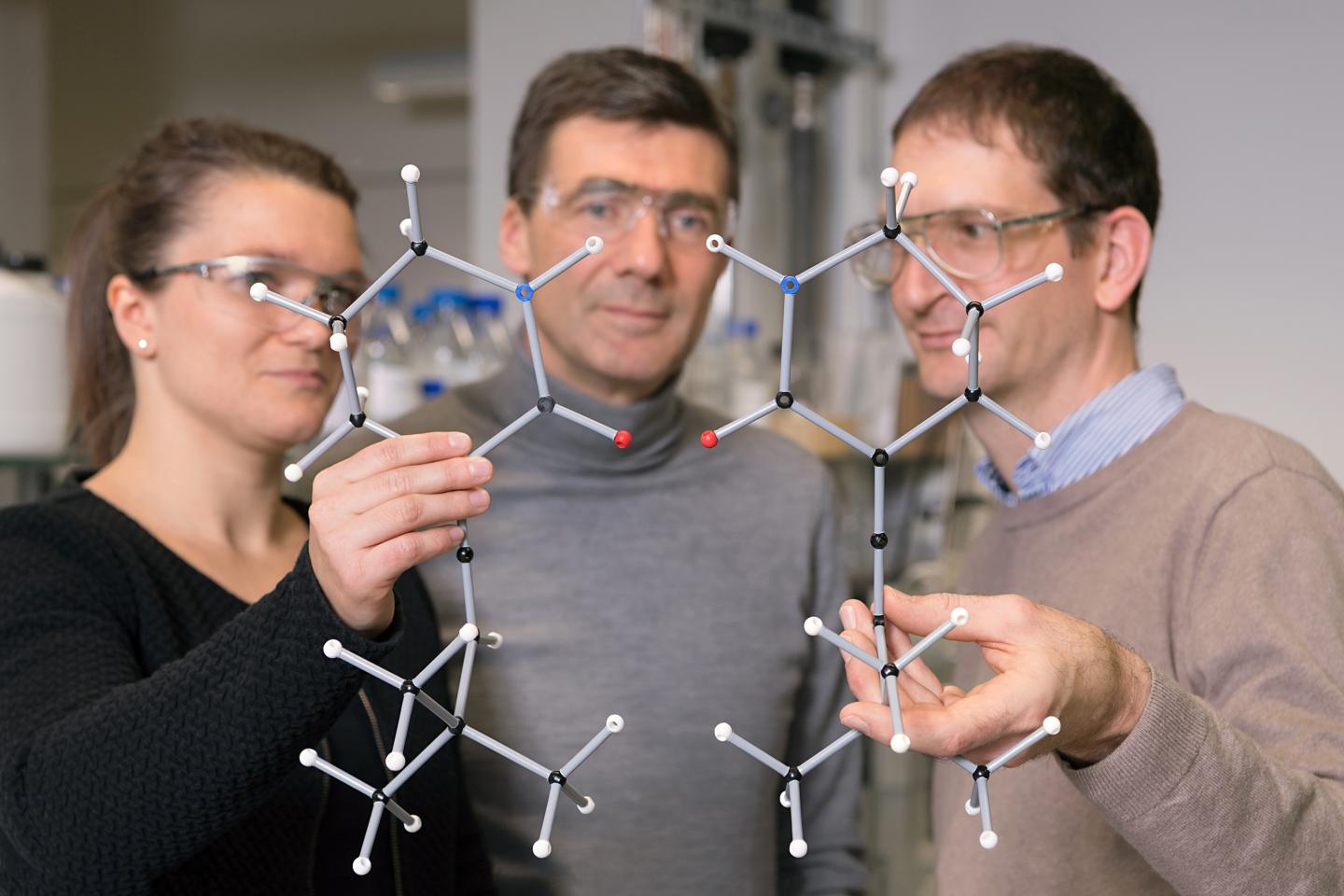
IMAGE

Credit: Uli Benz / TUM

Enantiomeric molecules resemble each other like right and left hands. Both variants normally arise in chemical reactions. But frequently only one of the two forms is effectual in biology and medicine. Hitherto, completely converting this mixture into the desired enantiomer was deemed impossible. Deploying a photochemical method, a team from the Technical University of Munich (TUM) has now achieved this feat.

Producing active ingredients with very specific properties – antibacterial characteristics, for example – is not always so easy. The reason: many of these organic compounds are chiral. They have two mirror-image forms, so-called enantiomers.

This small difference can be consequential because the two enantiomers can have different properties. While one has a healing effect, the other might be ineffective or even cause unwanted side effects.

Saving time, energy and resources

“For a long time, researchers around the world have been seeking ways to selectively synthesize only the desired enantiomer from a racemate,” explains Prof. Thorsten Bach, holder of the Chair of Organic Chemistry at the Technical University of Munich. However, this has been very difficult, since chemical reactions usually produce both molecule variants.

Together with his team, the researcher has now developed a method with which the desired enantiomer can be obtained from a racemate, the mixture of both enantiomers, in high concentrations of up to 97 percent.

Rather than painstakingly extracting the unwanted mirror-molecules from the mixture, the researchers use a photochemical reaction to transform them into the desired end product. “That saves time, energy and resources because all the molecules are used and you do not need to throw away half of them,” explains Bach.

A catalyst for the “right” compounds

The secret of the transformation is a special photochemical catalyst. Originally, the thioxanthone sensitizer was developed for [2 + 2] photocycloadditions. The dye is itself chiral and therefore specifically converts only one of the enantiomers to the other. In the span of a few minutes, the equilibrium shifts in favor of the desired molecule. The undesirable mirror images disappear.

The chemists have successfully tested their new method on various molecular mixtures from the allene structural class. “We could thus demonstrate that selective and efficient catalysis to prepare enantiopure compounds from racemates is fundamentally possible,” said Bach.

###

Further information:

The project was funded by the German Research Foundation (DFG) as part of the Research Training Group GRK 1626, a Reinhart Koselleck project and the Cluster of Excellence RESOLV. Cooperation partners were the universities of Bonn and Bochum.

Publication:

Catalytic deracemisation of chiral allenes enabled by sensitised excitation with visible light,

Alena Hölzl-Hobmeier, Andreas Bauer, Alexandre Vieira Silva, Stefan M. Huber, Christoph Bannwarth, Thorsten Bach

Nature, 564, 240-243 (2018) – DOI: 10.1038/s41586-018-0755-1

Media Contact
Dr. Andreas Battenberg
[email protected]
49-892-891-0510

Original Source

https://www.tum.de/nc/en/about-tum/news/press-releases/detail/article/35146/

Related Journal Article

http://dx.doi.org/10.1038/s41586-018-0755-1

Tags: BiochemistryBiomedical/Environmental/Chemical EngineeringChemistry/Physics/Materials SciencesIndustrial Engineering/ChemistryOpticsPharmaceutical SciencesTechnology/Engineering/Computer Science
Share12Tweet8Share2ShareShareShare2

Related Posts

Evaluating Pediatric Emergency Care Quality in Ethiopia

February 7, 2026

TPMT Expression Predictions Linked to Azathioprine Side Effects

February 7, 2026

Improving Dementia Care with Enhanced Activity Kits

February 7, 2026

Decoding Prostate Cancer Origins via snFLARE-seq, mxFRIZNGRND

February 7, 2026
Please login to join discussion

POPULAR NEWS

  • Robotic Ureteral Reconstruction: A Novel Approach

    Robotic Ureteral Reconstruction: A Novel Approach

    82 shares
    Share 33 Tweet 21
  • Digital Privacy: Health Data Control in Incarceration

    63 shares
    Share 25 Tweet 16
  • Study Reveals Lipid Accumulation in ME/CFS Cells

    57 shares
    Share 23 Tweet 14
  • Breakthrough in RNA Research Accelerates Medical Innovations Timeline

    53 shares
    Share 21 Tweet 13

About

We bring you the latest biotechnology news from best research centers and universities around the world. Check our website.

Follow us

Recent News

Evaluating Pediatric Emergency Care Quality in Ethiopia

TPMT Expression Predictions Linked to Azathioprine Side Effects

Improving Dementia Care with Enhanced Activity Kits

Subscribe to Blog via Email

Success! An email was just sent to confirm your subscription. Please find the email now and click 'Confirm' to start subscribing.

Join 73 other subscribers
  • Contact Us

Bioengineer.org © Copyright 2023 All Rights Reserved.

Welcome Back!

Login to your account below

Forgotten Password?

Retrieve your password

Please enter your username or email address to reset your password.

Log In
No Result
View All Result
  • Homepages
    • Home Page 1
    • Home Page 2
  • News
  • National
  • Business
  • Health
  • Lifestyle
  • Science

Bioengineer.org © Copyright 2023 All Rights Reserved.