• HOME
  • NEWS
  • EXPLORE
    • CAREER
      • Companies
      • Jobs
    • EVENTS
    • iGEM
      • News
      • Team
    • PHOTOS
    • VIDEO
    • WIKI
  • BLOG
  • COMMUNITY
    • FACEBOOK
    • INSTAGRAM
    • TWITTER
Wednesday, October 7, 2026
BIOENGINEER.ORG
No Result
View All Result
  • Login
  • HOME
  • NEWS
  • EXPLORE
    • CAREER
      • Companies
      • Jobs
        • Lecturer
        • PhD Studentship
        • Postdoc
        • Research Assistant
    • EVENTS
    • iGEM
      • News
      • Team
    • PHOTOS
    • VIDEO
    • WIKI
  • BLOG
  • COMMUNITY
    • FACEBOOK
    • INSTAGRAM
    • TWITTER
  • HOME
  • NEWS
  • EXPLORE
    • CAREER
      • Companies
      • Jobs
        • Lecturer
        • PhD Studentship
        • Postdoc
        • Research Assistant
    • EVENTS
    • iGEM
      • News
      • Team
    • PHOTOS
    • VIDEO
    • WIKI
  • BLOG
  • COMMUNITY
    • FACEBOOK
    • INSTAGRAM
    • TWITTER
No Result
View All Result
Bioengineer.org
No Result
View All Result
Home NEWS Science News Chemistry

The structural basis of Focal Adhesion Kinase activation on lipid membranes unravelled

Bioengineer by Bioengineer
August 11, 2020
in Chemistry
Reading Time: 3 mins read
0
IMAGE
Share on FacebookShare on TwitterShare on LinkedinShare on RedditShare on Telegram

IMAGE

Credit: CIB-CSIC

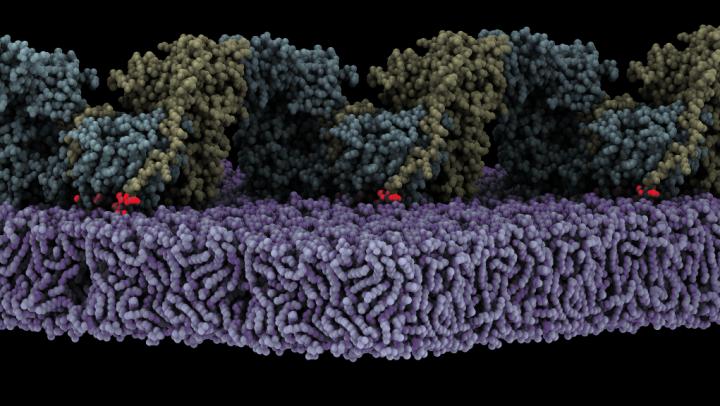
A research team led by Daniel Lietha has just published in The EMBO Journal the mechanistic details of the activation of the Focal Adhesion Kinase (FAK) on lipid membranes. Lietha started this research during his work at the Spanish National Cancer Research Centre (CNIO) and has culminated it in his current institution, the Centro de Investigaciones Biológicas Margarita Salas (CIB-CSIC).

FAK is a key protein ensuring controlled cell adhesion, proliferation, migration and survival which in cancer is often responsible for aberrant cell invasion leading to metastatic cancers. In the cytosol, FAK adopts an autoinhibited state but is activated upon recruitment into focal adhesions, yet how this occurs or what induces structural changes was unknown.

Lietha’s group have demonstrated that FAK is activated when it is localised to the cell membrane where it interacts with specific phosphoinositide lipids. Now, the high-resolution structure of an oligomeric form of FAK bound to a lipid membrane has been obtained using Cryo-Electron Microscopy. The analysis of the structure shows that initial binding of FAK to the membrane causes steric clashes that release the kinase domain from autoinhibition, allowing it to undergo a large conformational change and interact itself with the membrane in an orientation that places the active site towards the membrane.

The structure also reveals that several interfaces align in the rearranged conformation to allow oligomerization of FAK on the membrane with a key phosphorylation site exposed, leading to autophosphorylation and, in turn, activation of FAK. Molecular dynamics simulations were carried out to understand the mechanism and dynamics of the process of autophosphorylation and subsequent activation on the membrane.

To validate the computational model, different mutants of FAK have been generated carrying mutations at the observed interfaces. Extensive biochemical experiments have been carried out to evaluate how the different mutations affect lipid binding, FAK autophosphorylation and activation. Moreover, how the mutations affect FAK function in cancer cells was also studied revealing that the uncovered mechanism is key for cancer cell invasion and proliferation.

###

This work is the result of an international collaboration between the CIB Margarita Salas and researchers at the Spanish National Cancer Research Centre (Madrid, Spain), Center for Cellular Imaging and NanoAnalytics, Biozentrum (University of Basel, Switzerland), Cancer Research UK Edinburgh Centre, Institute of Genetics and Molecular Medicine (University of Edinburgh, United Kingdom), Heidelberg Institute for Theoretical Studies and Interdisciplinary Center for Scientific Computing (Heidelberg, Germany).

The research has been funded by the Spanish Ministry of Science and Innovation, the National Institute of Health Carlos III, the Spanish Ministry of Education, Culture and Sports, the Werner-Siemens Foundation, the University of Basel, the Swiss National Science Foundation, Cancer Research UK, the Klaus Tschira Foundation, the Deutsche Forschungsgemeinschaft, the State of Baden-Wuertenberg, the Carl Zeiss Foundation, the European Regional Development Fund, the European Social Fund, the Spanish National Research Council, and the Autonomous Region of Madrid.

Reference article: Structural basis of Focal Adhesion Kinase activation on lipid membranes. Iván Acebrón et al (EMBO J, 2020). DOI: https://www.embopress.org/doi/10.15252/embj.2020104743

Media Contact
Vanessa Pombo
[email protected]

Original Source

https://www.cnio.es/en/news/publications/the-structural-basis-of-focal-adhesion-kinase-activation-on-lipid-membranes-unravelled/

Related Journal Article

http://dx.doi.org/10.15252/embj.2020104743

Tags: BiologyBiomechanics/BiophysicscancerCell BiologyGeneticsMedicine/HealthMolecular Biology
Share12Tweet8Share2ShareShareShare2

Related Posts

NYC Congestion Pricing Tied to 13 Percent Drop in Fine Particle Pollution

NYC Congestion Pricing Tied to 13 Percent Drop in Fine Particle Pollution

October 7, 2026
Pencil-Shaped Zinc Oxide Heterostructure Boosts Solar Water Splitting Performance

Pencil-Shaped Zinc Oxide Heterostructure Boosts Solar Water Splitting Performance

October 7, 2026

Greener HPLC Method Promises Safer Quality Control for Antidepressant Sertraline

October 7, 2026

Carboxyl-Coated Nanotubes Grip Tuberculosis Drug Isoniazid, Quantum Study Shows

October 7, 2026
Please login to join discussion

POPULAR NEWS

  • Alloys That Shrink Their Own Grains: New PIX Mechanism Refines Metals With Heat Alone

    Alloys That Shrink Their Own Grains: New PIX Mechanism Refines Metals With Heat Alone

    29 shares
    Share 12 Tweet 7
  • Endurance Exercise Reshapes the Liver in Males and Females Through Distinct Molecular Routes

    29 shares
    Share 12 Tweet 7
  • Single Transcription Factor PU.1 Rapidly Converts Fibroblasts into Macrophage-Lineage Cells

    29 shares
    Share 12 Tweet 7
  • New Scale Measures How Ready Nurse Educators Really Are for the AI Era

    29 shares
    Share 12 Tweet 7

About

We bring you the latest biotechnology news from best research centers and universities around the world. Check our website.

Follow us

Recent News

Alloys That Shrink Their Own Grains: New PIX Mechanism Refines Metals With Heat Alone

Endurance Exercise Reshapes the Liver in Males and Females Through Distinct Molecular Routes

Single Transcription Factor PU.1 Rapidly Converts Fibroblasts into Macrophage-Lineage Cells

Subscribe to Blog via Email

Success! An email was just sent to confirm your subscription. Please find the email now and click 'Confirm' to start subscribing.

Join 85 other subscribers
  • Contact Us

Bioengineer.org © Copyright 2023 All Rights Reserved.

Welcome Back!

Login to your account below

Forgotten Password?

Retrieve your password

Please enter your username or email address to reset your password.

Log In
No Result
View All Result
  • Homepages
    • Home Page 1
    • Home Page 2
  • News
  • National
  • Business
  • Health
  • Lifestyle
  • Science

Bioengineer.org © Copyright 2023 All Rights Reserved.