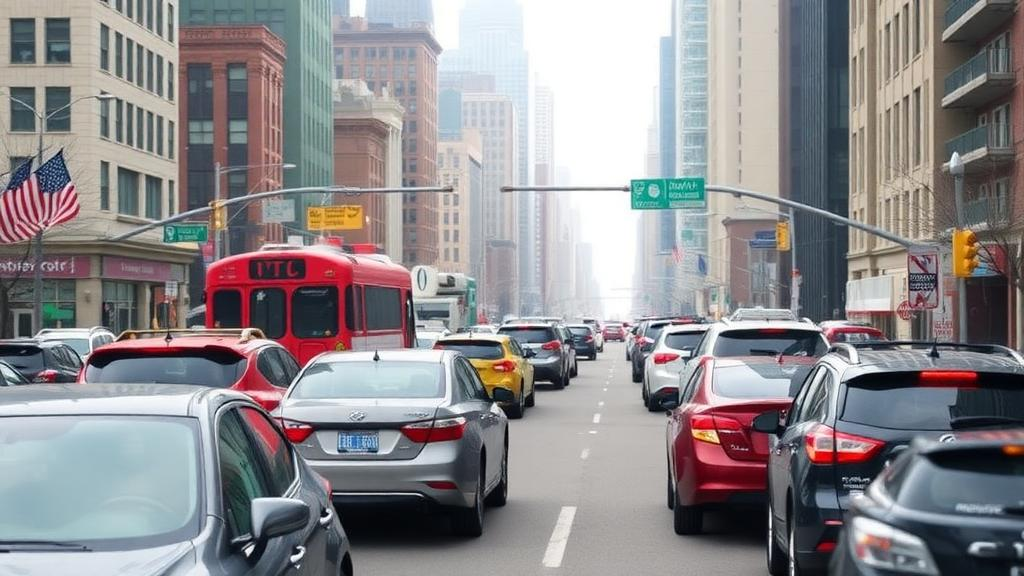
One year after New York City switched on the nation’s first congestion pricing program, the air inside Manhattan’s tolling zone is measurably cleaner, according to a new analysis published in Environmental Science & Technology Letters. Researchers found that fine particulate pollution, known as PM2.5, was roughly 13 percent lower inside the congestion relief zone than would have been expected without the policy, after carefully accounting for regional pollution trends, weather patterns and the normal year-to-year variability that complicates any assessment of urban air quality. The finding offers some of the strongest neighborhood-scale evidence yet that charging drivers to enter a city core can deliver tangible environmental benefits, not just smoother traffic flow.
The Central Business District Tolling Program took effect on January 5, 2025, making New York the first American city to adopt congestion pricing, a policy long used in cities such as London, Stockholm and Singapore. The program charges most vehicles entering Manhattan south of 60th Street, with the twin goals of reducing traffic congestion and generating revenue for public transit. Because other cities have been watching New York closely before considering similar measures, the research team prioritized rigor over speed. A full year of data, they reasoned, would reveal whether any changes in air quality held steady across all seasons and weather conditions rather than reflecting a temporary fluctuation.
To evaluate the program’s early impacts, the researchers assembled an unusually rich set of observations. They analyzed ground-level air pollution measurements from 15 sites in New York City’s Community Air Survey real-time monitoring network, hourly traffic counts from two major tunnel crossings into Manhattan, and satellite observations of nitrogen dioxide, a traffic-related pollutant. This combined approach allowed the team to measure changes within the congestion zone itself while also checking for possible spillover of pollution into adjacent neighborhoods, a persistent concern among critics of the policy.
The traffic data told a clear story. In 2025, the number of vehicles entering the congestion zone through the Queens Midtown and Brooklyn Battery tunnels was generally lower than in 2024. While the overall shape of daily traffic patterns remained similar, vehicle counts during morning and evening rush hours declined after congestion pricing began, signaling genuine shifts in travel behavior during the busiest periods of the day. That roughly 11 percent drop in vehicles entering the zone would later prove important for interpreting the air quality results.
Monthly and daily monitoring data showed lower levels of PM2.5 in 2025 compared with the 2022 to 2024 period, particularly at sites in lower Manhattan. All six representative sites examined in detail recorded lower median PM2.5 concentrations in 2025 than in the prior three years. The largest decrease, about 2.7 micrograms per cubic meter, occurred at the Broadway and 35th Street site in midtown Manhattan. The smallest change appeared at Queens College, the monitoring site farthest from the congestion zone, and there the difference was not statistically significant, a geographic gradient that itself hints at the policy’s influence.
The challenge for the researchers was that PM2.5 has been declining across the region for years due to seasonal patterns and broader policy influences, so a simple before-and-after comparison would overstate the tolling program’s effect. To isolate the program’s contribution, the team applied a statistical approach that compared monitoring sites inside the zone with sites outside it while controlling for weather and seasonal effects. That analysis found PM2.5 concentrations inside the zone were about 1.3 to 1.4 micrograms per cubic meter, or roughly 13 percent, lower than would be expected based on trends at sites outside the zone. This estimate is deliberately more conservative than the largest raw site-level declines, because it reflects only the share of the improvement attributable to the tolling program itself.
The alignment between the two independent lines of evidence strengthens the case for causation. The statistically estimated 13 percent decline in PM2.5 broadly tracked the roughly 11 percent drop in vehicles entering the zone, and monitoring data also showed fewer pronounced rush hour spikes in 2025, suggesting the policy reduced both average pollution levels and the short-term peaks that expose commuters and residents to bursts of poor air. For the most part, the program appears to be working, said Daniel M. Westervelt, a study coauthor and associate research professor at Lamont-Doherty Earth Observatory, part of the Columbia Climate School. It reduced particulate pollution inside the congestion zone by a modest amount, he said.
The researchers also investigated a possible downside: increases in pollution just outside the zone, where traffic diverted by the tolls might concentrate. At two monitoring sites near the Brooklyn Queens Expressway and in the Mott Haven neighborhood of the Bronx, the estimated increase was about 0.5 micrograms per cubic meter, but the result did not meet conventional thresholds of statistical significance. It would be premature to say there were definitely increases that were directly attributable to the congestion pricing policy, Westervelt said. Continued monitoring, the team notes, will be needed to determine whether any localized spillover persists as travel patterns settle.
Satellite observations added an important regional context to the ground-level findings. Tropospheric nitrogen dioxide, a pollutant linked to traffic that can aggravate respiratory problems and contribute to smog formation, declined by more than 20 percent across the New York City metropolitan area in 2025 compared with a 2018 to 2024 baseline. Nitrogen dioxide levels fell slightly more in lower Manhattan than in other boroughs, but the difference was not large enough to attribute the reductions to congestion pricing alone. The satellite data likely reflect broader regional influences, including other air quality policies, with congestion pricing potentially contributing to the overall decline. Importantly, the analysis found no evidence that nitrogen dioxide increased in the outer boroughs, suggesting the policy did not simply push this pollutant into surrounding communities.
While the study did not evaluate the health consequences of the observed changes, even small reductions in fine particle exposure can matter at the scale of a city. PM2.5 particles are small enough to penetrate deep into the lungs and enter the bloodstream, and long-term exposure is linked to cardiovascular and respiratory disease, so reductions in ambient concentrations are generally expected to improve health outcomes for the millions of people who live in or commute through Manhattan. By comparing conditions inside and outside the congestion zone, the study provides one of the first neighborhood-scale estimates of a congestion pricing program’s air quality impact in a United States city, and the evidence from New York’s first year may help inform policymakers and urban planners considering similar programs elsewhere.
The results also carry a methodological lesson: evaluating congestion pricing across a broad area, not just within the tolling boundary, is essential to understanding how pollution patterns shift when traffic is repriced. First author Polina Goldberg, who began the research with Westervelt as an undergraduate through Lamont’s summer internship program and is now starting graduate school at Columbia, emphasized that other cities have been waiting to see what happens in New York before they consider anything similar, so the team wanted to get the analysis right rather than fast. Westervelt said longer-term analyses, incorporating additional pollutants and improved satellite observations, will help determine how durable the first-year improvements prove to be as traffic patterns continue to adjust. The study was coauthored by Abhishek Anand of Lamont-Doherty Earth Observatory and Daniel L. Goldberg of the Milken Institute School of Public Health at George Washington University.
Subject of Research: The effect of New York City's congestion pricing program on air quality in Manhattan
Article Title: Study links NYC congestion pricing policy to cleaner air in lower Manhattan
Article References: Study links NYC congestion pricing policy to cleaner air in lower Manhattan. (n.d.). Original publication
Image Credits: AI Generated
DOI: Not provided
Keywords: congestion pricing, air quality, PM2.5, New York City, Manhattan, nitrogen dioxide, traffic pollution, urban policy, public health, satellite monitoring, Environmental Science & Technology Letters, Columbia Climate School
News Source: Russell Cooper. (October 7, 2026). NYC Congestion Pricing Tied to 13 Percent Drop in Fine Particle Pollution. Scienmag.