• HOME
  • NEWS
  • EXPLORE
    • CAREER
      • Companies
      • Jobs
    • EVENTS
    • iGEM
      • News
      • Team
    • PHOTOS
    • VIDEO
    • WIKI
  • BLOG
  • COMMUNITY
    • FACEBOOK
    • INSTAGRAM
    • TWITTER
Saturday, May 16, 2026
BIOENGINEER.ORG
No Result
View All Result
  • Login
  • HOME
  • NEWS
  • EXPLORE
    • CAREER
      • Companies
      • Jobs
        • Lecturer
        • PhD Studentship
        • Postdoc
        • Research Assistant
    • EVENTS
    • iGEM
      • News
      • Team
    • PHOTOS
    • VIDEO
    • WIKI
  • BLOG
  • COMMUNITY
    • FACEBOOK
    • INSTAGRAM
    • TWITTER
  • HOME
  • NEWS
  • EXPLORE
    • CAREER
      • Companies
      • Jobs
        • Lecturer
        • PhD Studentship
        • Postdoc
        • Research Assistant
    • EVENTS
    • iGEM
      • News
      • Team
    • PHOTOS
    • VIDEO
    • WIKI
  • BLOG
  • COMMUNITY
    • FACEBOOK
    • INSTAGRAM
    • TWITTER
No Result
View All Result
Bioengineer.org
No Result
View All Result
Home NEWS Science News Biology

The revolt of the plants: The arctic melts when plants stop breathing

Bioengineer by Bioengineer
May 14, 2020
in Biology
Reading Time: 3 mins read
0
IMAGE
Share on FacebookShare on TwitterShare on LinkedinShare on RedditShare on Telegram

IMAGE

Credit: Jong-Seong Kug (POSTECH)

The vapor that plants emit when they breathe serves to lower the land surface temperature, much like watering the yard on a hot day. Until now, the greenhouse effect has been blamed for the rise in global temperature. But an interesting study has shown that the Artic temperature rises when the moisture released by plants is reduced due to the increase of carbon dioxide (CO2 ) in the atmosphere.

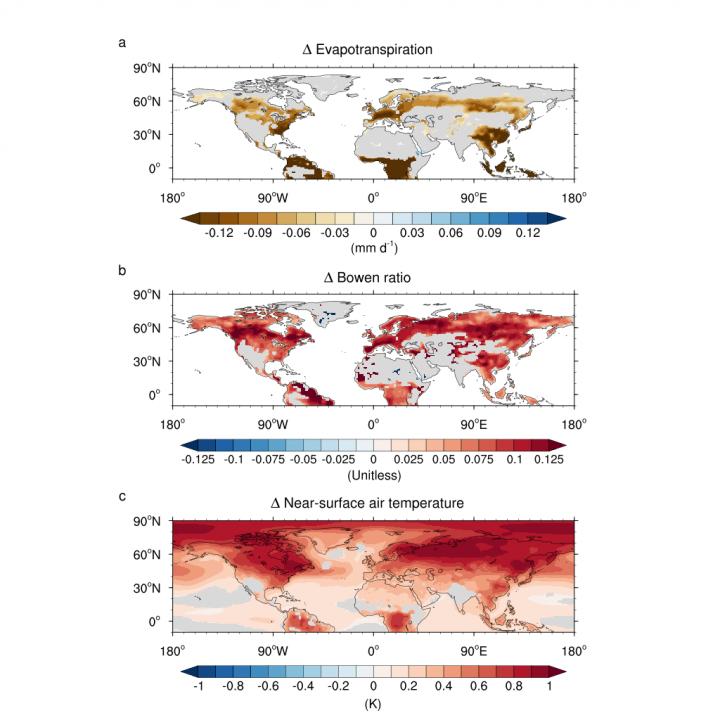
The joint research team led by Professor Jong-Seong Kug and doctoral candidate So Won Park of POSTECH’s Division of Environmental Science and Engineering, and Researcher Jin-Soo Kim of the University of Zurich has confirmed that the increase in atmospheric CO2 concentration closes the pores (stomata) of plants in high-latitude areas and reduces their transpiration, which ultimately accelerates Arctic warming. The findings, which were studied through the Earth system models (ESM) simulations, were recently published in Nature Communications, an authoritative journal in science.

Plants take in CO2 and emit oxygen through photosynthesis. During this process, the stomata of leaves open to absorb CO2 in the air and release moisture at the same time.

However, when the CO2 concentration rises, plants can absorb enough CO2 without opening their stomata widely. If the stomata open narrowly, the amount of water vapor released also decreases. When this transpiration of plants declines, the land temperature rapidly rises under greenhouse warming. Recently, such a decrease in transpiration has been cited as one of the reasons for the surge in heat waves in the northern hemisphere.

This response from the vegetation leads to the global climate change by controlling the exchange of energy between the surface and atmosphere, referred to as ‘physiological forcing.’ But so far, no study has confirmed the effects of physiological forcing on the Arctic climate system.

The joint research team analyzed the EMS simulation and confirmed that the increase in CO2 leads to stomatal closure in land vegetation causing land warming, which in turn remotely speeds up Artic warming through an atmospheric circulation and positive feedback in Earth systems process.

In addition, a quantitative estimate of the stomatal closure’s effect on Arctic warming due to increased CO2 showed that about 10% of the greenhouse effect is caused by this physiological forcing.

Professor Jong-Seong Kug, who has studied Arctic warming in a variety of perspectives, commented, “The stomatal closure effect due to the increased CO2 levels is not fully counted in the future climate projection.” He pointed out, “This means that Arctic warming can proceed much faster than current forecast.” He also warned that “the increase in CO2 is accelerating global warming not only through the greenhouse effect that we all knew of, but also by changing the physiological function of plants.”

###

This research was financially supported by the climate feedback research in the land-ocean biogeochemistry division of the National Research Foundation of Korea.

Media Contact
Jinyoung Huh
[email protected]

Original Source

http://postech.ac.kr/eng/the-revolt-of-the-plants-the-artic-melts-when-plants-stop-breathing/?pageds=1&k=&c=

Related Journal Article

http://dx.doi.org/10.1038/s41467-020-15924-3

Tags: Atmospheric ScienceBiologyClimate ChangeClimate ScienceEarth ScienceEcology/EnvironmentPlant SciencesTemperature-Dependent Phenomena
Share12Tweet8Share2ShareShareShare2

Related Posts

Single mother must adapt swiftly — the survival of her colony depends on it — Biology

Single mother must adapt swiftly — the survival of her colony depends on it

May 15, 2026
Why Are Nearly Everyone Right-Handed? It Might Be Linked to How We Learned to Walk — Biology

Why Are Nearly Everyone Right-Handed? It Might Be Linked to How We Learned to Walk

May 15, 2026

Excessive Neuronal Activity Initiates Severe Autoimmune Brain Disorder

May 15, 2026

Precision Anti-Aging Strategies Focus on Eliminating Harmful Senescent Cells While Preserving Beneficial Ones

May 15, 2026
Please login to join discussion

POPULAR NEWS

  • Research Indicates Potential Connection Between Prenatal Medication Exposure and Elevated Autism Risk

    843 shares
    Share 337 Tweet 211
  • New Study Reveals Plants Can Detect the Sound of Rain

    730 shares
    Share 291 Tweet 182
  • Salmonella Haem Blocks Macrophages, Boosts Infection

    62 shares
    Share 25 Tweet 16
  • Breastmilk Balances E. coli and Beneficial Bacteria in Infant Gut Microbiomes

    58 shares
    Share 23 Tweet 15

About

We bring you the latest biotechnology news from best research centers and universities around the world. Check our website.

Follow us

Recent News

New Actinomycin Derivatives Target Malaria More Selectively

Mobile App Enhances Exercise for Older Adults’ Cognition

Botulinum Toxin Reduces Urinary Retention Post-Hemorrhoidopexy

Subscribe to Blog via Email

Enter your email address to subscribe to this blog and receive notifications of new posts by email.

Join 82 other subscribers
  • Contact Us

Bioengineer.org © Copyright 2023 All Rights Reserved.

Welcome Back!

Login to your account below

Forgotten Password?

Retrieve your password

Please enter your username or email address to reset your password.

Log In
No Result
View All Result
  • Homepages
    • Home Page 1
    • Home Page 2
  • News
  • National
  • Business
  • Health
  • Lifestyle
  • Science

Bioengineer.org © Copyright 2023 All Rights Reserved.