Insects have long been celebrated as the tireless engine rooms of terrestrial ecosystems — pollinating crops, recycling nutrients, and feeding countless hungry mouths. But a sweeping new review argues that this familiar list barely scratches the surface of what insects do for vertebrate life. An international team of researchers, co-led by Eliza Grames, assistant professor of biological sciences at Binghamton University, State University of New York, has compiled hundreds of studies spanning decades to document the astonishing variety of ways animals with backbones depend on the six-legged majority. The paper, titled “The importance of insect biodiversity for vertebrates,” was published on September 30 in the journal Nature Reviews Biodiversity, and its central message is as simple as it is unsettling: without insects, the world’s vertebrates would lose far more than a meal.
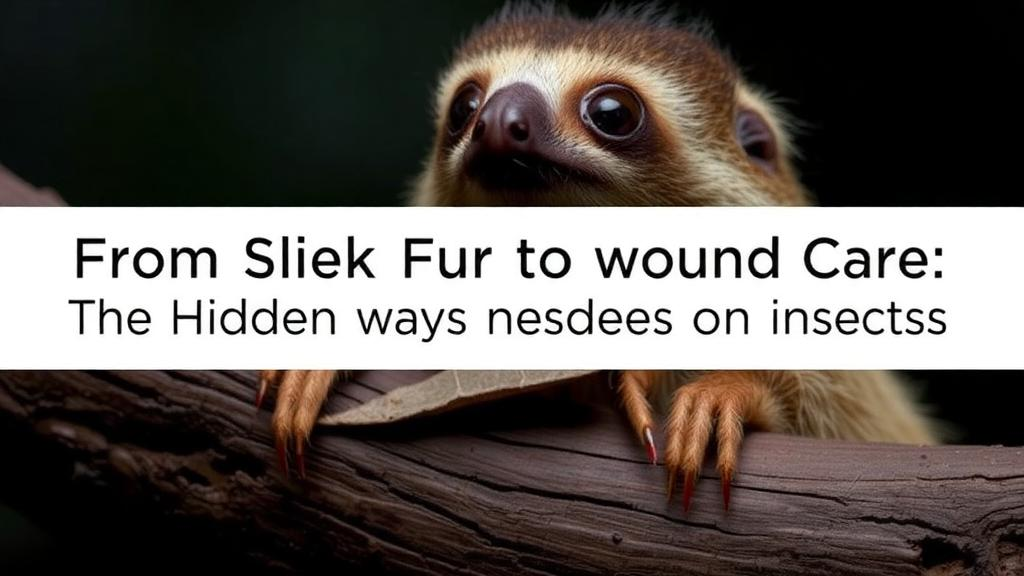
The evidence assembled by the team ranges from the charming to the downright bizarre. Consider the Hoffmann’s two-toed sloth, whose shaggy coat hosts a miniature ecosystem. Sloth moths live out their lives in the animal’s fur, and their activities help cultivate algae that grow in the sloth’s hair — algae the sloth then eats, supplementing its otherwise meadow-sparse diet of leaves. In this sense, the sloth is not merely tolerating its insect tenants; it is actively farming them, or at least farming the garden they fertilize. Remove the moths, and the sloth loses both a nutrient source and a living camouflage that helps it vanish into the canopy.
Other examples reveal insects serving as tools, infrastructure, and even medicine. Chimpanzees have been observed applying insects to open wounds, a behavior that appears to help sterilize injuries and may represent a form of self-medication. Herons, meanwhile, have turned insects into fishing equipment, using them as bait to lure fish within striking distance. Birds and reptiles lay their eggs inside termite mounds, exploiting the structures’ remarkably stable internal temperatures as natural incubators. In arid environments, some desert frogs take refuge inside ant nests, where the humidity offers a buffer against desiccation in landscapes where water is the scarcest resource of all.
“Insects are sometimes called the ‘little things that run the world’ because they are so important to life on Earth,” said Grames, the paper’s co-lead author. “We often hear about their importance as pollinators, or decomposers, or food for insectivores like birds and bats, but we forget about all the other things they do for us and for other species.” That observation captures the review’s core ambition: to move beyond the well-worn categories of pollination and predation and catalog the full breadth of insect-vertebrate relationships, many of which fall through the cracks of conventional ecological research.
The project was a genuinely international undertaking, with authors drawn from eight countries. Alongside Grames, the review was co-led by Rob Cooke, an ecological modeler at the UK Centre for Ecology and Hydrology, and Chris Elphick, professor of ecology and evolutionary biology at the University of Connecticut. Additional Binghamton contributors included Lindsey Swierk, assistant professor of biological sciences, and biological sciences alumni Julianna Yager and Suyeon Jang. In a fitting touch, Jang — an undergraduate with a painting minor — created the paper’s main illustration as an independent study project, translating the review’s scientific breadth into a single visual statement.
The effort traces its origins to 2022, when researchers established the Status of Insects: An International Research Coordination Network, an initiative funded by the National Science Foundation. The network emerged directly from Grames’ doctoral work in Elphick’s laboratory, and it was designed to confront a persistent problem in entomology and ecology more broadly: the literature on insect-vertebrate interactions is scattered across hundreds of individual studies, each examining a narrow slice of the picture. By consolidating that dispersed evidence into a single synthesis, the review offers the most comprehensive account yet of how deeply vertebrate life is woven into the fabric of insect diversity.
The scale of that dependence is difficult to overstate. There are an estimated 14 to 30 million species of insects on Earth, and they underpin the health and function of ecosystems on nearly every continent. They feed species ranging from hummingbirds, whose metabolisms demand near-constant refueling, to grizzly bears, which gorge on moths and other insects during critical seasons. Insects also enable other food sources indirectly through pollination, and they produce substances — honeydew, honey, and wax among them — that are themselves consumed by other species. For many vertebrates, insect abundance is not a background condition but a calendar: a variety of species time their breeding seasons to coincide with seasonal pulses of insect availability, synchronizing reproduction with the brief windows when their young can be fed.
The review also documents subtler forms of dependence that border on engineering. Birds incorporate spider and insect silk into their nests, taking advantage of materials with tensile properties that few natural substances can match. Some birds go further, deliberately situating their nests near stinging insects such as wasps, recruiting the colony’s venomous defenses as a security system against predators. More than 200 bird species use crushed ants for grooming — a behavior known as anting, in which the birds rub ants over their plumage, likely benefiting from the insects’ chemical secretions. And the relationship between insects and nesting vertebrates stretches deep into the past: insects once lived inside dinosaur nests, cleaning them out, and according to Grames, they still perform that sanitation service today in the nests of some owls and kingfishers.
Yet for all this richness, the scientific literature has a conspicuous blind spot. Few studies consider how insect population declines affect vertebrate species beyond the most obvious channel — a shrinking food supply. That narrow framing, the authors argue, dramatically understates the risk. If insects disappear, vertebrates lose not only calories but nesting materials, incubators, medicines, sanitation services, climate refuges, and the ecological timing cues that structure their reproductive cycles. Some insect populations have experienced alarming declines in recent decades, and those losses will ultimately propagate through the vertebrate communities that depend on them in ways that current research has barely begun to measure.
The numbers behind that warning are stark. “We’re losing insects at a rate of about 1-2% per year,” Grames said. “When you scale that up across a few decades, we’re talking about a major change to ecosystems. Insect conservation should be a top priority for anyone worried about the future of biodiversity.” A decline of even one to two percent annually, compounded over half a century, translates into a transformation of insect communities on a scale that has no precedent in recent ecological memory. Elphick, an ornithologist by training, framed the implication as a call for scientific bridge-building: he hopes the review will foster increased collaboration between scientists who study vertebrates and those who study insects. “If you want to have vertebrates, then you’ve got to be thinking about insect conservation, and we don’t do that nearly enough,” he said. In an era when conservation planning is often organized around charismatic vertebrates and their habitats, the review’s synthesis delivers a pointed reminder that the fates of sloths, songbirds, chimpanzees, and frogs are entangled with creatures small enough to escape notice — and that protecting the little things that run the world may be the surest way to protect everything that runs on them.
Subject of Research: The diverse roles of insect biodiversity in supporting vertebrate species
Article Title: Insects are essential to vertebrate life — as food, shelter and medicine
Article References: Insects are essential to vertebrate life — as food, shelter and medicine. (n.d.). Original publication
Image Credits: AI Generated
DOI: Not provided
Keywords: insects, vertebrates, biodiversity, conservation, sloths, entomology, ecology, insect decline, termite mounds, chimpanzees, Nature Reviews Biodiversity, ecosystems
News Source: Gavin Prescott. (October 5, 2026). From Sloth Fur to Wound Care: The Hidden Ways Vertebrates Depend on Insects. Scienmag.