• HOME
  • NEWS
  • EXPLORE
    • CAREER
      • Companies
      • Jobs
    • EVENTS
    • iGEM
      • News
      • Team
    • PHOTOS
    • VIDEO
    • WIKI
  • BLOG
  • COMMUNITY
    • FACEBOOK
    • INSTAGRAM
    • TWITTER
Wednesday, June 24, 2026
BIOENGINEER.ORG
No Result
View All Result
  • Login
  • HOME
  • NEWS
  • EXPLORE
    • CAREER
      • Companies
      • Jobs
        • Lecturer
        • PhD Studentship
        • Postdoc
        • Research Assistant
    • EVENTS
    • iGEM
      • News
      • Team
    • PHOTOS
    • VIDEO
    • WIKI
  • BLOG
  • COMMUNITY
    • FACEBOOK
    • INSTAGRAM
    • TWITTER
  • HOME
  • NEWS
  • EXPLORE
    • CAREER
      • Companies
      • Jobs
        • Lecturer
        • PhD Studentship
        • Postdoc
        • Research Assistant
    • EVENTS
    • iGEM
      • News
      • Team
    • PHOTOS
    • VIDEO
    • WIKI
  • BLOG
  • COMMUNITY
    • FACEBOOK
    • INSTAGRAM
    • TWITTER
No Result
View All Result
Bioengineer.org
No Result
View All Result
Home NEWS Science News Chemistry

The origin of bifurcated current sheets explained

Bioengineer by Bioengineer
July 20, 2021
in Chemistry
Reading Time: 3 mins read
0
IMAGE
Share on FacebookShare on TwitterShare on LinkedinShare on RedditShare on Telegram

IMAGE

Credit: POSTECH

A Korean research team has identified the origin of bifurcated current sheets, considered one of the most unsolved mysteries in the Earth’s magnetosphere and in magnetized plasma physics.

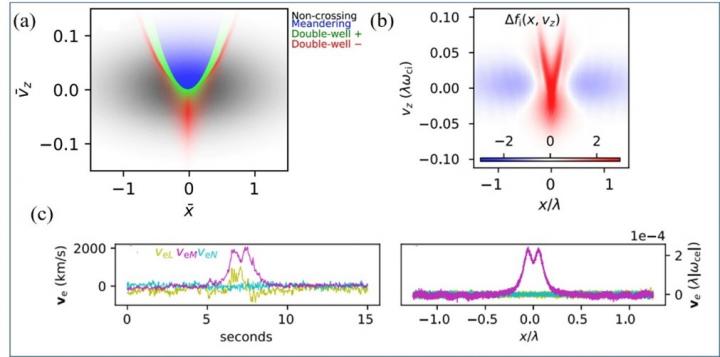
A POSTECH joint research team led by Professor Gunsu S. Yun of the Department of Physics and Division of Advanced Nuclear Engineering and Dr. Young Dae Yoon from the Pohang Accelerator Laboratory has theoretically established the process of collisionless equilibration of disequilibrated plasma current sheets. In addition, by comparing this with particle simulations and satellite data from NASA, the origin of the bifurcated current sheets – which had remained largely unknown – has been revealed.

In the Earth’s magnetosphere, a sheet-shaped plasma is observed that is trapped between two regions of opposing magnetic fields. Because current flows inside it, it is also called a current sheet. According to the conventional theory, the current sheet exists as a single bulk in which the magnetic pressure due to the magnetic field generated by the current and the thermal pressure of the plasma balance one another, thereby forming an equilibrium. However, in 2003, the European Space Agency’s Cluster mission observed a bifurcated current sheet in Earth’s magnetosphere. Since then, similar phenomena have been observed.

On the other hand, extensive research has been accumulated on the condition in which the magnetic force and thermal pressure are perfectly balanced with each other in the current sheet. But the process through which a disequilibrated current sheet equilibrates remains largely unknown. Since plasma systems generally do not start from an equilibrium state, comprehension of the equilibration process is desired to better understand the current sheet plasma dynamics.

The joint research team thoroughly analyzed the process in which the disequilibrated sheet achieves equilibrium by considering the orbit classes and phase-space distributions of particles that constitute the current sheet and found that the current sheets can naturally bifurcate during the equilibration process. It was then confirmed that these theoretical predictions were consistent with the particle-in-cell simulation results performed by the KAIROS supercomputer at the Korea Institute of Fusion Energy. In addition, the simulation data were compared and verified with NASA’s Magnetospheric Multiscale (MMS) measurements.

This achievement has enhanced the comprehension of magnetized plasma dynamics by incorporating theoretical analyses, supercomputer simulations, and satellite observations. Since the Earth’s magnetospheric plasma has similar characteristics as other magnetized plasmas such as nuclear fusion plasmas in various ways, it is anticipated to contribute to a wide range of fields.

“This study has a significant academic value in that it simultaneously resolved two mysteries: the process through which disequilibrated current sheet equilibrates and the origin of bifurcated current sheets,” explained Professor Gunsu S. Yun of POSTECH who participated as a co-corresponding author in the study. “We are trying to extend the analysis framework for plasmas with strong guide fields and hope to understand similar phenomena that occur in fusion plasmas.”

###

Supported by the National Research Foundation of Korea, this study was published in Nature Communications on June 18, 2021.

Media Contact
Jinyoung Huh
[email protected]

Original Source

https://postech.ac.kr/eng/the-origin-of-bifurcated-current-sheets-explained/#post-22897

Related Journal Article

http://dx.doi.org/10.1038/s41467-021-24006-x

Tags: AstronomyAstrophysicsChemistry/Physics/Materials SciencesEarth ScienceElectromagneticsResearch/DevelopmentSpace/Planetary Science
Share13Tweet8Share2ShareShareShare2

Related Posts

Autonomous Chemistry Lab Uncovers Catalysts for On-Demand Product Switching — Chemistry

Autonomous Chemistry Lab Uncovers Catalysts for On-Demand Product Switching

June 24, 2026
Microwave-Produced Biochar Offers Promising Solution for Cleaner Water and Safer Soils from Waste Biomass — Chemistry

Microwave-Produced Biochar Offers Promising Solution for Cleaner Water and Safer Soils from Waste Biomass

June 24, 2026

Mayo Clinic Scientists Uncover Structure of Crucial Protein Implicated in Cancer and Neurological Disorders

June 23, 2026

Scientists Unveil Innovative Method to Regulate Ice Formation with Polymer Nanoparticles

June 23, 2026
Please login to join discussion

POPULAR NEWS

  • Saying Goodbye to PGY-6: Pediatric Fellowship Realities

    103 shares
    Share 41 Tweet 26
  • Multi-Hospital Study Reveals Long Covid Burden Is Twice as High as Current Estimates

    92 shares
    Share 36 Tweet 23
  • Detection of EDCs in Breast Milk and Infant Urine Up to Six Months Highlights Early Exposure Risks

    77 shares
    Share 31 Tweet 19
  • New Drug Candidate Developed at McMaster Shows Potential for Treating Brain Cancer

    58 shares
    Share 23 Tweet 15

About

BIOENGINEER.ORG

We bring you the latest biotechnology news from best research centers and universities around the world. Check our website.

Follow us

Recent News

Germline Mutations in Young Women’s Breast Cancer Genes

Breakthrough Chip Enhances Tiny Robots’ Ability to Navigate Complex Terrains

Caution for Consumers: How “Green” Are Your Sustainable Shopping Choices Really?

Subscribe to Blog via Email

Enter your email address to subscribe to this blog and receive notifications of new posts by email.

Join 82 other subscribers
  • Contact Us

Bioengineer.org © Copyright 2023 All Rights Reserved.

Welcome Back!

Login to your account below

Forgotten Password?

Retrieve your password

Please enter your username or email address to reset your password.

Log In
No Result
View All Result
  • Homepages
    • Home Page 1
    • Home Page 2
  • News
  • National
  • Business
  • Health
  • Lifestyle
  • Science

Bioengineer.org © Copyright 2023 All Rights Reserved.