• HOME
  • NEWS
  • EXPLORE
    • CAREER
      • Companies
      • Jobs
    • EVENTS
    • iGEM
      • News
      • Team
    • PHOTOS
    • VIDEO
    • WIKI
  • BLOG
  • COMMUNITY
    • FACEBOOK
    • INSTAGRAM
    • TWITTER
Wednesday, June 24, 2026
BIOENGINEER.ORG
No Result
View All Result
  • Login
  • HOME
  • NEWS
  • EXPLORE
    • CAREER
      • Companies
      • Jobs
        • Lecturer
        • PhD Studentship
        • Postdoc
        • Research Assistant
    • EVENTS
    • iGEM
      • News
      • Team
    • PHOTOS
    • VIDEO
    • WIKI
  • BLOG
  • COMMUNITY
    • FACEBOOK
    • INSTAGRAM
    • TWITTER
  • HOME
  • NEWS
  • EXPLORE
    • CAREER
      • Companies
      • Jobs
        • Lecturer
        • PhD Studentship
        • Postdoc
        • Research Assistant
    • EVENTS
    • iGEM
      • News
      • Team
    • PHOTOS
    • VIDEO
    • WIKI
  • BLOG
  • COMMUNITY
    • FACEBOOK
    • INSTAGRAM
    • TWITTER
No Result
View All Result
Bioengineer.org
No Result
View All Result
Home NEWS Science News Health

The molecule that can AUTAC bad proteins

Bioengineer by Bioengineer
November 27, 2019
in Health
Reading Time: 2 mins read
0
IMAGE
Share on FacebookShare on TwitterShare on LinkedinShare on RedditShare on Telegram

IMAGE

Credit: Tohoku University


Tohoku University researchers have developed a strategy that could help cells get rid of disease-related debris. Further research could lead to treatments for neurodegenerative and metabolic diseases, Down syndrome, and maybe even aging-related diseases. The findings were published in the journal Molecular Cell.

Cells have a natural ability to routinely rid themselves of unnecessary or dysfunctional proteins and organelles. During this process of ‘autophagy’, debris are tagged with a compound called ubiquitin and then degraded within tiny cellular vacuoles. Autophagy is impaired in some cancers, and neurodegenerative and metabolic diseases, so scientists have been working to develop drugs that can regulate this process. However, little is known about the details of autophagy, such as how the cell knows which components to tag with ubiquitin.

In previous research, Hirokazu Arimoto, a chemical biologist at Tohoku University, and colleagues found that autophagy is initiated against invading streptococci bacteria when they are tagged with the nucleic acid guanine. The researchers wondered if guanine tagging could also initiate autophagy against other cellular components.

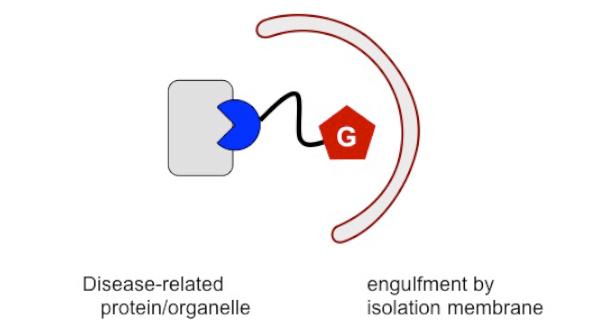
Their investigations led to the development of a molecule they called AUTAC, which stands for autophagy-targeting chimera. AUTAC is formed of guanine attached to a ‘warhead’, which can be changed to target specific intracellular components. Different AUTACs successfully targeted and tagged specific intracellular proteins for autophagy, the researchers report.

For example, they designed an AUTAC targeting a protein on the mitochondrial membrane. Mitochondrial dysfunction causes some symptoms frequently seen in Down syndrome, including heart disease, hearing loss and dementia. It also causes several diseases associated with aging.

The AUTAC successfully targeted fragmented mitochondria in cells taken from someone with Down syndrome. Not only did this accelerate their removal, it also fast-tracked the formation of new, normally functioning mitochondria.

“AUTAC degrades its target, making it a game-changing innovation for the drug industry,” says Arimoto. “Current small molecule drugs bind to molecules, like proteins, and interfere with their functions, but do not degrade them. The degradation of biomolecules gets rid of all the functions and is a more powerful method.”

Arimoto and his team are now working on developing second-generation AUTAC molecules that will be at least 100 times more effective, he says.

###

Media Contact
Hirokazu Arimoto
[email protected]
81-222-176-201

Original Source

https://www.tohoku.ac.jp/en/press/molecule_autac_bad_proteins.html

Related Journal Article

http://dx.doi.org/10.1016/j.molcel.2019.09.009

Tags: Medicine/Health
Share13Tweet8Share2ShareShareShare2

Related Posts

Blocking HSPA8 Eases Autoimmune Brain Inflammation

June 24, 2026

Could Daytime Light Exposure Offer Protection Against Dementia?

June 24, 2026

Rapid Test Developed for All Orthoebolavirus Glycoproteins

June 24, 2026

Choosing Between Togetherness and Safety in Dementia Care

June 24, 2026
Please login to join discussion

POPULAR NEWS

  • Saying Goodbye to PGY-6: Pediatric Fellowship Realities

    103 shares
    Share 41 Tweet 26
  • Multi-Hospital Study Reveals Long Covid Burden Is Twice as High as Current Estimates

    92 shares
    Share 36 Tweet 23
  • Detection of EDCs in Breast Milk and Infant Urine Up to Six Months Highlights Early Exposure Risks

    77 shares
    Share 31 Tweet 19
  • New Drug Candidate Developed at McMaster Shows Potential for Treating Brain Cancer

    58 shares
    Share 23 Tweet 15

About

We bring you the latest biotechnology news from best research centers and universities around the world. Check our website.

Follow us

Recent News

Blocking HSPA8 Eases Autoimmune Brain Inflammation

10 Months Exercise Boosts Kids’ Ketone Levels

Reevaluating the Impact of ‘Yo-Yo Dieting’: Is It Less Harmful Than Commonly Thought?

Subscribe to Blog via Email

Enter your email address to subscribe to this blog and receive notifications of new posts by email.

Join 82 other subscribers
  • Contact Us

Bioengineer.org © Copyright 2023 All Rights Reserved.

Welcome Back!

Login to your account below

Forgotten Password?

Retrieve your password

Please enter your username or email address to reset your password.

Log In
No Result
View All Result
  • Homepages
    • Home Page 1
    • Home Page 2
  • News
  • National
  • Business
  • Health
  • Lifestyle
  • Science

Bioengineer.org © Copyright 2023 All Rights Reserved.